|
Around the world by bike
|


|
14 September - Lao Border - Mengla – 72 km
It was a short 20-kilometre ride up
a moderate hill to the border and then a smooth border crossing
into China. Once across the border, the ATM was more guesswork
than anything else as it never gave an option for English. In
the end, it spat out a few Chinese yuan, after
From the border, a brand-new highway, with bridges and tunnels, ran to Mengla through very scenic countryside. Bike problems made it increasingly difficult to turn the peddles, and stomach problems made it even harder work. Fortunately, it was a downhill ride from the border to the first town in China.
At first glance, China was nothing like expected and Mengla a modern and fast-growing border town and not very “Chinese”. (I’m not sure what I had hoped by “Chinese”.) My first day in China wasn’t a good one and I was extremely relieved to find accommodation to lay down and spent the evening shivering under a blanket with a high fever.
15 September - Mengla The following day was spent in Mengla to recuperate and check out this new and very different country. Good thing I drew money at the border as there appeared no ATMs accepting Visa or MasterCards at the time. I found a SIM card but was still unable to phone, although it seemed one could send text messages. Facebook was offline, which could have been due to recent political unrest in the province or maybe Facebook was blocked in China. Blog sites were blocked, but at least there was a way around it.
Ernest tried to work on my bike and, hopefully, it would peddle a bit more freely than before. He was brave enough to shop for meat at the local market, a surreal place, which made one realise you were indeed in China. Noodles could be found in all shapes and sizes, and rice was, of course, plentiful.
16 September - Mengla (Meng La)- Menglun – 75 km After a leisurely start onto Menglum, still along a new highway, Ernest had another flat tyre, but it only took a few minutes to fix.
I wasn’t feeling my usual energetic self but struggled along to Menglun where accommodation was found just minutes before a massive thunderstorm rolled in.
17 September - Menglun - Jinghong – 75 km
A short, scenic and leisurely ride
led to Jinghong situated along the Mekong
(Lancang) River. After
a few kilometres, I had enough of
Jinghong was a large, modern and busy city. Although it appeared very European from a distance, the main difference was absolutely everything was written in Chinese, making it somewhat challenging locating accommodation. Very few people spoke English, which added to the confusion. Enquiring about a hotel (indicating sleep by putting our hands together and placing it under our tilted heads), a man pointed to a sign above our heads, something which would make anyone feel stupid. Still feeling unwell, I had a peaceful and quiet evening, wandering around the night market and nibbling on street food.
18 September – Jinghong
The entire day in Jinghong was spent looking for a guidebook and/or road map. All in vain, though, as the only maps found were (obviously) in Chinese. Jinghong was, clearly, not a tourist area, and I saw neither a single foreigner nor Ernest the entire day and, by the way, curious locals inspected me. I guess not many “long noses” ever visited Jinghong - not that I could ever be described as a long nose.
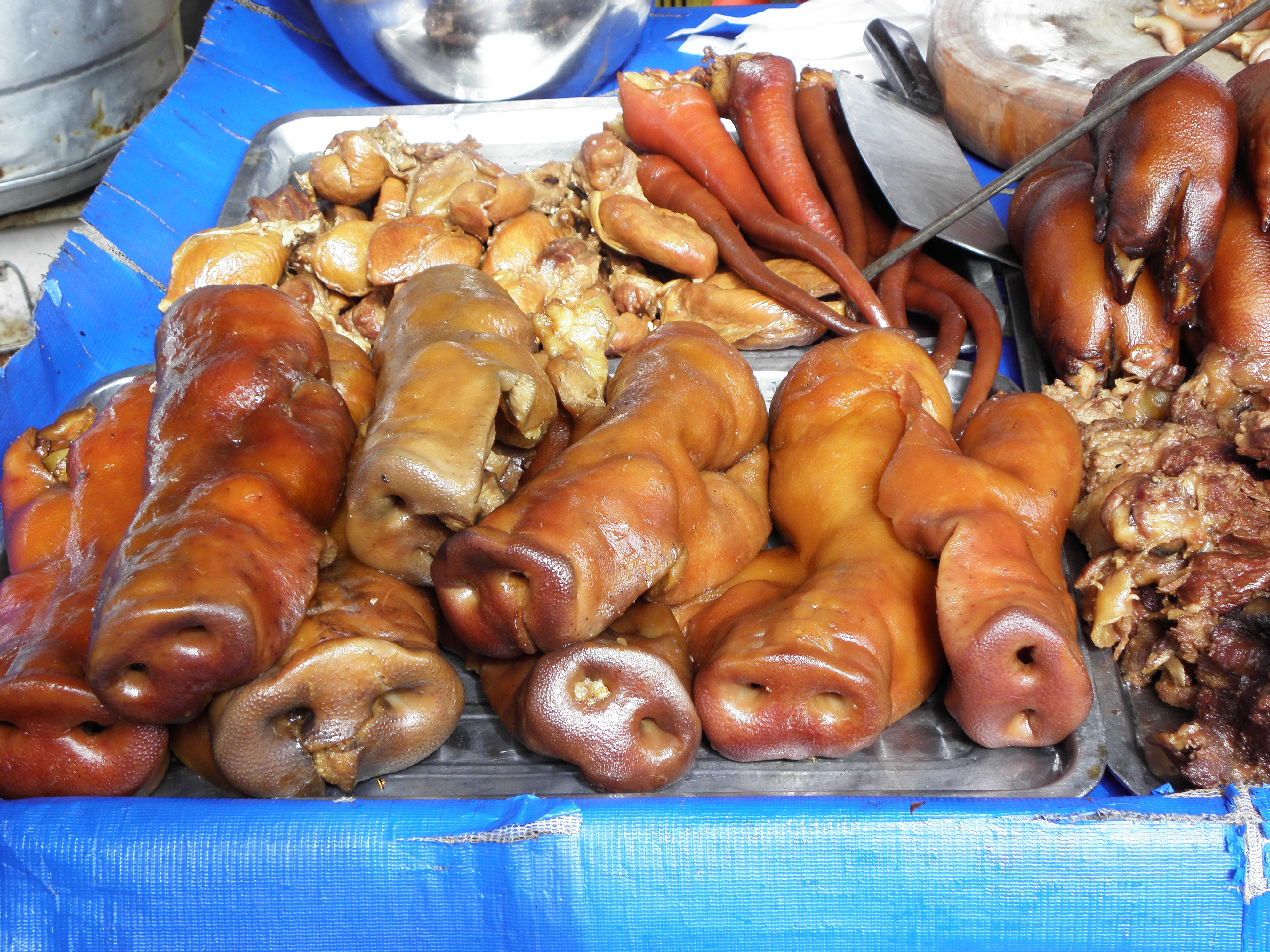
Even though not feeling well, I was intrigued by the food as there were exciting vegetarian eats to be found. One I especially liked was dried, spicy mushrooms which one could eat like jerky, or mix in with noodles. Pig’s nose and ear salad was very popular but of no use to vegetarians. Bread and cheese were unheard of, and it was local food or nothing.
19 September - Jinghong – Puwen – 105 km
Ernest never showed up again and,
unsure if he was still around, I cycled out of town. Without a
map, it was best to follow the highway, but after 20 kilometres,
Most of the day was spent cycling uphill, a slow and tedious task. By 5 o’clock, I slinked into Puwen, a small hamlet which, fortunately, had basic accommodation. I could hear the sounds of the village, an old man was wailing in the back yard, chicks chirped, children laughed, and it wasn’t long before one started crying. It could have been anywhere (except for the wailing man).
October 1 was China’s National Day. At the time of my visit, they celebrated the 60th anniversary of the PRC, and TV mostly showed preparation for a weeklong festival, as well as pro-China documentaries and speeches (just like any other country).
20 September - Puwen – Unknown village – 90 km Without a map and with no means to read road signs, all one could do was follow the road. From time to time, I checked if it was still the path to Kunming but, in most cases, people only stared blankly. It was taking some getting used to people staring - it was only day five in China, and it was already getting to me.
Eventually, I reached a reasonably large town. After finding a hotel and rinsing my cycling clothes, the next challenge was to find a supermarket and food. I was stared at to no end; all the way to the shop and back. While shopping, my every move was watched, and every item placed in the basket discussed. Even arriving back at the hotel, my bag was eyed with great curiosity.
The hotel staff was very accommodating and understood I was looking for a road map. A few minutes later, the lady arrived with a map of Yunnan province, all in Chinese, with the result the name of the town still eludes me to this day. It was, however, better than nothing and at least showed cities and villages along the way.
21 September - Unknown town - an unknown village - 80 km Map in hand, I set off, up and over mountains again. Kilometres on the map and the distances cycled didn’t add up. Trying to compare the squiggles on the map to the squiggles on road signs weren’t very successful either. On top of one of the mountains, I located a small village with rooms to let. It was only 15h00, but according to my estimates, it was, at best, another 45 kilometres to the next town and over yet another mountain pass. The fact that a faded signboard indicated 71 kilometres to an unknown location made me stay put. The accommodation was rather basic but, then, what can one expect for $1. Used condoms and cigarette butts covered the floor, which I kicked aside and settled in.
22-23 September - Unknown town – MoJiang In the morning, I found another cyclist had arrived late the previous evening. It was a Chinese guy cycling around Yunnan Province. Without speaking, we cycled together for the rest of the day. I didn’t feel very well and was still plagued with the stomach problem picked up in Laos. Little did I know it would last another two weeks.
It was, however, nice to have company and to realise I wasn’t the only one moving along at a snail's pace up the long, winding mountain passes. Regular stops made for admiring views, and he could speak to locals and tried to explain what was being said. On top of one of these passes, a lady invited us in and we sat in her humble home enjoying tea and cucumber, which was dipped in chilli powder, and it appeared it was the only food she had, except for the corn being dried in the sun. On the downhill into the city of MoJiang, my cycling partner had a flat tyre and waved me on. MoJiang was reasonably large and lodging reasonably priced and modern, but without internet access.
I was sick all night with stomach problems and decided to stay the following day, which was spent in bed, only leaving to see if I could find an internet connection. I found an internet café where hordes of kids were playing computer games. From what I understood, I needed a prepaid card for such a purpose, but from their hand signals assumed they couldn’t sell me one. How strange… It felt like I had just landed from Mars! Shops along the street were, however, happy to let me use their computers without any cost - how very kind of them.
24 September - MoJiang- Xingcheng 75 km On waking, I felt weak from lack of food but decided to move on. It was probably not the wisest decision and I could hardly get up the first hill. Creeping along, with thousands of flies buzzing around my head and getting into my ears and nose wasn’t something I could handle at that stage. Someone up there must have been looking after me, as after the first hill it was virtually a downhill run into the next city. The way was slightly bumpy, and although it made the downhill rather slow, it was better than going up. Relieved to reach Xingcheng, I booked into a hotel and ate plain noodles with added salt for supper, hoping I could keep it down. At the rate I was going, it was going to take a long time to get to Kunming City.
25 September - Xingcheng – Yang Wu- 60 km
Every morning I woke, convinced I
felt better than the day before but, on eating or drinking, it
came straight out. With no solution to my problem, it was back
on the bike and up the next mountain pass. Thirty-five
kilometres of climbing took four hours and left me utterly
exhausted. By lunchtime, I realised I would never make the next
place as I had no energy left and was happy to find a
It was easily one of the worst places imaginable but, in no condition to argue, I took it. Surely, by morning I had to feel better. Still, I couldn’t eat anything, and even drinking water made me feel nauseous. Staying without food and water wasn’t an option; it was a day which counted as one of the worst cycling days ever. A strange set of circumstances played out as, after a few hours, the lady of the house woke me to say the bus will be there in 30 minutes. It was, most likely, not a place for staying overnight, but maybe just a rest stop where people waited for the bus, or it was a place not licensed to house foreigners. I had no energy to argue and packed the bike. She walked me to the highway and flagged down a bus. At least the bus took me to the next big town about 65 kilometres further where a comfortable hotel was found. What was that all about?
26 September – Eshan The day was spent in Eshan, mostly staying in bed and trying to get to the internet, all to no avail but I at least found a supermarket as well as an ATM.
27-28 September - Eshan to Kunming
The following day was spent wandering around all the fancy shops, supermarkets and well-stocked outdoor stores. Parks were plentiful and real havens, especially early morning when elderly ladies were doing their exercises.
29 September - 4 October – Kunming
Cloudland Hostel was a great
get-together for all and a place for meeting interesting
travellers. Although feeling week, I managed to walk to
Still suffering from severe stomach cramps and a hugely bloated stomach; I was rather listless and quite desperate to get better. A visit to the pharmacy came with a diagnosis of pregnancy (I guess indicating a bloated stomach and nausea, one couldn’t blame them!) and I gave up trying to find a solution to my problem. It was still impossible to eat anything without suffering from stomach cramps and nausea. This condition carried on for the next five days, and I felt weaker by the day as it was only possible to eat tiny bits at a time and by then I only weighed 48 kg.
In the meantime, there was more than enough drama to keep me occupied. Two of the lockers in Ernest’s dormitory were broken into, and with him being the only other person there he was suspect number one. Fortunately, one guy’s alleged stolen goods were recovered in his locker, and together with a whole list of other circumstances, he became the prime suspect and Ernest was cleared. However, he was still a witness and had to provide lengthy statements to the police.
5 October - Kunming – Unknown town – 80 km
6 October - Unknown town to Lufeng – 38 km
I felt weaker than expected; my legs
just didn’t want to do the job required. The road was in a
terrible condition but ran through a scenic rural area where
corn was hanging from balconies and rafters; some, obviously,
had a better crop than others. With local dogs snapping at our
heels, we pulled into Lufeng, known as the hometown of
dinosaurs. Lufeng
was a fair-sized town, with suitable
accommodation in the centre of the city.
At the time of our visit, Lufeng was well known for the discovery of more than 110 dinosaur fossils, said to be the location with the highest number and most complete skeletons in the world. More recently, the earliest collection of fossilised dinosaur embryos to date was discovered dating back 197 million to 190 million years ago! That’s a seriously long time ago!
7-8 October - Lufeng – Chuxiong – 83 km
The stretch of road between Lufeng
and Chuxiong was a most scenic ride, and although the way was in
poor condition, it was an enjoyable day as our path followed
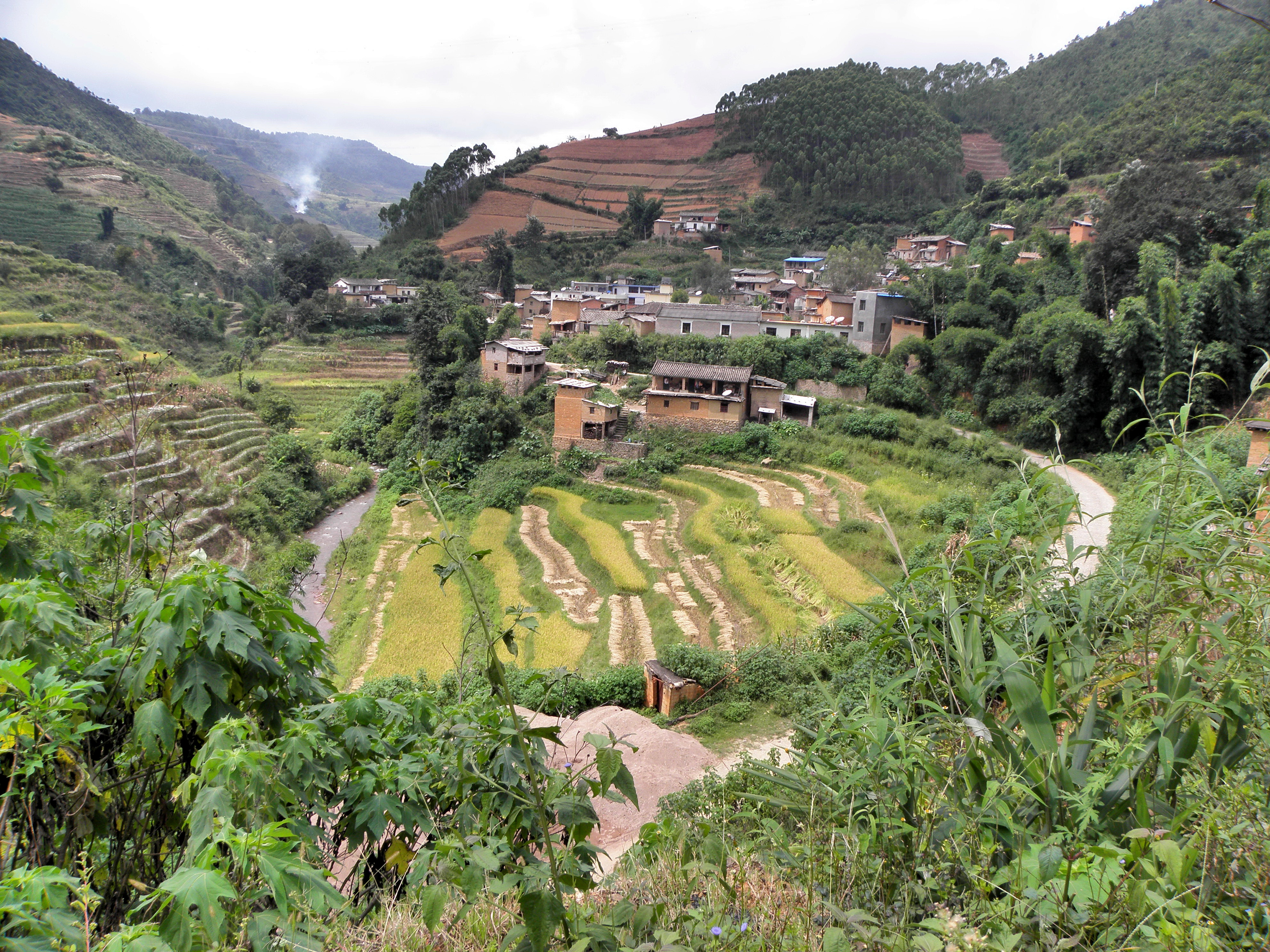
Chuxiong turned out to be an exciting place. Being the capital of the Yi Autonomous region, it was home to Yi Ren Gu Zhen (Ancient Town of the Yi People). The Yi being one of China's 55 ethnic minorities. But then, most of the villages we cycled through looked like ancient towns with their low, tiled-roof houses and narrow, cobbled streets.
The next day was spent in Chuxiong to extend our Chinese visas and, in the process, a better room was found close to the Foreign Affairs office. The fact that one could find delicious vegetarian food on just about every street corner was an added bonus, and most of the day was spent eating rice and various types of vegetables.
9 October - Chuxiong - Shaqiao – 61 km
Feeling somewhat stronger after a day of rest and food, we followed a bumpy road out of Chxiong. My assumption that it would improve was, clearly, incorrect. It was sweaty work up the hills, but on the downhill, one could feel winter approaching. I had to dig out my windbreaker from the bottom of my pannier, something I hadn’t needed in more than a year and not something I was particularly thrilled about.
The Chinese were big tea drinkers, and one seldom saw a Chinese without a jar from which they sip all day, clutched under their arm. It reminded of the mate drinking in South America and, just like in South America, hot water was readily available just about anywhere.
10 October - Shaqiao - Xianyun – 95 km The ride from Shagiao to Xiangun was most difficult as it was in poor condition and extremely bumpy, something which tested my mental strength to no end. Not only were the hills steep but a headwind hampered our efforts, making for late arrival in Xianyun.
On arrival in Xianyan, it was the usual procedure of finding an abode around the food alleys. Supper was a most delicious meal consisting of rice and crispy wok-fried vegetables. Being totally exhausted, it was an early night for me.
11 October - Xianyun – Xiaguan (modern-day Dali City) – 71 km
Still tired in the morning, I
wondered how I would fair. The route out of Xianun started with
a long mountain pass, but once over the top it was a downhill
run into Dali City. The road led past numerous small
communities, where crop harvesting was in full swing, and all
types of conceivable grains were being dried by the roadside -
Although it was early, we decided to take a room and find more tasty Chinese food. I was slightly disappointed as, in more touristy towns, prices were much higher and the food not nearly as good as in the countryside.
12 October - Old Dali – 14 km Leaving Dali City was at a leisurely pace as it was hardly 15 kilometres to Old Dali where we found an inexpensive room, just outside the walls of the old town and close to the South Gate. The gate has a history dating back more than 600 years and was said to be the oldest building in the area.
Dali Old Town was a major stop on the Ancient Tea Horse Road, or Southwest Silk Road and dated back more than 1,000 years when it was the capital of the region and one of the largest cities in the world.
It was, therefore, not surprising that the Old Town was very touristy with stacks of tourist buses pulling in throughout the day. It was, however, still a relaxing and easy-going village, graced with traditional Chinese style buildings, under tiled roofs, with plastered brick, or white-washed walls, situated along cobblestone streets.
I couldn’t wait to explore the alleys, shops and touristy stalls which lined the streets. There was food aplenty and just as many clothing and jewellery stalls, all offering overpriced items for the busloads of tourists (mainly from other parts of China). Many restaurants provided pizzas and western-style food, which I wasn’t going to complain about right then.
13-14 October - Dali After three days in Dali and as many pizzas later, it was time to move on. As we were heading north where I believed it would be even colder, I bought some warm clothes and some money was spent on a new pair of pants as the old ones kept falling down. The Chinese were such tiny people, the pants fitted but were only three-quarter length for me.
15 October - Dali – Songgui – 99 km
It was fun walking out in search of food as it was always a surprise what one would find. The typical street-side restaurants had ingredients on display to choose from, which was then cooked in a wok, and usually served with rice or noodles.
16-18 October - Songgui – Lijiang – 74 km Again, the weather was perfect for cycling: sunny, cloudless skies, even a mild tailwind, made it a pleasure to be out and, for once, the road was in good condition. The scenery was again outstanding as we cycled up and down hills through traditional settlements. (Darn, those hills were steep!).
Lunch was rice with side servings of beans and cabbage, all fried up in a wok, and with full bellies it was up the next pass, reaching the old city of Lijiang in good time where digs were found in the narrow, cobble-stoned streets of this ancient city.
Lijiang's’ Old Town was a well-preserved old city that can be traced back to the Warring States Period (476-221 BC). During the Tang Dynasty (618-907), Lijiang’s economy reached its peak with the development of the Ancient Tea Horse Road. During that time, it was an important trade centre between Sichuan, Yunnan and Tibet, as it was located at the junction of the southern Silk Road and the Ancient Tea Horse Road.
Old Lijiang was declared a UNESCO World Heritage Site and is now the most visited old town in China. It was, understandably, crowded as I understood it got eight million visitors a year. The next two days were spent exploring the ancient city with its maze of cobbled streets and canals, getting lost and, eventually, finding my way back to the popular budget Ma Ma’s Naxi Guest House.
Ma Ma’s was a great place to hang out. Besides the cosy courtyard, Ma Ma looked after every guest and fed us fruit and copious amounts of tea (all for free).
I decided to play backpacker/tourist for a few days and to take the bus north to the highland town of Shangri-La (formerly Zhongdian) and, on the way back, hike the Tiger Leaping Gorge. The plan was to return to Lijiang as from Lijiang a road ran to Lugu Lake - there was no road indicated on the map running from Shangrila La to Lugu Lake.
19 October - Lijiang to Shangri-La (by bus)
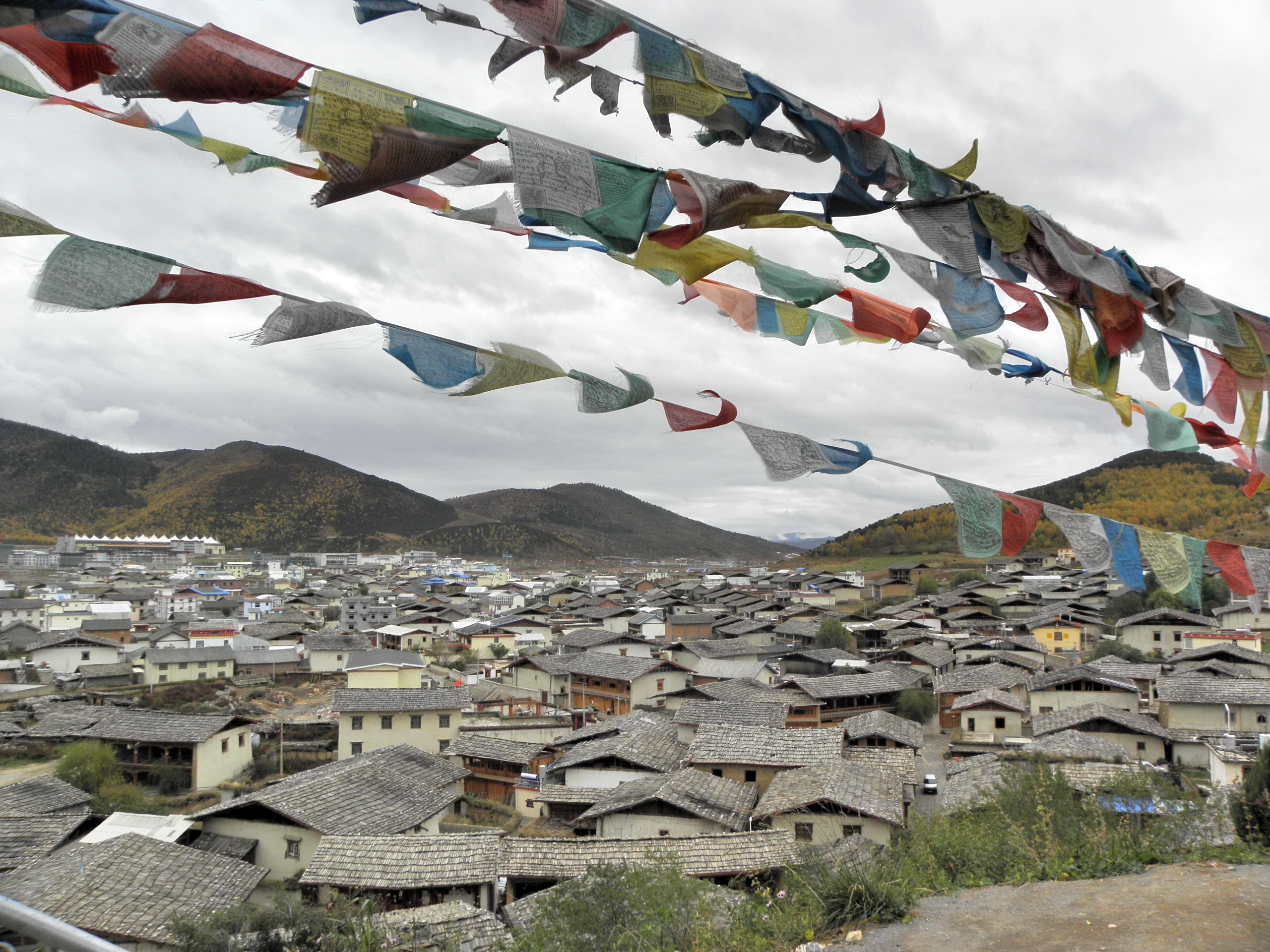
After more than four hours, the bus reached Shangri-La, a place that conjured images of a mythical paradise; instead, I found it over-commercialised and, situated at an altitude of 3,300m, it was bitterly cold. Although very touristy, it had an Old Town area with a strong Tibetan influence. In ancient times, it was the fiefdom of three sons of a Tibetan King. Today the majority of the population is still Tibetan, and with their fascinating ethnic culture, it made for an interesting place to visit.
20 October - Shangri-La
The accommodation was well equipped
for the cold weather, making getting up hard. Eventually, I
braved the weather and headed for the square where hawkers sold
local BaBa (fried flatbread served with chillies). Just around
the corner from the square was the ever-present steamed rice
dumplings, this time a vegetarian version with veggies or
mushrooms,
Ernest and I wandered around the old town, along narrow alleys and cobblestone streets, dodging hordes of Chinese tourists. The entrance fee for the nearby monastery was rather steep, and we gave it a miss, and instead went back to town and walked up the hill to the picturesque temple overlooking the old city.
21 October - Shangri La – Qiaotou Reluctantly, I left my warm bed, and it was late in the morning before I, eventually, donned my little backpack and headed for the bus station and Qiaotou. The bus took approximately two hours to reach Qiaotou and, once there, I first wandered around the small town before heading for Tiger Leaping Gorge. The entrance fee to the gorge was 50 yuan and, once past the ticket office, the signs for the High Trail were clearly visible. Guest houses advertise themselves on large stones along the trail and I reached the first inn after about an hour and a half. Right from the start, the views were exceptional, and I felt thrilled and privileged walking along the trail without another person in sight.
According to my brochure, it was a three-hour trek to the next inn and I decided to stay at Naxi Family Guest House for the night. The guest house was a traditional Naxi home run by an amicable Naxi family. The rooms had excellent views and were very comfortable and came complete with electric blankets.
22 October - Tiger Leaping Gorge - Naxi Family Guest House – Tina’s Guest House
I woke to excellent views of Jade
Dragon Mountain from my bedroom window. At a leisurely pace, I
had breakfast consisting of a plate of fried noodles and veggies
as well as a walnut pancake. By 9h00, I was ready to start the
walk and strolled along the path with high mountains on both
sides and the river far below. The day’s walk took me past small
Now and again, one came upon a lodge where trekkers could stop and have a cup of tea, which was provided free of charge.
High waterfalls spilt over the trail making for careful manoeuvring not to be washed away over the edge. With a sigh of relief, I made it across and continued along the track. The views of the gorge with the river far below were excellent. In no time, I reached Tina’s Guest House, which was located at the junction with the road and, as there was a bus leaving for Lijiang, I hopped on and found myself back in Lijiang at around 21h00. I should have walked much slower as it was over far too quickly.
23 October - Lijiang
I couldn’t wait to head for the BaBa
and fried potato-stand down the alley, all very oily and greasy,
but yummy. I spent the day lazing in the sun, eating and
chatting
with other travellers. I had, by then, picked up much
of the weight lost during my illness and felt strong and healthy
again (thanks to the fried babas and all the fried potatoes).
I loved China, especially the fact that there were many ethnic groups and all still with their own customs. Besides the Han majority in the south-east, there were regional minorities such as Dai, Bai, Naxi, Yi, Mosu, etc., all with different looks, clothing, food and architecture. Many of the places where we stayed were part of the family home, and one could get a peep into their daily family life. The restaurant area was usually the family kitchen/lounge where the family ate, watched TV, kids played, and pets lazed about.
Just as I found something really nice to eat, it completely disappeared as one moved into another area. Lijiang was situated around a lake and had an abundance of fish, and piglets on spits were barbequed at nearly every corner. The custom was to sit at low tables with wire mesh in the middle and coals underneath, allowing one to barbeque your individual food.
24 October- Lijiang
The plan was on leaving that day, but Ernest drank too much of the rice wine the night before and another day was spent at Ma Ma’s Naxi Guest House. I sat talking to other travellers in the courtyard while being fed fruit and tea continuously by Ma Ma. Ma Ma was, obviously, in charge and consistently busy organising lifts to the bus or train station, or organising bus and plane tickets for travellers while Ba Ba did the driving or dozed in front of the TV.
Amazingly, Lijiang was a great place to hang out, given it was immensely touristy. I loved the fact that I wasn’t being stared at, something which I got a bit tired of in the countryside. At least in Lijiang, there were thousands of tourists (albeit mostly Chinese), and one could easily blend in.
25 October - Lijiang – Mountain camp – 61 km After being fed coffee and banana pancakes by Ma Ma (all free of charge), she sent us on our way with a bag of fruit. We headed out of town towards Lugu Lake, home to Mosu villages. I believe the Mosu is the last practising matriarchal society in the world. After reading “Leaving Mother Lake”, a fascinating account of the author’s childhood memoirs growing up in that remote part of China, I was keen to see what it was all about.
After a long downhill ride, the road
crossed the Yangzi River and then climbed for 40
Being such a mountainous area, trucks and busses frequently stopped to fill up with water for the water-cooled brakes. These places made suitable camping, as there were usually toilets, water and sometimes basic food stalls. It, however, came with loads of bus passengers all wanting to chat and invitations to pose with them. One passenger laughingly pointed out that they thought they were roughing it on the bus! The owner of the water point was super kind and supplied us with a flask of hot water and a spade full of coals to keep us warm, which was much appreciated as it was bitterly cold.
26 October - Mountain Camp - Ninglang – 74 km
I laid rolled up in the sleeping bag
while waiting for the sun to rise over the ridge as it was
rather cold so high up in the mountain. Soon,
At snail's pace, we moved up the mountain, slipping and sliding on the cobblestones, and dodging stones rolling down from the steep mountainsides. Landslides seemed a regular occurrence, and now and again the path was blocked with only a small section cleared allowing traffic through. Eventually, the cobblestone road gave way to a perfectly good paved road after which better progress was made. On reaching the top (3,100m), a real good downhill awaited, and by the time our shadows grew long, we coasted into Ninglang with the long climb (nearly) forgotten. A room in Ningland provided a luxuriously hot shower and plenty of nearby food stalls.
27 October - Ninglang – Mountain camp – 59 km The mornings were, understandably, freezing cold, making it a struggle to get out of bed. After unsuccessfully searching for an ATM we left and immediately encountered a mountain pass, it turned out not the only one for the day.
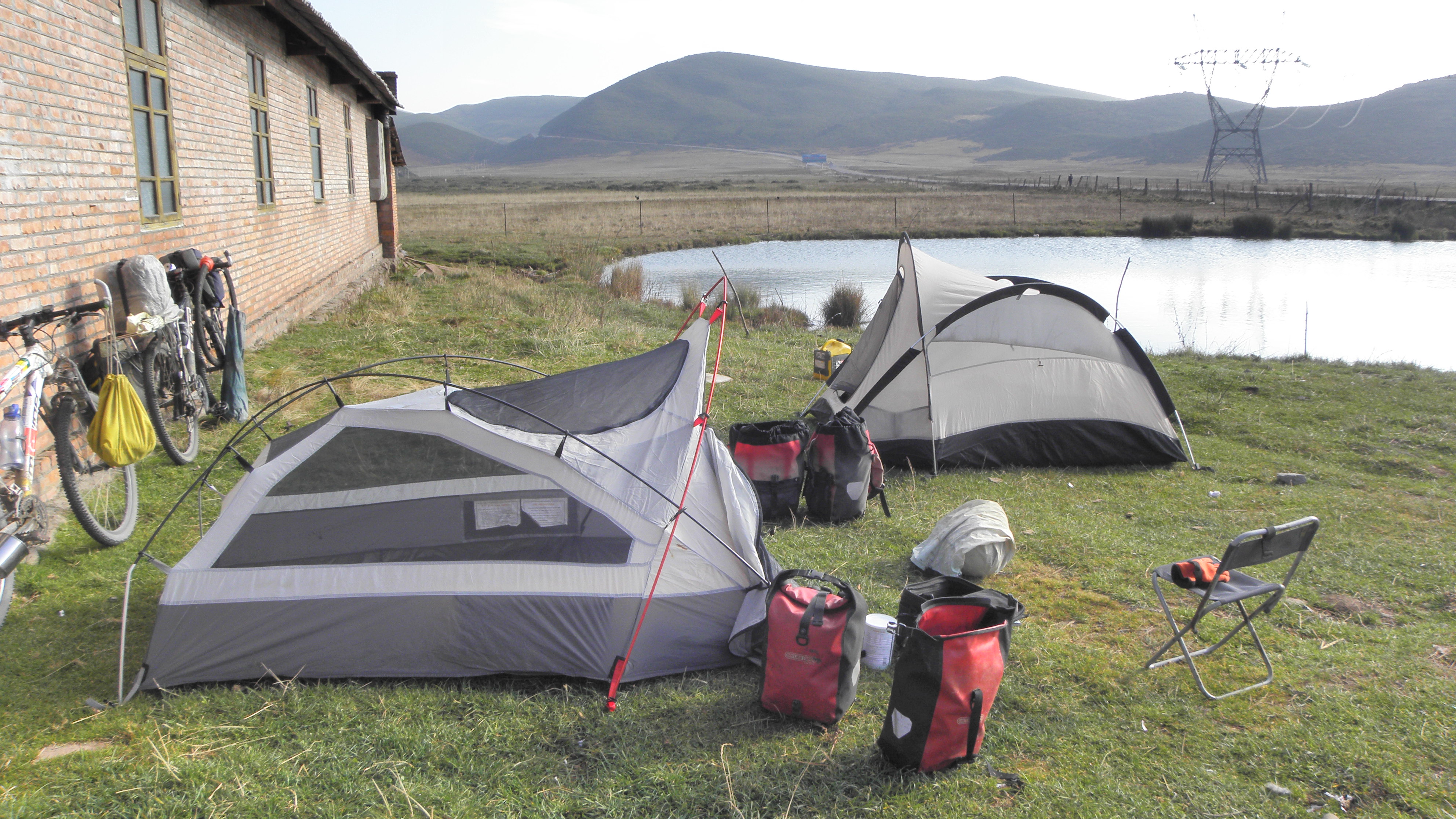
As night fell, the only piece of level ground seen for a while appeared. It was a tiny patch bordered by the curve of the road, a homestead, and an animal shed, just big enough for our tents. More importantly, there was a stream for water from which residents supplied water to the passing trucks and busses. At 3,000 metres it was rather cold as soon as the sun disappeared, and it meant donning all our warm clothes. Again, our activities were strictly observed by all, including the pigs, dogs and chickens in the makeshift shed a metre or two away.
28 October - Mountain Camp – Lugu Lake – 21 km
It was after
11h00 before we got going as the sun never rose over the
surrounding mountains. The pass continued up for the next six
kilometres before reaching the top at 3,350 metres. There was no
mistaking the top for all the prayer flags and the
The border between the province of Yunnan and Sichuan ran through the middle of the lake, and it was, therefore, the end of our ride through Yunnan.
Luoshui was the first community along the lake and we took a room, as I understood some shops and guesthouses could give a cash advance on a bank card. The phone line was, however, off and, if understood correctly, I was to try again in the morning. It was a significant risk but our only option.
29 October - Luohui – Lige – 10 km
The lake may not be as remote as it used to be but was still absolutely stunning. Curio shops sold colourful embroidered clothing, long-stem pipes and all kinds of animal skin clothing. New guesthouses were going up fast and furious, and I didn’t think it long before the whole area would be totally developed. That said, I didn’t see any other foreigners.
30 October - Lige – Wuzhiluo – 27 km
The next day, the road continued
around the lake and we came upon many small communities, where
villagers still fished for a living and lived a traditional
lifestyle, including practising “walking or visiting marriages”.
Traditional Mosuo women don’t
We went pretty slow, and only reached the small village of Wuzhiluo at around 15h00. It was peaceful and tranquil, and we stayed the night. Wind’s Guesthouse even had food and so much was served it felt I was going to burst.
Over the previous few days, Ernest had developed a nasty cough, and the owner made and delivered to the room a unique remedy for his chest (steamed pears in honey). Here we also encountered the first Western tourists we’d seen in the Lake area – Marie and Robert from France.
31 October - Wuzhiluo – Yanyuan – 124 km
Although my legs were tired, it was a most stunning ride, once again past small and remote communities where houses clung to the steep mountainside, and past rivers and waterfalls. That said, I was happy to reach YanYuan, where one could find a room and have a shower. Ernest and I walked out and found a restaurant where, again, one could go into the kitchen and point at the ingredients you wanted to be prepared. With a bag full of food, we returned to our abode, and that was me done for the night.
1 November - Yanyuan – Yalong River – 77 km
Once over the highpoint, the road sped downhill for 45 kilometres, and we raced down the mountain in bitterly cold weather to 1,200m - descending 2,000 metres in the process! Halfway down, a roadside eatery provided some much-needed warmth after which the road continued downhill until reaching the Yalong River.
On the other side of the river, one could see the road zigzagging up the pass and we thought it a good idea to find a room and continue in the morning. Fortunately, there was a conveniently located hotel shortly after crossing the river.
2 November - Yalong River – Xichang – 79 km
The following morning, the going was
extremely slow as we climbed higher and higher. Now and then one
could catch a glimpse of the river, every time from a higher
Arrival in Xichang was late, and we were cold and hungry as we hadn’t eaten since the previous evening, except for a few sweets I still had in my bag, and it was after dark before finding a suitable room. Ernest immediately set off to the food shops and returned with fried rice, noodle soup and dumplings - he must have been starving. At least there wasn’t a room to be had without a flask of hot water and tea before I even had a shower, so I sat down and had a cuppa.
3 November - Xichang We slept in, and it was late by the time we headed for the nearest dumpling and rice bun stall. Street food was cheap and delicious, and one couldn’t get enough of it. After doing much overdue laundry, it was off in search of the local PSB for our visa renewal. It was easy and the people friendly and helpful; nothing like I’d expected. The extension was processed while waiting, and I got the feeling that if we’d asked for more than another month, it might have been granted.
4 November - Xichang – Mountain Camp – 47 km
It was 11h00 by the time we left as the next place indicated on the map looked about 65 kilometres away and we reckoned there was no rush. As always in China, there was, however, a bit of a surprise as the road led up yet another mountain pass. I don’t know why it came as a surprise to me.
It was a slow crawl as we climbed higher and higher while it became increasingly colder. By the end of the day, we still hadn’t reached our destination and being frozen decided to camp. A small roadside restaurant provided camping for the night (at least there was water and a basic toilet). It was bitterly cold as we set up camp at above 3,100 metres, cooked our food and crawled into our tents.
5 November - Mountain camp – Unknown town – 85 km We stayed tucked in our sleeping bags until the ice on the tents had melted, and then slowly emerged to defrost ourselves in the morning sun. At least it turned out we were almost at the top of the pass, as shortly after leaving the route started descending.
It turned out a most interesting day
past rural villages, with pigs, goats and chickens all munching
on garbage along the path. We cycled along rivers with high
waterfalls, where mountainsides were thick with ferns and moss.
Now and again, we came upon villagers herding
goats to better
pastures. Eventually, we reached a hamlet which had basic rooms
for the night. Kids were staring in absolute amazement at this
spectacle coming along.
6 November - Unknown town – roadside camp – 93 km Under close scrutiny, we loaded up our bikes, waved good-bye to the onlookers and took a reasonably obscure road, which followed the river in the direction of Leibo. Although it was mostly downhill, the way was in poor condition and the going slow. It was, however, stunning and little headway was made due to frequent stops to admire the view as the gorge became deeper and steeper.
As we dropped down to the Jinsha river valley, it became warmer, but a heavy mist/fog/dust engulfed the entire area. There were plenty of villages along the river, none of which I’m sure has ever seen a western tourist. It was Friday and, obviously, market day. We spotted plenty of villagers with loaded horses, and others carrying large baskets on their backs loaded with everything from noodles to plastic basins - all on their way back to their mountainside villages.
As usual, there was a surprise waiting at the end of the day! Suddenly, our downhill ride came to an end, and the road left the gorge and snaked up the mountainside to Leibo. It was orange country and along the road weren’t only orange orchards but also roadside stalls, selling delicious oranges. At least that part of the road looked brand new, making for more comfortable riding. As it was already late and the light fading fast, camping was next to the road at a truck stop (to the great amusement of the locals). We were given bottled water, bananas and, of course, a flask of hot water while they pulled up chairs to sit and watch as we pitched our tents. It was like the circus had come to town.
7 November - Roadside camp – Leibo – 7 km
On waking, the fog was so thick one could hardly see the river in the gorge way below. It was a short but very steep ride up the hill where we found Leibo to be a fairly large town. We spoiled ourselves and took a luxury room (by our standards), had a much-needed shower, did the laundry and stocked up with the usual supplies.
Ernest spent the day fixing punctured tubes, spraying the bikes down with the hotel firehose, and sampling the local brew. All I did was to fill my stomach with the local food, from fried noodles, steamed buns to fried potatoes, all served with chillies and soya sauce. The food was tasty. I couldn’t stop eating, it must be the large quantities of MSG that appeared to go into all dishes.
8 November - Leibo – Ma Hu – 50 km
We reckoned we were at the top of
the mountain and were looking forward to a good downhill run.
Surprise, surprise! The road continued up and up to a
devastating height with small settlements clinging to the cliffside, barely visible through the thick mist. Toothless old
ladies sat on their haunches, smoking thin long-stemmed pipes,
wrapped in cloaks of
A heavy mist hung over the area, and one could hardly see the valley floor or the top of the mountain; maybe it was a good thing. It was best not to see where the road was heading, but on spotting kids with go-carts flying down the hill, we reckoned we were over the worst of it.
It took 33 kilometres of climbing before reaching the downhill where we flew down the mountain for the next 20 kilometres, landing up in a small village with food, friendly people and basic rooms. As always, there was plenty of steamed buns, fried potatoes, grilled vegetables and loads of rice. It felt as if the entire village was following us as we strolled from shop to shop. Each shop owner eager for us to come and have a look at what he had on offer.
9 November - Ma Hu – Bridge junction town - 58 km
It appeared our route had reached the end of the very remote areas as it spat us out at a junction town where construction of a huge bridge, which dwarfed the town, was in progress. It was still fairly early, but the town was of a fair size, making a good place to spend the night. It was, clearly, not a touristy area as hotel staff became extremely shy, giggled and pushed one another forward to deal with their unusual visitors.
By the time a room was negotiated, half the town had gathered, all trying to help with the bikes while jabbering on in Chinese. The strangest thing was on realising we didn’t speak Chinese, the staff painstakingly wrote everything down (in Chinese). What were the chances that if unable to speak Chinese, one would be able to read Chinese characters? I later learned that the many different dialects varied to such an extent that at times they didn’t understand each other, but all could read the Chinese characters.
10 November - Bridge junction town -
Shuifu – 90 km What a confusing day. With poor visibility and an inadequate map, it continuously felt as if we were heading back in the direction we’d come from. But, with the aid of Ernest’s GPS, as well as everyone pointing in the same direction, we kept going. In the process, our path crossed the Jinsha River back into Yunnan province (completely unexpected, as the map didn’t indicate as much). Most of the day was spent cycling along a dusty road, made worse by quarries and construction sites.
By late afternoon, and while looking out for a suitable campsite, the road passed through a long tunnel, and on the other end, instead of camping, was a rather large town with skyscrapers and all! Shuifu was expected to be much smaller and still about 30 kilometres away. This was clearly “New China”! Dusty and sweaty, and in great need of a shower, the first convenient hotel was home for the night.
11 November - Shuifu – Yibin - 22 km
On leaving Shuifu city it was a pleasure to find a brand-new highway heading in the direction of Yibin. It was unclear how far Yibin was, but after a few kilometres a sign indicating it was only 30 kilometres left to Yibin - much closer than expected. Our joy was short-lived as soon a tollgate was reached that prohibited cyclists from proceeding. I much preferred rural China. Our presence was clearly a problem for the authorities as they couldn’t send us back on the highway, and there was no exit to an alternative route. Eventually, a vehicle was requested to come from Yibin, load us up, and drop us at the exit to the city - a round trip of about 40 kilometres for them!
On cycling into Yibin, a large and modern city with mostly brand-new buildings, there was some difficulty finding a room. It appeared the cheaper local hotels didn’t cater to foreigners. Staff at the hotel were, however, very friendly and walked us a few blocks to a hotel which accepted foreigners. Yiban was where the Min and Jinsha rivers merge to form the Yangzi, and a short walk led to this major confluence. Unfortunately, the visibility was too poor to see anything. There were, however, loads of tasty food in the alleys with which to fill our stomachs.
12 November - Yibin
During the night, the weather
changed, and we awoke to a cold and rainy morning and stayed
tucked in until it was time for breakfast, a
great buffet
included in the room price. It was nice not having to pack in
such
At first, I thought Yibin to be a rather soulless city, but the more I walked through the alleys, the more interesting it became. The narrow lanes were lined with dumpling and noodle stalls, and portable barbeques sold skewers of veggies, tofu and, of course, the ever-present tea-eggs (boiled eggs soaked in tea and soy sauce).
I tried to improve my appearance by colouring my hair, but it all went horribly wrong as it came out bright orange! That’s what happens if you can’t read Chinese. Eeeek, it sure wasn’t the colour on the box. Maybe a good thing I couldn’t find the hair removal cream I was looking for.
13-14 November - Yibin – Zigong – 107 km
Hallelujah, at last! A day without a
mountain pass! The road was mostly in good condition and the
weather mild as the way led past dense
Arrival in Zigong was as the sun was setting, and the town, again, much larger than expected. After searching around in the dark, a fair enough room was found. After settling in, the usual hunt for food was on but it wasn’t as simple as in Yibin (every place tended to have different specialities and this was probably not the ideal area for good eats). The take-aways taken back to the room contained mostly meat - at least one of us went to bed with a full stomach.
The next day was also spent in Zigong as there were reportedly several interesting sites to see in the city.
15 November - Zigong
Then it was off to the Salt History Museum, which wasn’t as impressive, but the building in which it was housed was absolutely gorgeous. It was a most impressive old Chinese building with interesting nooks and crannies, constructed in 1736 by one of the salt merchants of the time.
16 November - Zigong - Rongxian – 48 km
It was a cold, rainy and windy morning as we cycled out of Zigong. My friends from the frozen north may think: What is this woman on about, it’s only three degrees C? I’m sure my South African friends, would have agreed three degrees C is darn cold! Ernest kept reminding me I was a baby when it came to cold weather, and I didn’t feel sorry for him when his gear cable broke on entering Rongxian. It was also more than enough reason to find a room with a hot shower. Why pass a perfectly good town with hotels and restaurants, when you’ve long forgotten you have fingers or toes?
After a steaming bowl of noodle soup, I got into the wooden spa-like tub in the room and stayed indoors for the rest of the evening.
17 November - Rongxian – Leshan – 92 km
Although it was bitter cold, it was thankfully not raining. The road was in good condition and led past temples, pagodas, rivers and valleys until reaching the town of Leshan, known for its Grand Buddha, which I was keen to get a glimpse of. Once again, I was struck by the friendliness and honesty of the Chinese people. Cycle rickshaw drivers were keen to show us to a popular budget hotel (in other places this is normally done at a fee). Once there, we offered to pay, but he refused and only waited to see if we were happy with the room before quietly disappearing.
18 November - Leshan
There’s nothing like a Snickers Bar and a cup of coffee for breakfast on a cold and windy morning! We stayed tucked in until fairly late as it was freezing cold. Eventually, I ventured out and was delighted to come upon a small corner shop, where through a cloud of feathers, I could only just make out the owner busy sewing and stuffing down coats. I invested in a half-length coat, to keep the worst of the cold at bay. Where I was going to pack it on the bike was a bit of a mystery.
After donning my new purchase, it was off to the sight-seeing ferry for a view of the Grand Buddha. Although it was a rather expensive and touristy trip (us and a lot of frozen Chinese tourists), it was worthwhile as it was the only way to see the total statue at once. Carved out of the riverside cliff in AD 713 it took 90 years to complete the job. At 71 metres high, with 7-metre ears and big toes of 8.5 metres long, it’s quite an impressive sight.
19 November - Leshan – Meishan – 89 km It was close to zero degrees on leaving Leshan, and it wasn’t the most scenic of days - most of the way was through built-up areas. Just to add icing on the cake, it rained for the last 30 kilometres or so. At least the road was mostly in a fair condition, and there were no major hills.
In the end, I had to don my coat and cassock hat and head to the corner to pick up the fried potatoes. At least I had already had a shower and, I’m sure, as a woman I didn’t look as threatening.
20 November - Meishan – Chengdu – 98 km
After wandering around the city for about an hour in peak-hour traffic and darkness, Sims Guesthouse was found. The place seemed nice, but a bit expensive in comparison to other accommodation. We booked in as by that time I’d had enough of cycling up and down busy, multi-lane roads with thousands of cars, buses, bicycles, motorbikes and the dangerous silent electric scooters.
21 November - Chengdu Our Chinese visas were only valid for another two weeks, and it was time to start heading south. After much deliberation, we came to the conclusion it was best to take the train to Kunming and from there a bus to Jinghong close to the Laos border as we’d already cycled that stretch. I also had to make a plan to get to Bangkok before the end of December to take care of urgent business which I could only do at a South African embassy, and the closest one was in Bangkok. The day was spent organising train tickets to Kunming and wandering the crowded streets and alleys of Chengdu.
22 November - Chengdu – Kunming (by train)
What a performance it was to take a train! The bikes had to be booked in at a different location to where one boarded the train which made it a bit of a mission. Once on the train, it was, however, comfortable as our sleeper came with bedding and the carriage was heated. Food trolleys came by every so often and, as there was nothing else to do, we ate and stared out the window. Although the train was full, it wasn’t overcrowded as everyone had a said. It’s a great pity one couldn’t talk to the other travellers as the language barrier remained a problem.
Ernest, however, had himself a great party all by himself with his bottle of moonshine.
23 November - Kunming The train arrived in Kunming at around 9h00. It took forever to get the bike out of the cargo section, load up and cycle to the nearest hotel. I found a hotel close to the Thai consulate as I wanted to apply for a Thai visa the following day and Ernest continued into the city. The Thai visa one got at the border was only valid for two weeks which was way too little time to get to Malaysia.
Kunming felt like home as it was seldom I visited the same place twice. I took a walk into town to see if I could find a map of Laos, as I planned on taking a different route than the one followed to China. The search was, however, unsuccessful. Although there was a Lonely Planet for sale, I didn’t buy it as it appeared a little expensive for such a short trip.
24 November - Kunming
First thing in the morning, it was off to the Thai embassy but was told I needed a flight or bus ticket to apply for the visa and that, apparently, I could get a 30-day visa at the border. Oh well, I guess it was “wait and see”. I also bought a bus ticket on an overnight sleeper bus to the Laos border for the following day.
I took another walk to the bookstore and, in the end, bought South-East Asia Lonely Planet as it was the same price as the Laos one and at least it covered the whole of South-East Asia. I bought a novel as I reckoned I would need something to read on such a long bus ride.
25 November - Kunming
The bus only left at 17h00, and I had the whole day to kill and wandered around Kunming, which I knew pretty well by then.
Another surprise waited as I got to the bus station. The cargo section of the bus was full, and they couldn’t take the bike. At least they refunded the ticket, and I cycled to the Cloudland Hostel where we’d stayed two months earlier on our way north. The hostel was cheaper and more social than the Camilla Hotel where I’d stayed the previous two nights. Shortly after my arrival, Ernest, who also had been booked on a south-bound bus and who also found the cargos section of his bus full, arrived at Cloudland Hostel.
26 November - Kunming
I couldn’t believe I was still in
Kunming. After a leisurely start, I decided to cycle back to the
bus station to see if I would be luckier this
The most amazing thing about the bus was the driver had a TV he could watch while driving! Of cause, not even the bus came without a hot water machine - there is no chance the Chinese will go anywhere without their tea.
It was a long and tedious bus ride, as I was coming down with the flu. I don’t know how all the backpackers do it. I’d much rather cycle even though it is much slower. I felt sick and after the nine-hour trip I was happy to see there was a bus station hotel. It saved us from re-packing the bikes and cycling around looking for a hotel in the dark.
27 November - Jing Hong We packed up and left the Bus Station Hotel in search of a better location closer to the city centre. I was still suffering from a headache and body aches and decided to stay on one more day to recover. Seeing they were rather strict at the border with the N1H1 flu virus, (taking your temperature and all), I didn’t want to risk being kept in quarantine for goodness knows how long. |