|
Around the world by bike
|

|
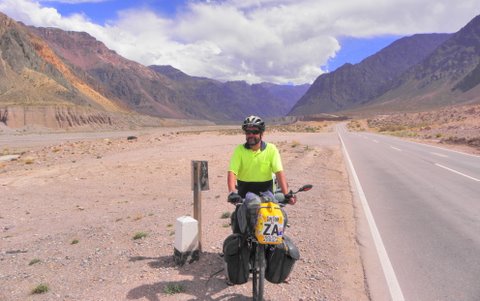
27 January - Roadside camp to Puente Del Inca – 40 km
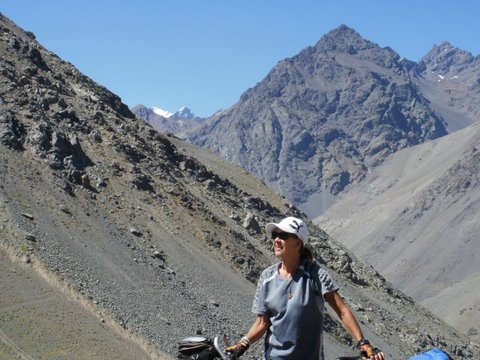
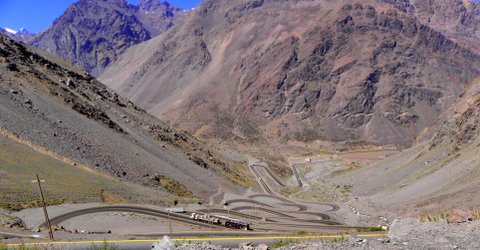
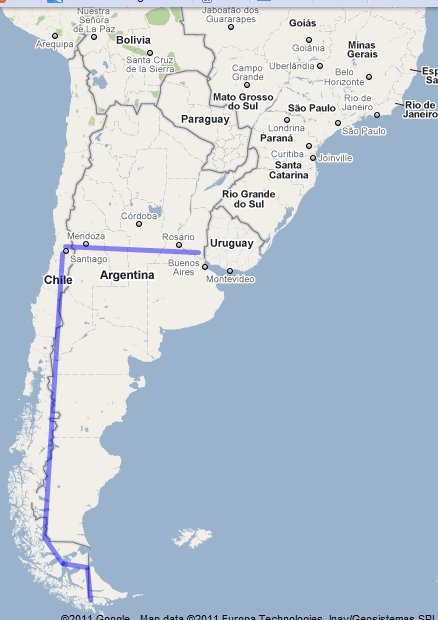
It was the day for heading over the Andes to Argentina. The road
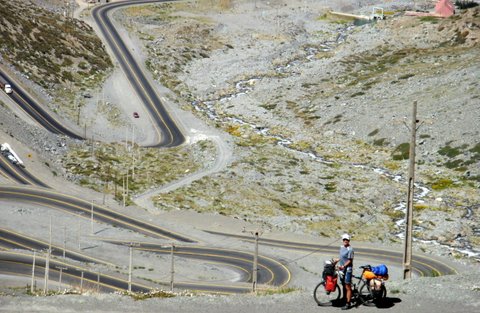
zig-zagged up the pass, and although the gradient was
acceptable, it was still a steep and dreadfully slow
22-kilometre climb from where we'd spent the night. Roadworks
caused lengthy delays and a much-needed time for a breather.
After huffing and puffing to the top, one could look down at the
winding road coming up the mountain and I could hardly believe I
made it up there. After reaching the top and yet another lift by
the authorities through a tunnel, it was still 18 kilometres to
the customs office.
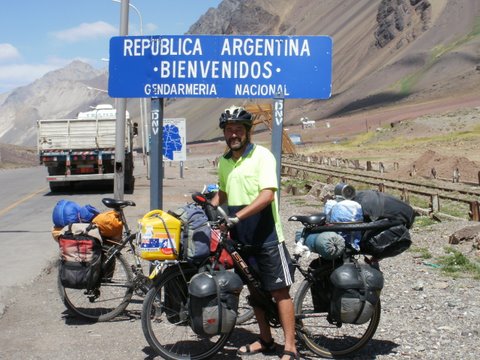
It was an uneventful border crossing where immigration staff stamped people out of Chile and into Argentina at the same time. From the immigration office, the path led downhill past the small settlement of Las Cuevas with only a few timber restaurants and the strong smell of lentil soup. With that, I reached the end of Patagonia and Chile. After my disastrous start to the Americas, Chile was a welcome change and provided a relaxing and rewarding ride. To this day, I claim that Patagonia will never see me again.
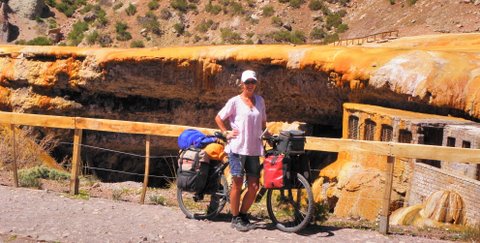
Our first stop in Argentina was the small touristy village of Puente Del Inca, with a basic campsite with a view of Aconcagua, the highest peak in the America's (6960m).
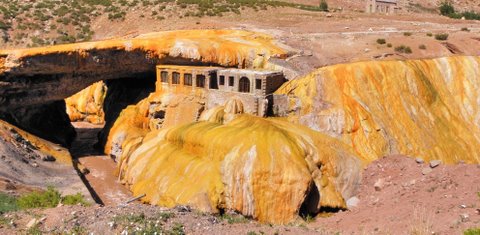
Puente Del Inca enjoyed spectacular scenery as it was surrounded by high mountains which turned all colours of the rainbow at sunset. It was home to a natural bridge over the Vacas River, said to have been formed by both glaciers and the presence of hot springs. The water from the hot springs was rich in sulphur and had, through the years, turned the bridge a lovely orange colour. The remains of an old spa were still visible directly under the bridge and were slowly becoming the same colour.
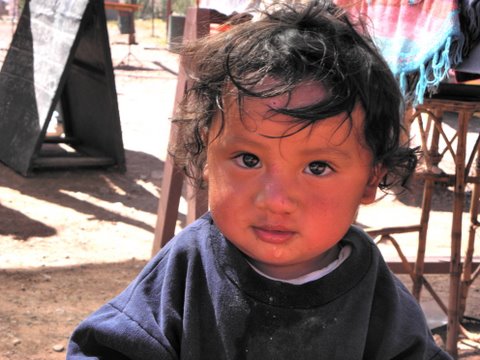
The amusing part was kids (ages 7-10, I guess) came to chat with us. On discovering I didn’t speak Spanish, they proceeded to address me very slowly and deliberately, the way one would talk to a small child. On the positive side, I did pick up quite a few words from them. Ernest cooked supper, and it was an early evening for me.
28 January - Puente Del Inca - Uspallata – 70 km
Ernest had work to do on his bike and it was midday by the time
we finally left. The road led past Cementerio Andinista, a small
cemetery for climbers who died in Aconcagua, and then past Los
Penitentes, a well-known ski resort, all boarded up as it
was summer. The pinnacles around Puente Del Inca were supposed
to resemble a line of monks, but I looked and looked but could
not see anything resembling a line of monks.
Route 7 followed the Rio Mendoza, a mostly downhill run to Uspallata. Unfortunately, a headwind called for pedalling even on the downhills and past abandoned railway stations situated on the old Transandine Railway line. The line was constructed in the late 1800s and ran from Mendoza, in Argentina, to Los Andes, in Chile. I couldn’t help but be in awe as to what a task it must have been to build a railway line over the Andes in the 1800s.
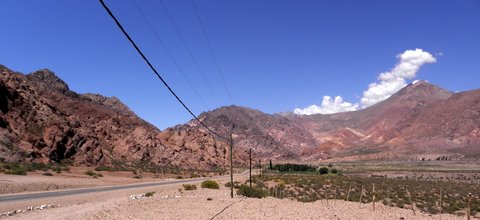
The scenery was most unusual as it was barren and at the same time colourful, I believe it was the film location of the movie “Seven Years in Tibet”. It was a stunning ride, and I tried many a time to capture the beauty but failed dismally. A large truck and trailer that had a blow-out while overtaking us on the downhill scared me to death. Pieces of tyre flew everywhere, nearly hitting Ernest, and the truck swerved wildly from side to side. The very skilful driver managed to keep his vehicle under control and averted a near disaster. Then it was on to oasis-like Uspallata with its poplar trees situated in a barren mountain landscape. Uspallata was a small community but with a campsite and all the necessary facilities.
29 January - Uspallata - Potrerillos – 58 km
The party next to the campground in Uspallata carried on through
the night, and little sleep was had. With Ernest as slow as ever
in packing up, it was 12h30 before we cycled out of Uspallata.
Again, the route followed Rio Mendoza, and the scenery was as
spectacular as the previous day. Although it was mostly
downhill, there were plenty of uphills with picturesque narrow
tunnels. The Rio Mendoza was perfect for
rafting, with water gushing down from the snowy peaks, and many
tour operators carted people to the drop-off for a fun day out.
Again, a headwind picked up, and I was somewhat peeved off with
Ernest for taking so long to pack up.
Our late start, together with the headwind, made for a short day of cycling. Next up was Potrerillos which had beautiful camping spots amongst shady poplars next to a dam. Ernest was dead set on having a barbeque in Argentina, and he bought a large chunk of beef as well as wood and spent the rest of the evening tending the fire and cooking his meat.
The Potrerillos Dam was located on the Mendoza River and was what was referred to as a “new” dam, as it was built between 1999 and 2003. The purpose of the dam was to provide flood control, hydroelectricity as well as irrigation water. The interesting part was the dam was shrinking due to the high silt content of the Mendoza River.
In later years, the dam would be in the news again due to an accident that happened during the filming of an MTV reality show “The Challenge” when the helicopter crashed into the reservoir, killing the pilot as well as the technician.
30-31 January - Potrerillos - Mendoza – 72 km
Then it was off to touristy Mendoza, but not before crossing a
few hills, after which it was smooth riding into the beautiful
Mendoza valley. On reaching Route 40, the
motorway widened and not only did it have a shoulder for cycling
but also breathtaking views of vineyards on
Although Mendoza was a reasonably large town, it was a stress-free cycle into the city. It was very touristy as not only was it popular amongst people travelling the country but it was a frequent stopover for climbers on their way to Aconcagua. The result was lodging was frightfully expensive but, still, we settled for digs in a hostel in the touristy part of town. It was high season and prices at a maximum. The weather was, however, fantastic with blue skies and temperatures in the upper 20s.
Included in the hefty room price were bed bugs which, together with the disco next door, kept me up most of the night. Fortunately, the hostel had a leafy garden with a swimming pool where one could relax during the day.
1 February 2011 – Mendoza
2 February - Mendoza – Las Catitas – 106 km After two days it was time to leave our bedbug-ridden accommodation and head east on Route 7 towards Buenos Aires, more than 1000 kilometres across the Pampas. It was a good day as the path was pancake flat and the temperature (I guess) in the low 30s. Camping was reasonably early at a petrol station with a grassy patch at the back as well as showers. A Japanese cyclist called Nobu, who had been travelling for the past year and a half, arrived from the opposite direction and camped for the night.
3 February - Las Catitas – Alto Pencoso – 99 km
We awoke to a reasonably strong wind, maybe sounding worse than
what it was due to the poplar trees we camped under. The Pampas
of South America is flat, fertile,
grassland plains covering an area of about 777,000 square
kilometres, from the Atlantic Ocean to the Andes Mountains. It
is, therefore, an area that was entirely exposed. There was
little in the
As always in a new country, there were many new and exciting things to discover. In Argentina, road fatalities weren’t just indicated by a humble cross, but by little shrines and sometimes quite elaborate ones. The collection of empty plastic bottles at some memorials baffled me. I later discovered the shrines surrounded by red flags had a fascinating history and I understood paid homage to Antonio Gil.
Still, others were for Difunta Correa. According to legend, in 1830/40s (no one is quite sure), a young woman, with her baby, set off looking for her husband who was recruited into Argentina’s Civil War. Unfortunately, she died of thirst along the way. When found days later, her baby was miraculously alive, and still suckling from her breast. Roadside shrines were constructed across the region, and to this day worshippers leave bottles of water as an offering and for quenching her eternal thirst.
In the small settlement of Alto Pencoso camping was possible at the municipal grounds and people went out of their way to accommodate us, even unlocking the community hall’s toilets. Most people were amazed two foreigners on bicycles arrived in their tiny village.
4-5 February - Alto Pencoso – San Luis – 22 km
Twenty kilometres into the ride Ernest’s back hub eventually
packed up entirely. He tried to do makeshift repairs, but it was
too severely damaged. Fortunately, a kind Argentinian gave
offered a lift into San Luis where Ernest could buy a new hub.
Spoking and straightening it was a time-consuming activity. The
next morning Ernest was still not happy with his
San Luis wasn’t a bad little town; it had a lively town centre with, as usual, a leafy central square, known as Plaza Pringles. Around the plaza were a few historic buildings including a 19th-century cathedral, featuring a neoclassical facade and twin bell towers.
I still found the language problematic; it wasn’t surprising few people spoke English and, unfortunately, my Spanish was near non-existing. To find food was equally problematic as Argentina was a beef country where vegetarianism was nearly unheard of. Argentineans were, at the time, the biggest consumers of beef per capita in the world and God forbid one should be a vegetarian in that part of the world. That said, there was plenty of good wine and pasta to be had, and I wasn’t complaining as, I hardly ever ate anything but bread and pasta.
6 February - San Luis – Picnic area (close to Villa Mercedes) – 85 km
Soon, people started packing up, and we were the only ones left. It could have been that it was a day-picnic area or it could have been they saw the weather come in.
7 February - Picnic area – Old petrol station (Washington) – 96 km
That night a massive storm came in and on waking at around 8h00, it was still raining, and I crawled back into my tent. Eventually, the rain stopped, and goats and sheep came wandering past. It was 12h00 before our tents had dried and we were back on the road. What a lonely stretch of road it was. There was little life along the way, and few places to fill up with water. By days end I was entirely out of water and was happy when a disused petrol station with a still-functioning tyre repair workshop came into view. As they had water it made for good overnight camping. I realised I would have to be much more careful about water on that desolate stretch of road.
8-9 February - Disused petrol station – Laboulaye – 128 km After thanking the staff, it was back on the bikes reaching Villa Mackenna, which had service stations, a camping area and a motel, soon afterwards.
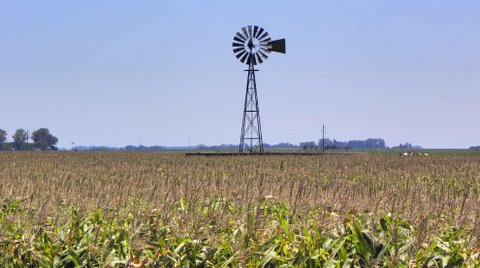
Once again, there wasn’t much along the road but large cattle ranches, or what is known as Estancias in Argentina. This was indeed a world-famous cattle country, and with enough rain and fertile soil, grazing was nutritious, and I understood the beef excellent. It’s said the good taste is due to the cattle’s organic and free-range roaming. Not only was it cattle country, but vast areas were planted under corn and soybeans.
From about this stage, Route 7 became narrow with heavy truck traffic, and care had to be taken to stay out of harm’s way. A steady headwind slowed us to a crawl, and it was getting late enough to get concerned the last stretch to Laboulaye would be cycled in darkness. Seven kilometres from Laboulaye, Ernest came to an unexpected and sudden halt. The front hub on his bike had also seized up and with a fast-setting sun, he quickly did an emergency repair job allowing for continuing to Laboulaye, albeit in the dark.
Laboulaye was much bigger than expected and it was easy to locate a reasonably priced hotel to stay while Ernest repaired his bike. Fortunately, Argentineans were a sporting nation, and one could find fairly decent bike shops in most sizable towns. Laboulaye was big enough to sport a bicycle shop where Ernest could buy the necessary to fix his bike.
10 February - Laboulaye – Rufino – 71 km
Argentinians take their siesta seriously and only seem to wake at around 17h00. No sooner had they woken from their nap and the entire village was at the park which doubled as a sports ground. People were out playing football, hockey, running, even the local marching band was out practising. What a delight it was observing a small Argentinean country town in full swing. Once again, there was a bike shop for the purchase of a mirror.
11 February - Rufino – Vedia – 119 km
The following day was another windy day, and 18-wheelers came
roaring past, causing diving off the road now and then. The
mirror bought the previous day at least
This was the Pampas and home to Gauchos and vast cattle ranches. To me, the Gauchos of Argentina conjured up romantic images of horsemen freely roaming the vast plains of Argentina. I wasn’t far off as I witnessed riders herding cattle, looking very comfortable on horseback. It was indeed a beautiful sight to see these Gauchos looking so comfortable on a horse, while sipping mate from a gourd through a silver straw, always with at least four dogs at their heels.
With Argentineans being the world’s biggest meat-eaters, no decent petrol station ever came without a grassy area and a few barbeque pits, making for convenient camping. Route 7 was a major road transport route and most petrol stations doubled as a truck stop. Petrol stations mostly came with clean toilets as well as showers. The majority of them had hot water on tap as it was entirely inconceivable one could go without a flask of mate. All this made for trouble-free camping along the Pampas.
12 February - Vedia – Junin – 58 km
The wind seemed to have picked up during the night, fortunately, it wasn’t as bad as I’d expected. Instead, I found the traffic a much bigger problem. My legs felt tired and we turned into Junin for the night. I always seemed hungry, and after a visit to the local supermarket, I’d my fill of bread and cheese as there appeared to be little else around except meat, meat and more meat.
13 February - Junin – Carmen de Areco – 126 km
The next day a tailwind made easy cycling and not being ones to
waste a tailwind,
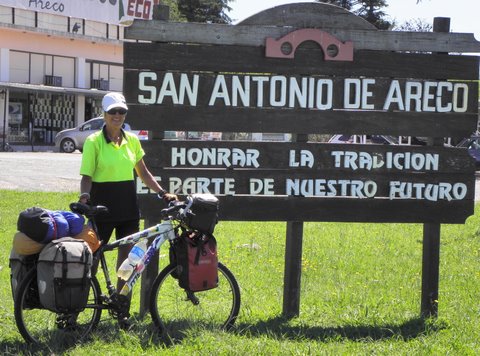
14 February - Carmen de Areco – San Antonio de Areco – 66 km I could tell it was going to be a day of cycling into a headwind and was pleased we’d pushed on the day before. After eating leftover bread with cheese and drinking our coffee (as I hadn’t yet acquired a taste for mate) it was on the bikes and onto San Antonio.
Traffic was horrendous, as usual, but, once off Route 7, slightly less. A beautiful ride through the countryside brought us to San Antonio. Dating from the 18th century, it was loaded with history and considered home to the Gauchos. The town had a campground where one could pitch a tent and relax in the shade.
15 February - San Antonio – Buenos Aires – 118 km
What a lively city, Buenos Aires was. Street cafes abounded, and people were out and about until the wee hours of the morning.
16 February - Buenos Aires
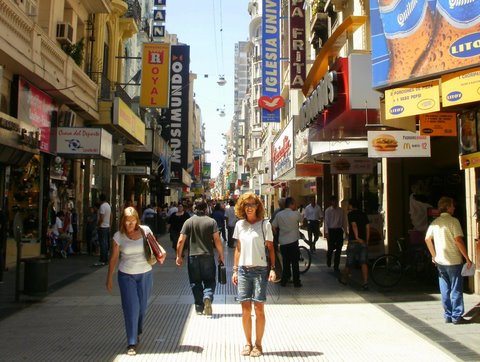
The following day was spent walking around town, down Avenue
Florida - a pedestrian mall jam-packed with people and street
vendors. Then on to Plaza de Mayo
with its pink palace (or presidential office), past lovely old
colonial-style buildings and around the famous
Eventually, it was time to sit down at a sidewalk restaurant, and while looking at the menu, a very skilled thief nicked my bag (which I’d placed on the ground between my feet). So good was the thief, neither Ernest nor I noticed anything. It was quite a disaster as the bagged contained my wallet with cash and bank cards, as well as my camera, glasses and, even more disastrous, memory cards with all my photos of South America since arriving in Ushuaia. Most of the rest of the day was spent cancelling cards and ordering new ones.
17-21 February - Buenos Aires
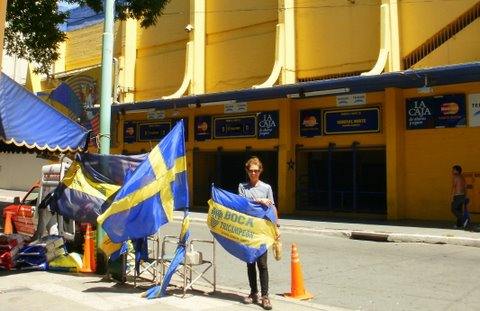
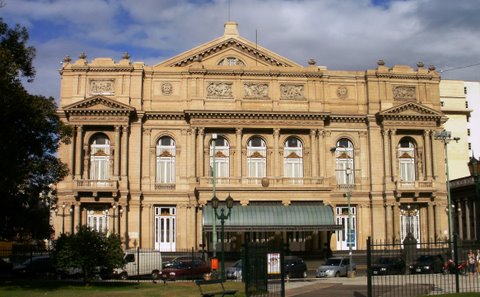
Early morning, I was woken by a phone call from the bank to advise new bank cards could be delivered, but it would take seven working days. Again, it was a day spent wandering around the city including a stroll to Puerto Madero (a waterfront area with a bunch of modern skyscrapers), and then south to San Telmo district with its narrow cobblestoned streets, old buildings and antique markets. We continued to La Boca district with its colourful houses and home of Boca Juniors football team. Eventually, taking the bus back to the city centre where I scanned shops for a new camera.
22-25 February - Buenos Aires
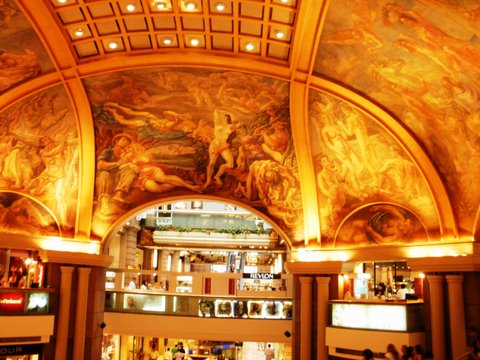
As
shopping malls go, I thought Galerias Pacifico, with its vaulted
ceilings and painted dome, to be one of the most stunning
shopping malls in the world.
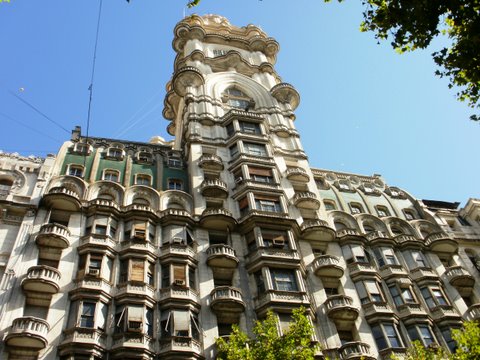
I further located Palacio Barolo, a magnificent building with a crazy story. Apparently, Luis Barolo, a European immigrant, arrived in Argentina in 1890. At that time, it was believed wars in Europe would destroy Europe. Luis was determined to save a part of it and built Palacio Barolo. I understood from a brochure it was inspired by the Italian poet, Dante’s Divine Comedy.
Even more bizarre was the fabulous Palacio de Aguas Corrientes (literally ‘The Palace of Running Water’) which was built in the late 1800s. The building was covered in (I was told) 300,000 glazed, multi-coloured terracotta tiles and was constructed as a water pumping station.
Counting my last pennies and had enough to take the train to
Tigre, a popular day excursion from Buenos Aires. Situated only
35 kilometres north of the capital on the Parana Delta,
third-largest river delta in the world. The day was spent
wandering
Still, there were loads to see and do in Buenos Aires and we visited the Recoleta Cemetorio. Quite a fantastic cemetery with loads of statues and crypts, all of course for the rich and famous of their time. The most-visited grave was undoubtedly that of Evita, and one could hardly catch a glimpse of it due to the many tourists.
Food-wise, however, I was in seventh heaven (and that in a
meat-eating country).
Right next door to our hotel was the most amazing vegetarian
restaurant. Owned by Chinese, it served the most delicious food
I have
In the meantime, I was still scanning shops for a camera and got a few tips from my cousin, Ansie, and my friend, Kathy, in what to look for. I ordered new reading glasses – but could only collect those items once I got my sweaty paws on money.
The bank card was eventually delivered but still needed activation. Again, I contacted the bank, who could only phone back the following day. To our horror, we discovered the guest in the room next door had passed away and police were in and out the entire day. I didn’t ask any questions but felt they could at least have closed the door or covered the body.
26 February - Buenos Aires The bank phoned back in the early hours of the morning to inform the card had been unlocked. There was hardly time for breakfast as I was keen to pick up my new reading glasses. Then it was straight to the ferry ticket office for the following day’s ticket to Uruguay, after which I visited the camera shops but none of the latest models was available and, in the end, I settled for a Lumix.
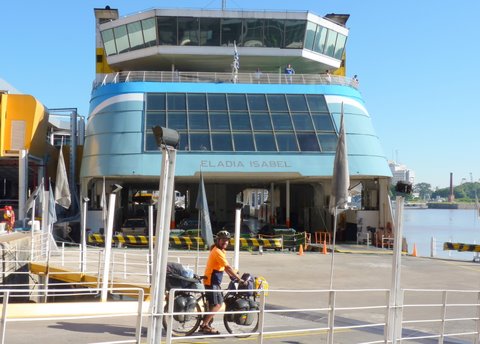
27 February - Buenos Aires, Argentina – Colonia, Uruguay - By ferry
Keen to get going, I was up amazingly early to start packing and
get the bikes out
of the storeroom where they were resting for 12 days.
The slow boat took three hours, and it was smooth sailing across the vast Rio de la Plata estuary, arriving in Uruguay in the heat of the day. Colonia, our first stop in Uruguay dated back to 1680 and was a UNESCO World Heritage Site.
A few hours were spent exploring the old town, a cobblestoned road lead through the old city gate, and onto the old part of town and down to the old harbour. Eventually, we headed for the local campsite where camping fees were shocking and the quality of the facilities dismal. There and then, a decision was made to wild camp from then on. |