|
Around the world by bike
|


|
28 November – Padang Basar, Thailand – Alor Setar, Malaysia – 87 km Malaysia must have had one of the easiest border crossings in the entire world. After being stamped out of Thailand, a short ride took me to the Malaysian immigration where one was stamped in. Still, it was after 9.30 before heading south.
With a population density of 97 people per square kilometre, Malaysia
wasn’t as
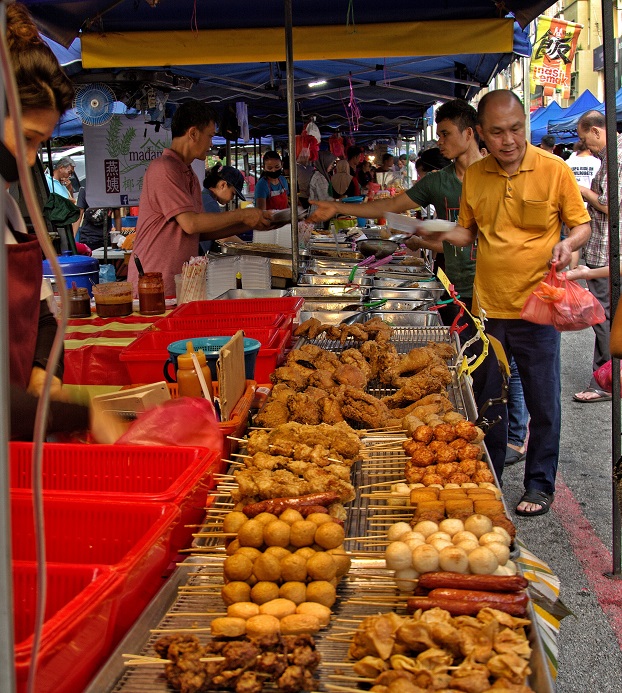
Malaysia is a multicultural and multiconfessional country, whose official religion is Islam. About 60% of the population practices Islam, 20% Buddhism, 10% Christianity, 6.5% Hinduism and 3.5% traditional Chinese religions. Therefore, the food was equally multicultural and included Chinese, Indian and Malay - a food paradise, if you ask me. The most common was Mee Goreng, consisting of yellow noodles, with added chicken, beef or soy sauce, veggies and egg. The only thing still required was to learn the word “vegetarian”. Then there was the very popular Nasi Lemak, Malaysia’s unofficial national dish. The basis of Nasi Lemak is rice cooked in coconut milk. It wasn’t always the same, but mostly served with a boiled egg, peanuts, vegetables, your choice of meat or fish, and sambal. My favourite was still roti canai, an Indian flatbread served with a scoop of chickpea curry, or curry laksa, a spicy noodle soup.
Oil-rich Malaysia’s currency (Malaysian ringgit) was somewhat stronger than the Thai baht (app. $1 = 4 Malaysian ringgit compared to $1 = 30 Thai baht) and one had to fork out a bit more for accommodation.
My first bowl of Mee Goreng was at a roadside stall after which it was on to Alor Setar. Alor Setar had plenty of budget accommodation, and I was literally “home and dry” before 15h00. A walk revealed I was in the Chinese part of town as there were plenty of Chinese restaurants, something I didn’t complain about. The food was delicious and washed down with a Tiger beer.
29 November - Alor Setar – Georgetown, Penang – 95 km
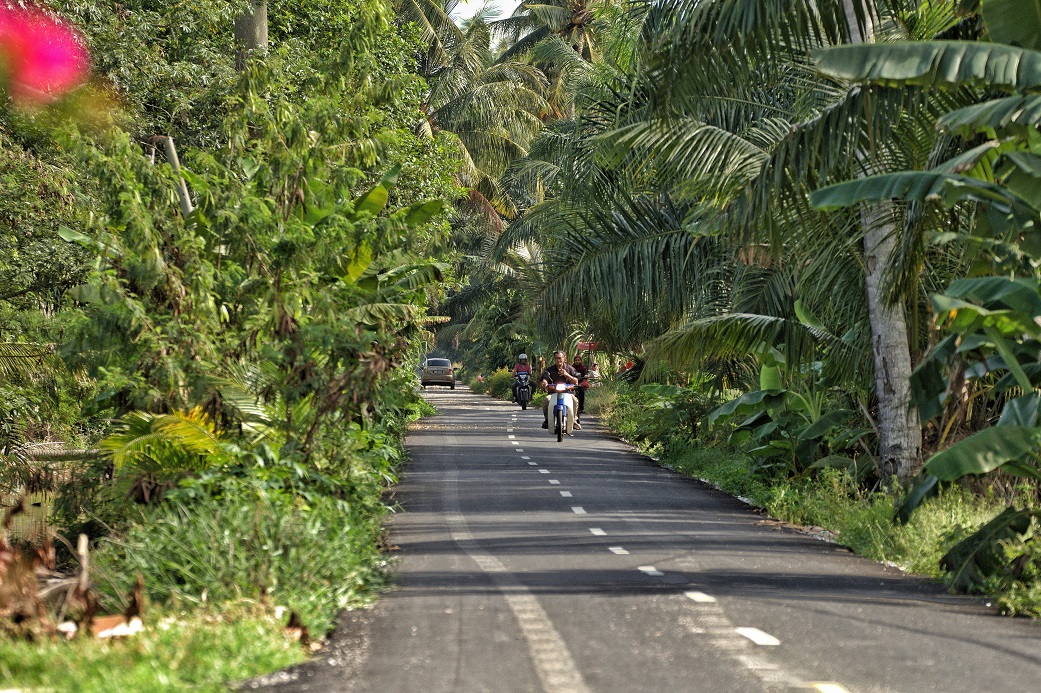
I wasn’t in the mood for traffic and headed straight for the backroads.
Soon, my route twisted and turned through rice fields and small hamlets
where ever-friendly
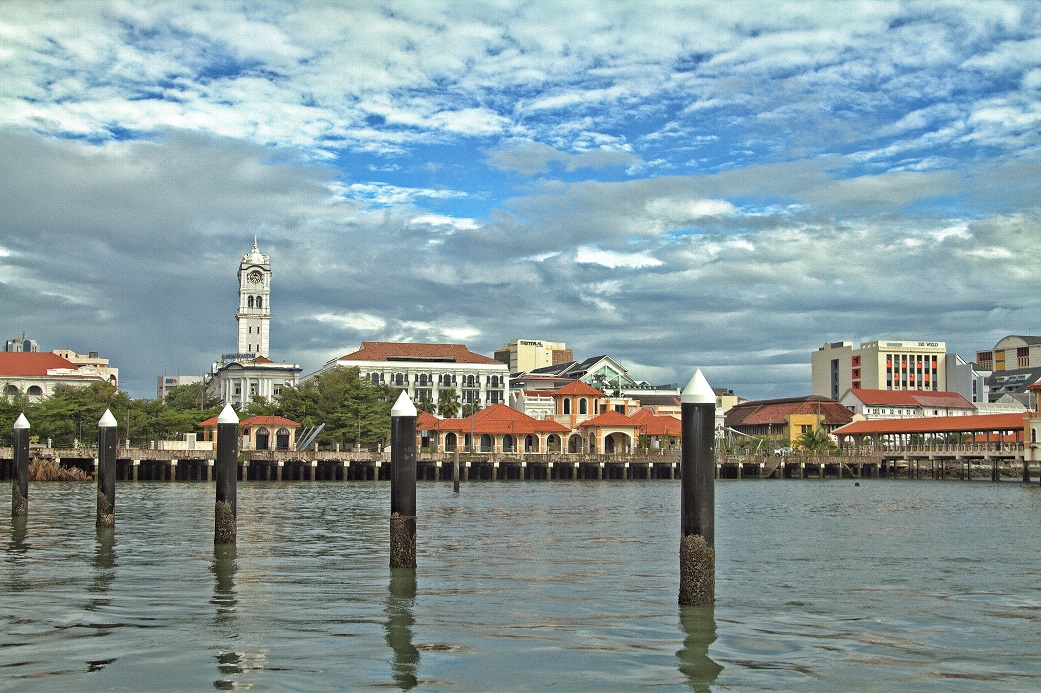
On reaching the large Merbok River, I was pleased to find a ferry operating across to Pantai Merdeka, saving me a long ride back to the main road. In Butterworth, the road led straight to the ferry terminal and onto Penang Island situated in the Strait of Malacca. It’s, in fact, this strategic location that made Penang what it’s today.
Many moons ago, the Strait was an important trade route between Europe, the Middle East, India and China. With the Strait of Malacca located exactly on the crossing of the two monsoon seasons, ships couldn’t set sail until the winds were favourable. While waiting for the winds to change, sailors left behind their unique cultures and today the streets are still lined with delicacies from China, India and the Middle East. No time was wasted in ordering, not only samosas but also falafel, again washed down with a tall Tiger beer.
30 November 2019 - Georgetown I woke to a drizzly morning and paid for another night.
Although Georgetown isn’t what it used to be hundreds of years ago, it’s
still a
One of the most interesting places, at least to me, was the clan jetties, dating back to 1882. In those years, the jetties were dominated by clans and homes were constructed along the wooden walkways. Nothing much has changed and to this day clans reside here.
2 December – Georgetown – Taiping – 110 km
After two full days in Georgetown, it was time to pack up and cycle to
the ferry port. Although the map indicated a cycle route, I had other
ideas and followed my
Clouds gathered, and it became clear I wasn’t going to make it to Taiping without getting soaked. Ten kilometres before Taiping, the heavens did indeed open up, and it poured as it could only do in the tropics. It wasn’t long before all was over, and a few kilometres further, the road was bone dry.
The old stalwart, Peking Hotel, was renovated and not as inexpensive as it used to be. Fortunately, I located Sojourn Beds & Café where a bed was only 35MR, and I the only one in the guesthouse. Conveniently located across the road from the night market made it even more perfect.
3 December – Taiping - Lamut – 100 km
The route was surprisingly scenic and along a perfect road past mostly oil-palm plantations. Indonesia and Malaysia are the largest producers of palm oil, and it’s, therefore, no surprise to cycle past large farms. Interestingly enough, it’s a tropical oil and only grows within 10 degrees north and south of the equator.
Eventually, I had to make a call and headed to Lamut, or rather Sitiawan, as it had heaps of accommodation and food.
4 December – Sitiawan – Kuala Selangor – 145 km
I don’t know what got into me, but I was on the road early and hardly
ever stopped.
Following the main road became quite impossible - not only was it busy, but it seemed the entire road was being widened. I stayed on the country lanes and thoroughly enjoyed myself. The path zigzagged through oil-palm plantations, sometimes on paved roads and sometimes on dirt roads. A ferry ride across the Bernam River made a fun way to get to the opposite side.
The weather was good, and as it didn’t look like rain, I made good use of the favourable conditions and only called it a day on reaching Kuala Selangor. The Melawati Hotel was home that night, and the room was easily the smallest I’ve ever stayed in. The room was so small the single bed only just fitted, not even leaving enough space for a bedside table!
5 November Kuala Selangor – Puchong – 88 km
My late start was partly due to my windowless room and partly to the
long distance and late night the previous day. It wasn’t the most scenic
of cycles as I was heading into Kuala Lumper, Malaysia’s capital
(commonly known as KL), and a city with an urban conglomerate of
7,700,000! It’s an ever-growing area and roadworks part of life but
something which didn’t make good cycle touring. However, I made it to my
hotel in good time and later met up with my friend Peter and his wife,
Alice. We
The next two days were spent packing my bicycle and panniers as from KL I planned on flying to my beloved India. Peter kindly got me a bicycle box beforehand and, with his help, the bicycle was soon in the box. My laundry was done, and a few beers were consumed (which was already chilled even before my arrival). It’s the kind of stuff one can never thank someone enough for.
Booking a budget flight meant my flight was at an ungodly hour, but Peter still drove me to the airport. Afterwards, I swore I’ll never book a budget airline again, no matter how tempting the price might be. The luggage fee was so astronomical I could’ve flown with a far more comfortable airline for the same price. |
 jabbered on forever as I haven’t seen them for a while.