|
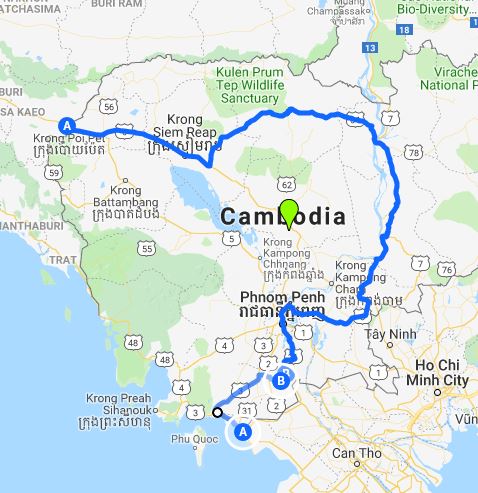
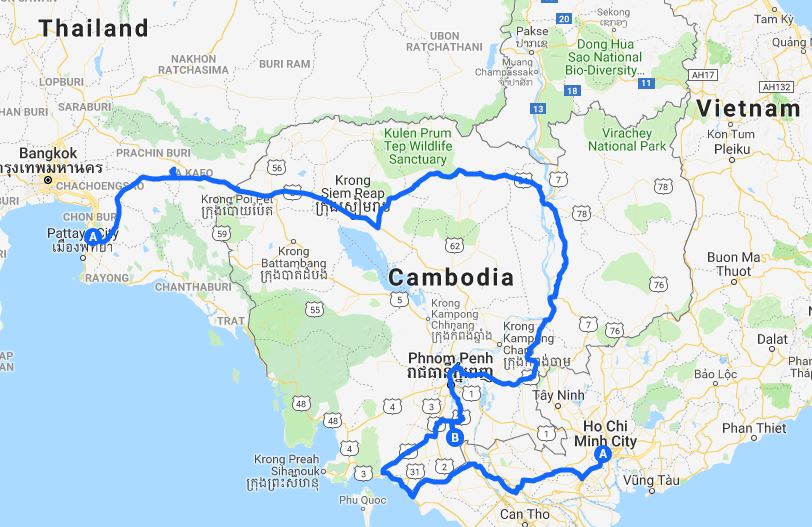
Thailand (379km - 7days)
2 August 2018 - Jomtien
Caron arrived after a very long flight from Cape
Town via Singapore. We almost immediately took a
walk to the beach to get the blood
3 August – Jomtien There was no rest for the wicked, and early morning we were up and off to the beach to watch the fishermen bring in their catch for the day. The women not only had the job of selling the catch but also preparing it right there on the beach, just in case you liked your crab or fish already cooked. Caron was somewhat shocked at what was brought ashore, and I had to agree that seahorses are not something I want to see for sale. We had a swim in the ocean and ate our noodle soup on the beach.
Then it was back home to take Caron’s bicycle out of
the box and to put it back together, a job that went
surprisingly smooth. We cycled
Lunch consisted of a typical Thai red curry (for me) as well as spicy minced fish cooked in banana leaves. Caron opted for a delicious home-made fruit salad consisting of rambutan, mango, mangosteen, passion fruit and banana, one can’t easily beat that! “Arroy mak mak,” as they say in Thailand.
As one cannot sit around doing nothing all day, we took a walk to the money changers and the night market where we not only shopped but also had a smoothie. Back at our abode, we swam the required lengths in the pool, hahaha. Then it was time for crisps and beer.
4 August - Jomtien – 60 km
It
was our last day of “rest and acclimatisation”, not
that there was much rest as
we
have decided to go the “no itinerary” route and
will,
Then it was off into the countryside for a test
ride. We cycled past large cassava plantations while
sharing the road with broom and feather duster
salesmen until we reached the tiny village of Ban
Chak Ngaeo. Ban Chak Ngaeo is a community of Thai
Chinese who still maintain their traditional
lifestyle. The amazing thing is that there are two
cinemas in this tiny settlement. We bought
pineapples at the market already cut up and served
with sugar and chilli. The road was lined by wooden,
traditional Chinese shophouses complete with shops
on the ground floor and living quarters with
balconies above. We also popped into the Hui Wei
Sheng Niang temple. Hui Wei Sheng is a
Hainan goddess that is
Legend has it that a fisherman named Pan, while
fishing out at sea, caught a block of wood which he
threw back into the ocean. The next day he, however,
caught it again. This repeatedly happened for a few
days and Pan decided to take the block of wood back
to his home. He felt that the block of wood had
magical power and thus prayed to it, asking to be
blessed with a great catch the following day. He
promised that he would build a temple to enshrine
the wood if his prayers were to be granted. Pan's
prayer was actually granted and he came back from
his fishing trip with a huge catch. However, Pan did
not have enough money to build a temple, and left
the wood outside his house by the pig sty and forgot
all about the promise he made. The next day, his
pigs became ill and his neighbours saw a woman
sitting on the branch of the longan tree near his
house. It made him remember his promise to the block
of wood. He informed his neighbours of the incident,
and they all raised funds for the construction of
the temple and prayed to ask where they should build
the new
It was a lovely temple and the family looking after it showed us how to ask for protection while cycling. We lit a few incense sticks and banged the gong three times to alert the goddess of our request. We took a few pics of the family and were on our way. What a pleasant experience it was.
We cycled out of the village in the direction of the enormous Wat Yansangwararam temple complex. The complex is set in a vast park, housing several buildings of very different architectural styles, as well as well-kept gardens and a large lake, making for a peaceful setting. We walked up a steep staircase flanked by a Naga balustrade to Wat Phra Phutthabat, the “temple of the Buddha’s footprint” that houses a footprint of the Buddha, discovered in Thailand in the 17th century. As always, there is a legend here as well but I’ll let it go this time as the story is getting somewhat long-winded.
Then it was on to our last stop. Up a small hill, we found Khao Chi Chan, a 109-metre tall carving of a seated Buddha on the side of a mountain. It made for a rather impressive sight. With a tailwind, we flew the last 20 kilometres back to Jomtien where we had a swim in the ocean after which we had a much-needed meal consisting of a delicious Thai curry and a Chang beer.
5 August - Jomtien - Nong Yai temple – 79 km
Woo-hoo, we were on our way and I, for one, was more
than happy to be on the road again. Dressed in my
super luminous pink top (a
Still chewing on the cotton candy, we stopped at the
pineapple depo to watch workers load huge heaps of
pineapples onto trucks and were promptly presented
with two large pineapples. We looked at each other
in disbelief as we had no idea where to pack this
very generous gift! Loaded with our massive
pineapples, we headed down the road laughing
The rest of the day was pure pleasure as we headed down a slightly undulated road past rubber tree plantation where the cups had already filled up with latex but still had to be harvested.
By the end of the day, we pulled into the tiny hamlet of Ban Nong Yai and found a typical small Thai village with wooden Chinese shophouses, a few roadside stalls, a restaurant and a temple. We asked the monks if would sleep at their temple and were pointed to a tiled undercover area. No doubt the monks are going to get a pineapple in the morning. Good thing Caron bought a sleeping mat as a tiled floor can be somewhat hard. We ate minced pork and rice with an egg on top at the local restaurant and was no doubt the topic of conversation!
6 August - Nong Yai Temple – Sronlai Homestay – 62 km
We
woke to the sounds of the temple gong, which not
only awoke the monks and us, but also the temple
dogs, geese, chickens and birds. With that
commotion, it was clearly time to wake up. We packed
up while listening to the chanting of the monks
No sooner had we departed and the heavens opened. We continued until we found a roadside stall where we could hide until the worse blew over. The lady from the stall was super-friendly and presented us with a bunch of litchis, and when we wanted to pay for the water we bought, she refused to accept our money. The rain soon cleared, and we were on our way again. As we had no breakfast, we were starting to feel somewhat nibblish and pulled into Bo Thong where we had a noodle soup at the market, to the great enjoyment of the curious locals.
It turned out quite an eventful day as, on leaving Bo Thong, I had a flat tyre which I fixed, but 500 metres down the road I discovered the problem, as a massive bulge appeared along the wall of the tyre and a huge bang indicated the end of both the tyre and the tube. It happened at a roadside stall, and the very helpful stall owner gave me a lift on her motorbike to the motorbike/bicycle store where I could purchase a new tyre and tube, albeit a very knobbly one. Beggars can’t be choosers and we were soon back on the road, new tyre humming on the road.
We
cycled past roadside stalls selling interesting
snacks as well as fruit and stopped to buy a
watermelon, and that after we were desperately
trying to get rid of the pineapples! We tied the
watermelon on the back of Caron’s bike, planning on
eating it
We encountered a few hills along the way, always with a shrine at the high point. These shrines always came with a multitude of red Fanta bottles and a few flower garlands. We sped down the hills where we took a few pics in the rubber tree plantation and then it was on to our overnight stop at the dam. It was a lovely setting where we could camp as well as rent canoes. We did exactly that which made for a delightful end to an already stunning day.
7 August - Sronlai Homestay – Khao Chakan - 93km
“We
have to eat this watermelon,” Caron said, as she had
no intention of carrying it another day.
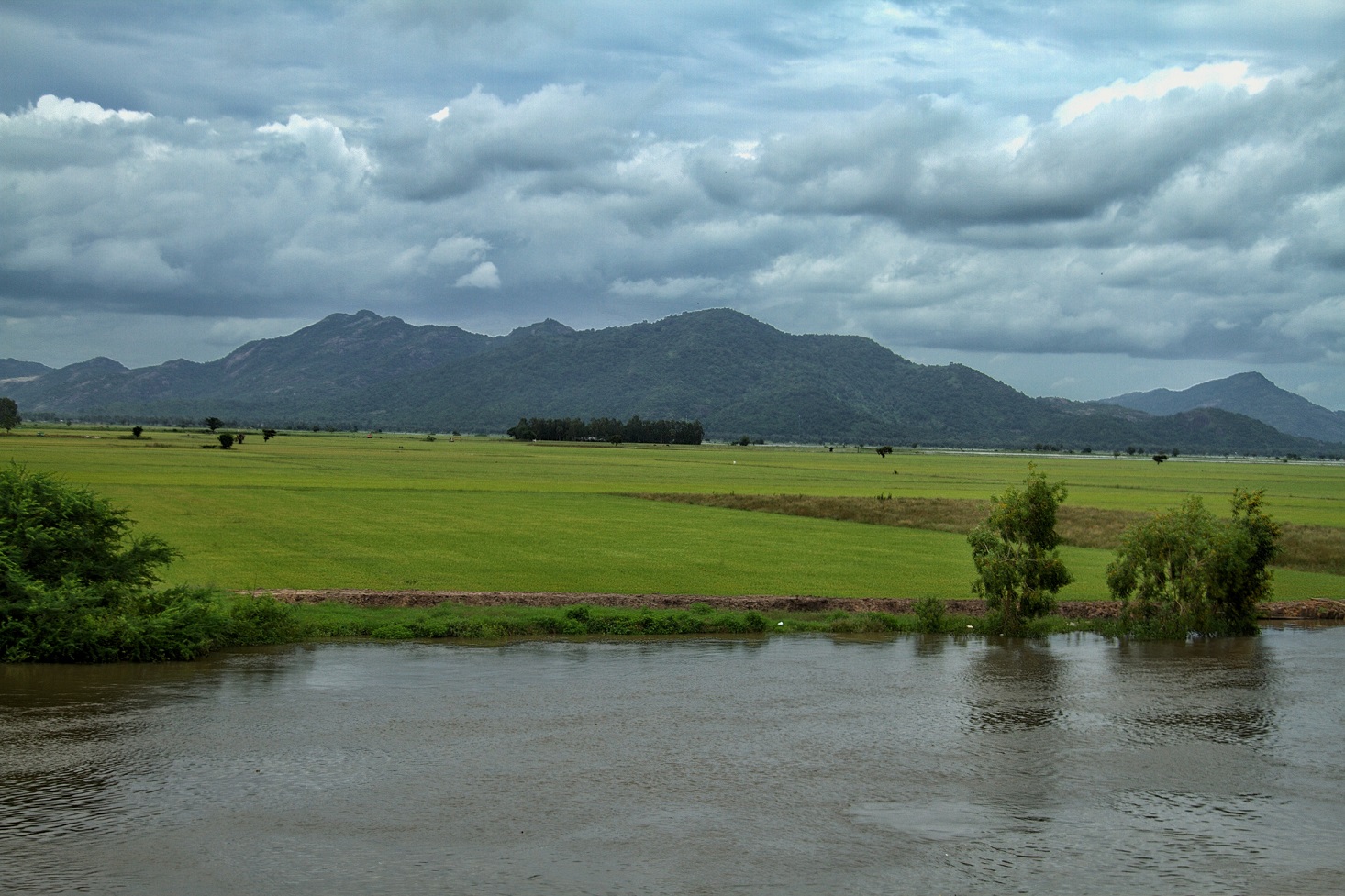
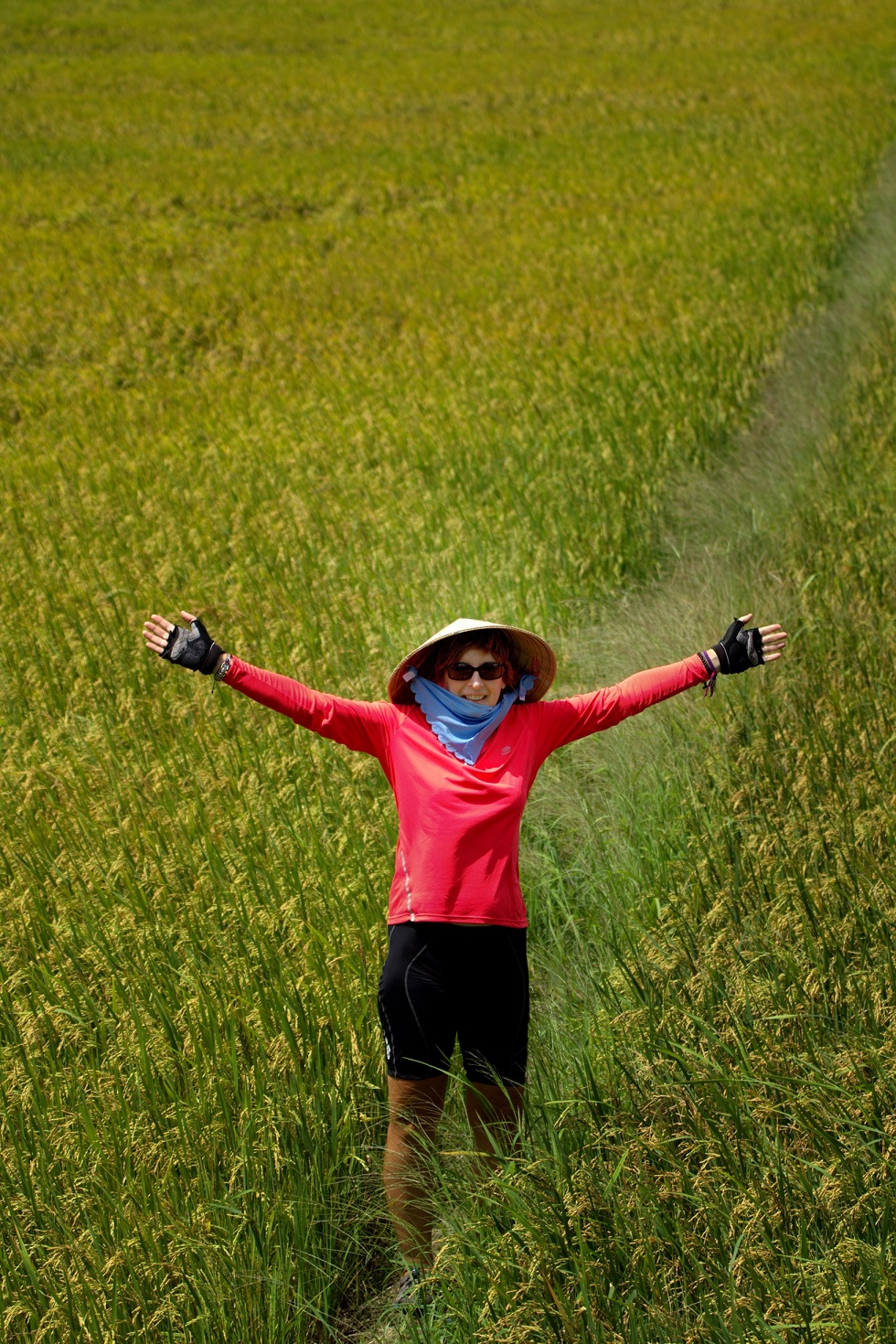
As always, the scenery was superb as we cycled past bright-green rice paddies and water buffalo waddling in the ponds left by the recent rain. After 50 kilometres, we stopped for our usual noodle soup lunch. Soon after leaving our lunch spot, it started raining and, as it was only a slight drizzle, we donned our rain gear and continued to our planned overnight stop.
8 August - Khao Chakan – Aranyaprathet – 85 km
We
left our colourful bus accommodation and headed in
the direction of Aranyaprathet where we planned on
crossing the border into Cambodia. It was an
extremely rural area as we cycled past old men
herding water buffalo and village dogs attempting to
give chase. At a small roadside stall, we stopped
for ice cream and, in the process, met just about
the entire community while little kids were
Our day was filled with beautiful flowers and sublime scenery as we attempted to locate old Khmer ruins. We followed a dirt road where we found Prasat Mueang Phai, said to have been an ancient city dating from the Dvaravati era (6-11th century). According to what I read, Mueang Phai was a walled city which measured 1 000 metres by 1 300 metres, and was surrounded by a 40-metre wide moat. Great was our surprise, therefore, to find only a small heap of bricks and earth! Our unsatisfactory discovery did, however, not put us off as we were determined to locate ruins. We headed for Prasat Khao Noi believed to have been built in the 12th century, stopping for our usual noodle soup lunch along the way. We located the site where we navigated 254 steps leading from the foot to the top of the small hill. We were in luck and on top we found the remains of three towners of which only the middle one was still intact. A lintel found on site dated back to 637 AD but was most likely re-used.
It was time to find a place to rest our weary legs, and we headed for the border town of Aranyaprathet. We handed in our laundry and then went in search of food of which there was no shortage. The central pond was surrounded by food stalls where we could sit and pick from any of many available dishes.
Desert was sankaya or Thai pumpkin custard, a Thai-style pumpkin pie in which lightly sweetened coconut milk and egg custard is steamed inside a pumpkin. It was delicious.
Ingredients 1 Kabocha squash (Japanese pumpkin)
10
cups of water for steaming 4-5 eggs 3/4 cups coconut milk 1/3 cup of coconut palm sugar pinch of salt pinch of cinnamon 1 tsp. vanilla extract
Preparation Cut out the pumpkin just like you would for Halloween. Cut out the top, remove all the seeds and the stringy insides.
In a mixing bowl, crack the eggs, add coconut milk, salt, cinnamon, vanilla and palm sugar. Stir well until the palm sugar is blended into the mixture.
Pour the mixture into the pumpkin.
Bring water to a boil in a steamer. Then place the pumpkin and the pumpkin lid inside the steamer basket. Don’t cover the pumpkin with the lid. Set the pumpkin lid in the steaming basket off to the side, so it cooks, too.
Cambodia (954km - 16days)
9 August Aranyaprathet – Roadside Guest house – 83 km
First thing in the morning, we headed for the
border, and with a quick stamp in the passport, we
left well-organised Thailand and entered a somewhat
more chaotic Cambodia. By the time we got to the
border, the border
We weaved our way through the dusty bumper-to-bumper traffic, dodging barefoot monks and muddy puddles to the Cambodian emigration, where we purchased a Cambodian visa for the specified $30 as per the embassy website; but the price was $30 plus 100 Thai baht. (The Thai baht, I assumed, was for their own pockets.) We counted eight staff all playing on their mobile phones.
At
last, we were on our way. We cycled along a good but
busy and dusty road, on which we encountered
numerous interesting roadside stalls. We made a
quick stop at a roadside restaurant where we bought
rice cooked in bamboo. The sticky rice is mixed with
sugar, sweet red beans and coconut milk, and then
stuffed into cylinders of hollow bamboo. The
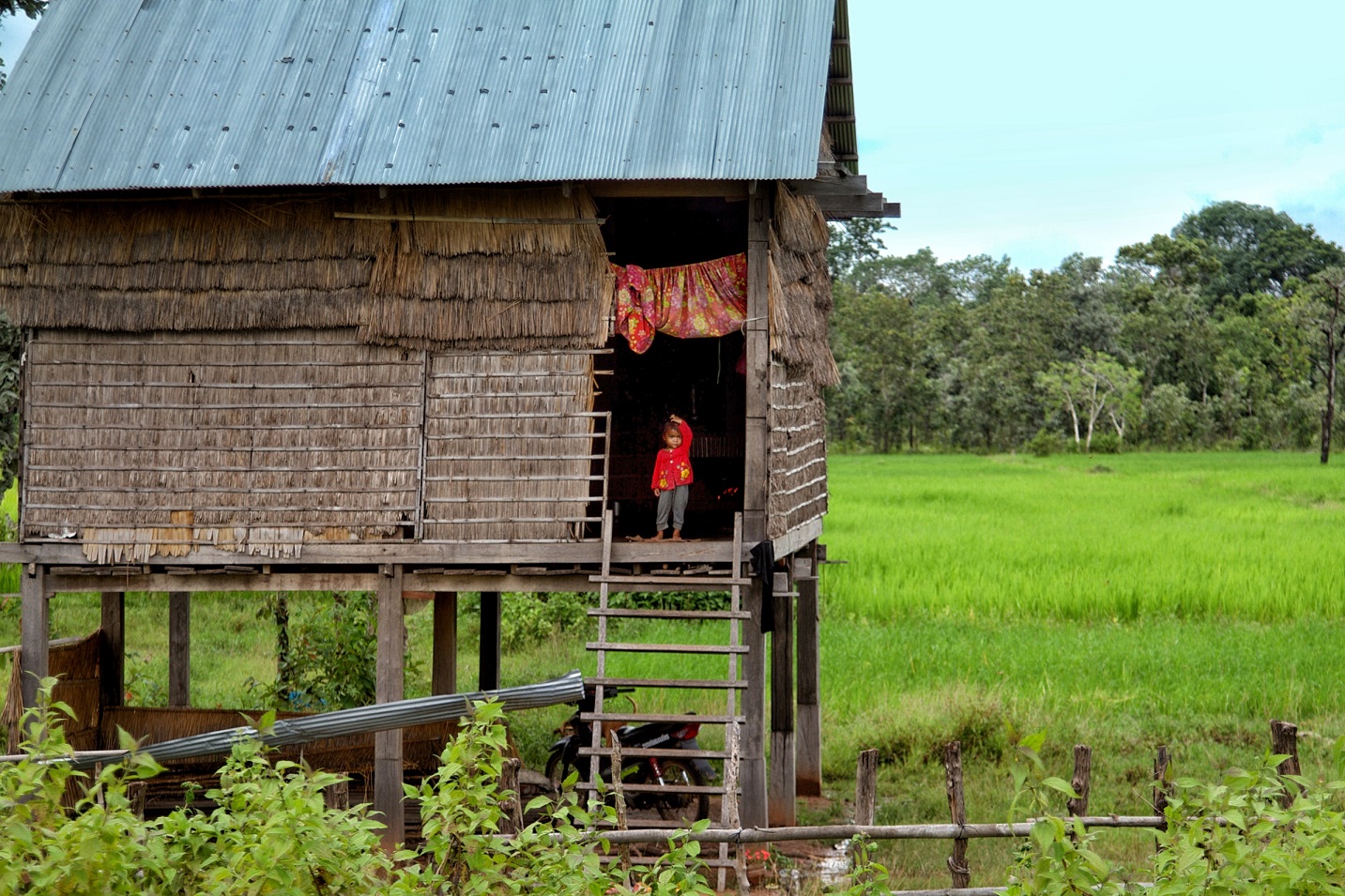
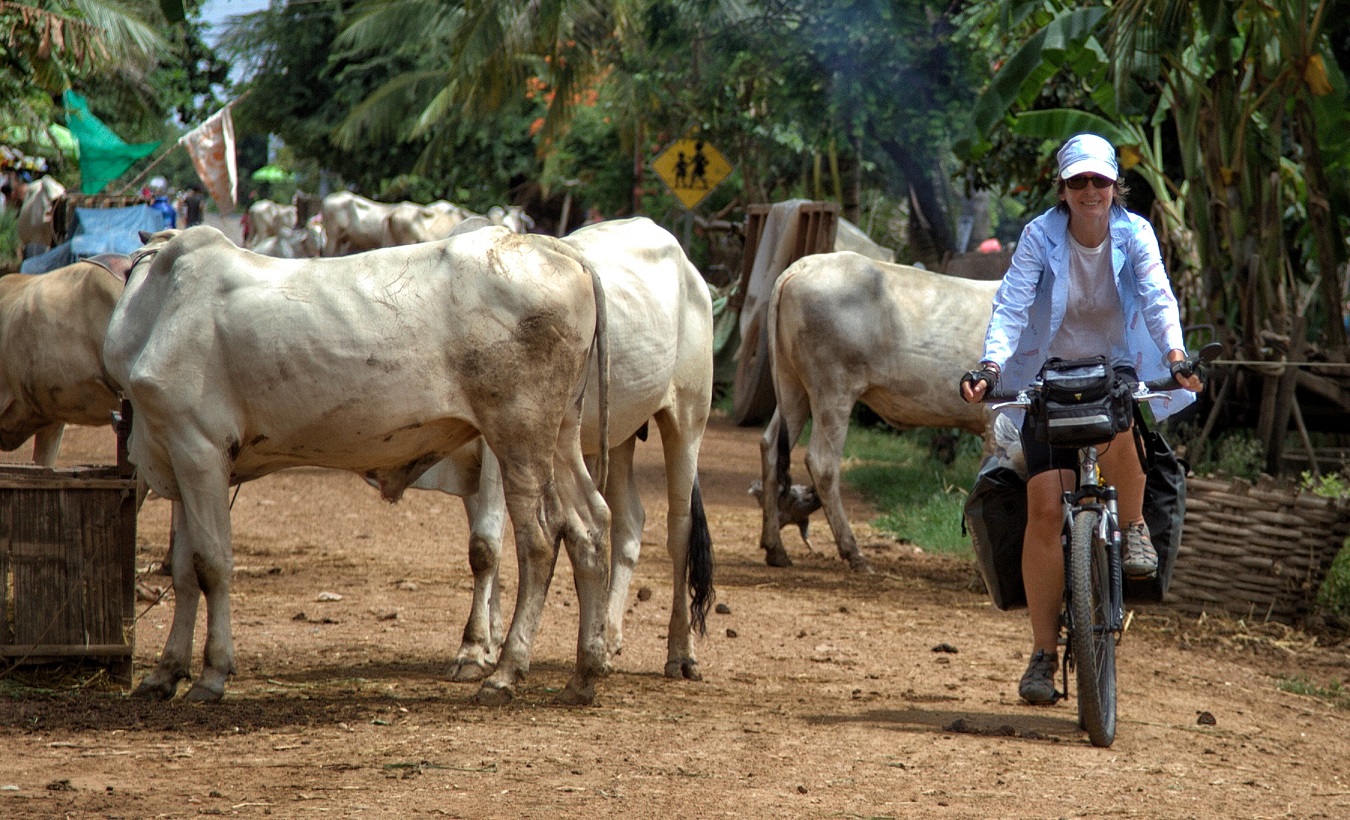
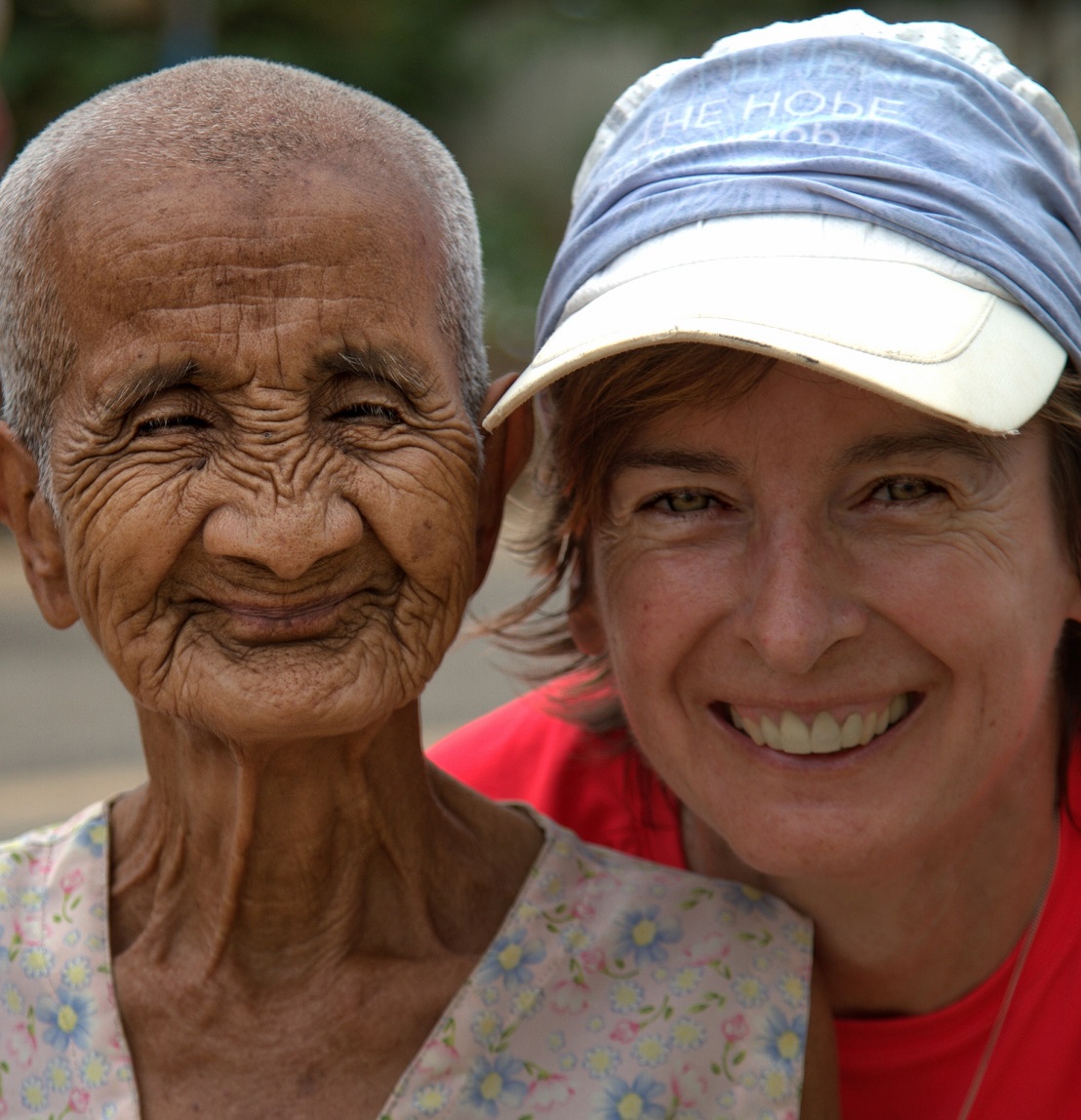
We made our way past bright green rice fields, wooden houses on stilts and friendly kids, stopping for coconut juice along the way. In the process, we met super-friendly rural Cambodians. Wrinkly old ladies gave us big toothless grins, and small kids shyly looked from behind their mother’s aprons at the two “farangs” (foreigners) in their midst. We ambled along, marvelling at our new country, as we passed men herding cattle and basic wooden houses where families were swinging in hammocks under their homes.
Eventually, we saw a sign for a guest house and turned off to explore. We were surprised to find a building offering ground floor rooms at $7, which we were more than happy to pay. We were, no doubt, the centre of attraction as we took a walk down the road to find food, and although no English was spoken, we managed to find what we were looking for, making for a lovely end to our day.
10 & 11 August - Roadside Guesthouse – Siem Reap – 85 km
We
sat outside our rooms chatting while I drank my
coffee and enjoyed the fresh, early morning air
before setting off down the road. We shared the road
with broom and feather duster salesmen. Ornate
temples jutted out of the forest and lent colour to
the rice fields that stretched as far as the eye
could see. We passed what we called the “nursery
carts” as they were loaded with plants and flowers,
Our noodle soup stop came, as usual, with a fair amount of interest from the locals and the bringing of children to be photographed. I had a feeling that the kids were not always that comfortable with their new role.
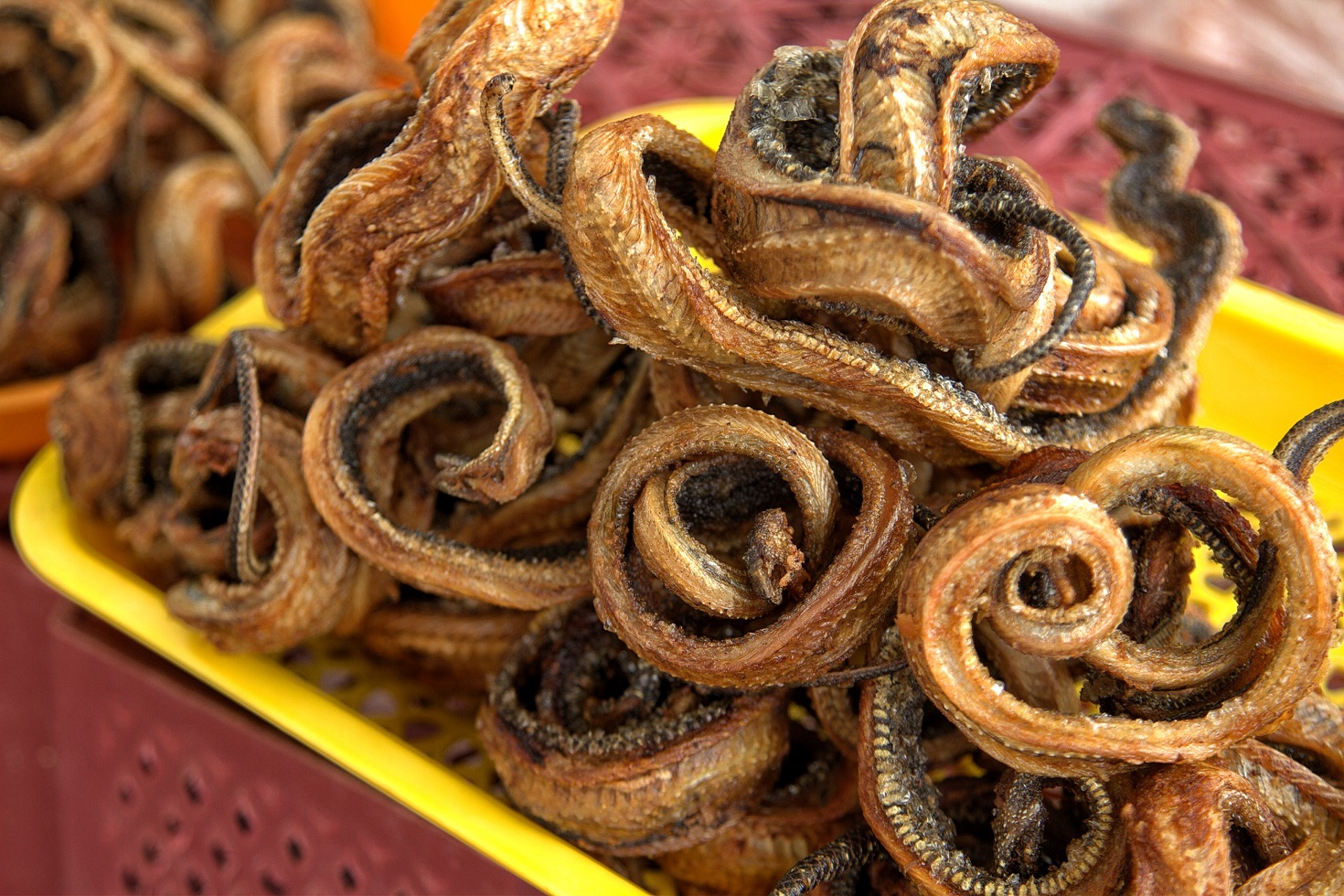
It was a marvellous day to be out on a bike. The weather was overcast, and we picked up a tailwind, making for easy cycling. Powered by the wind, we flew past water buffalo enjoying the muddy puddles left by the previous night's rain, and past roadside stalls selling cigarettes and petrol by the litre. We also encountered a rather interesting market selling deep fried snakes, frogs, and crickets. Caron could not face trying these delicacies, but I tried the snake that came with salt and lemon.
On reaching touristy Siem Reap, we were somewhat shocked at all the foreigners, fancy hotels, and upmarket eateries after being in the countryside for so long.
12 August - Siem Reap – Sroyorng Koh Ke Guesthouse – 116 km
On
cycling out of Siem Reap, I was surprised at the
amount of child labour we witnessed. It was Sunday,
and I hoped that they did go to school during the
week. As soon as we left touristy Seam Reap, the
road deteriorated and we bounced along through
potholes filled with
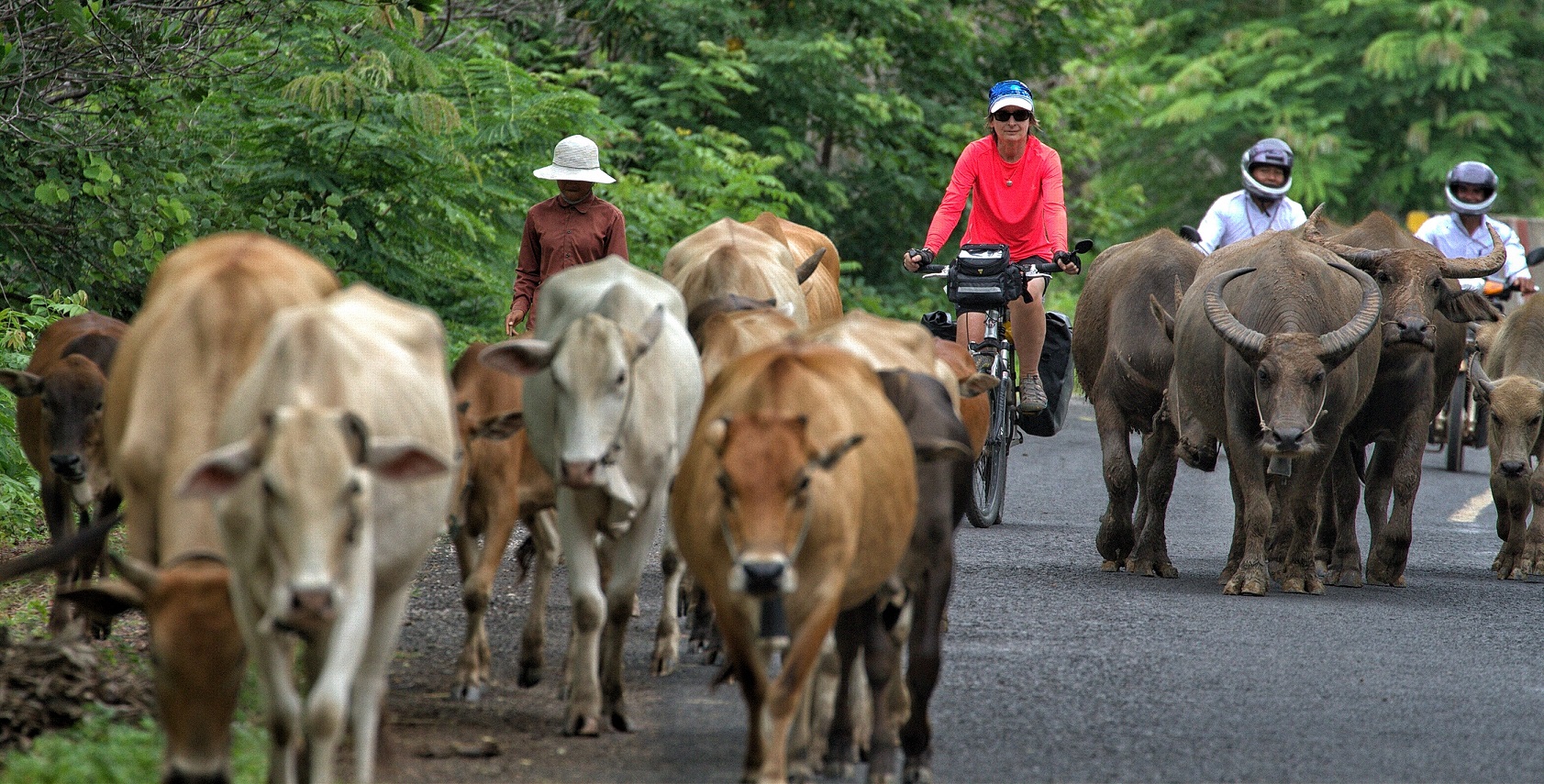
Instead of taking the highway, we opted for a much smaller path that we hoped would lead to the Mekong River. It was a fascinating ride along a dirt road and through the most rural of areas. It was an area where people farmed in primitive ways, lived in nipa huts, obtained water from wells and chewed paan. Wares were carted by ox-drawn carts, rice was milled in backyards and papadums made by the entire family. Corn was boiled at roadside stalls making it virtually impossible not to stop. We got caught by the rain no less than three times, each shower left us dripping wet with steam rising from our soaked bodies.
We passed kids playing in rivers and jumping off bridges and doing what kids do. Others were cutting rice in the paddies, and village dogs made it clear that we were in their territory. A pleasant day by anyone’s standards. Towards the end of the day, we were happy and somewhat lucky to find a guest house in a tiny village without a name.
13 August - Sroyorng Koh Ke Guesthouse – Chhaeb – 110 km
We
left our small overnight village together with child
monks collecting food. The road twisted and turned
through rural settlements where cattle and buffalo
had the right of way. Like the previous days, we
shared the road with two-wheel tractors pulling
wooden carts loaded
We passed motorbike salesmen loaded with piglets in bamboo cages or others with fish-trap baskets all destined for the local market. The most fascinating being a mobile separating rice milling machine (not sure what it is called). It went from house to house and separated the villager’s rice from the husk.
We
knew not many foreigners came this way as small kids
were fearful of us, hiding
After a quick shower, we headed for one of the roadside stalls and indicated that we wanted food. We were served chicken soup, consisting of a clear broth and chicken feet, rice and a pork dish that mostly included bones. Still feeling slightly hungry, we stopped at one of the other stalls to pick-up a noodle dish. While waiting Caron order a boiled egg that to her horror turned out to be “Balut” - a half-developing duck embryo! Needless to say, the dogs enjoyed it.
14 August - Chhaeb – Strung Treng – 86 km
Our
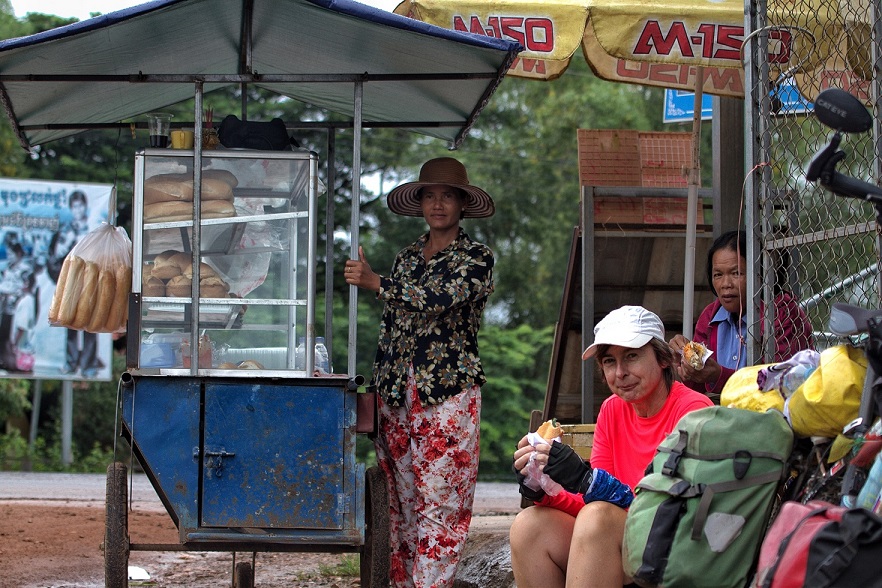
first stop was the baguette stand. Cambodia’s
traditional snack, the Nompang (baguette), is filled
with all kinds of strange things, including slices
of pork, meatloaf,
Then, it was on to our final stretch to the Mekong. Again, I have to stress that this is an extremely rural area where foreigners seldom venture. Although friendly, most of the children were very apprehensive of us. We cycled past wooden houses on stilts where friendly folk waved and shouted hello. Roadside stalls sold meagre supplies of petrol by the litre, as well as a few fruit and vegetables from the owner's garden. The most interesting was a collection of birds and other wildlife in cages as well as a baby monkey that seemed to have befriended a dog.
Each little hamlet appeared to have at least a
pharmacy, and some even had a small clinic,
consisting only of a few beds made with woven mats,
not that it was an unusual thing as most people in
southeast Asia sleep on woven rugs. Soon afterwards,
it started raining, and we
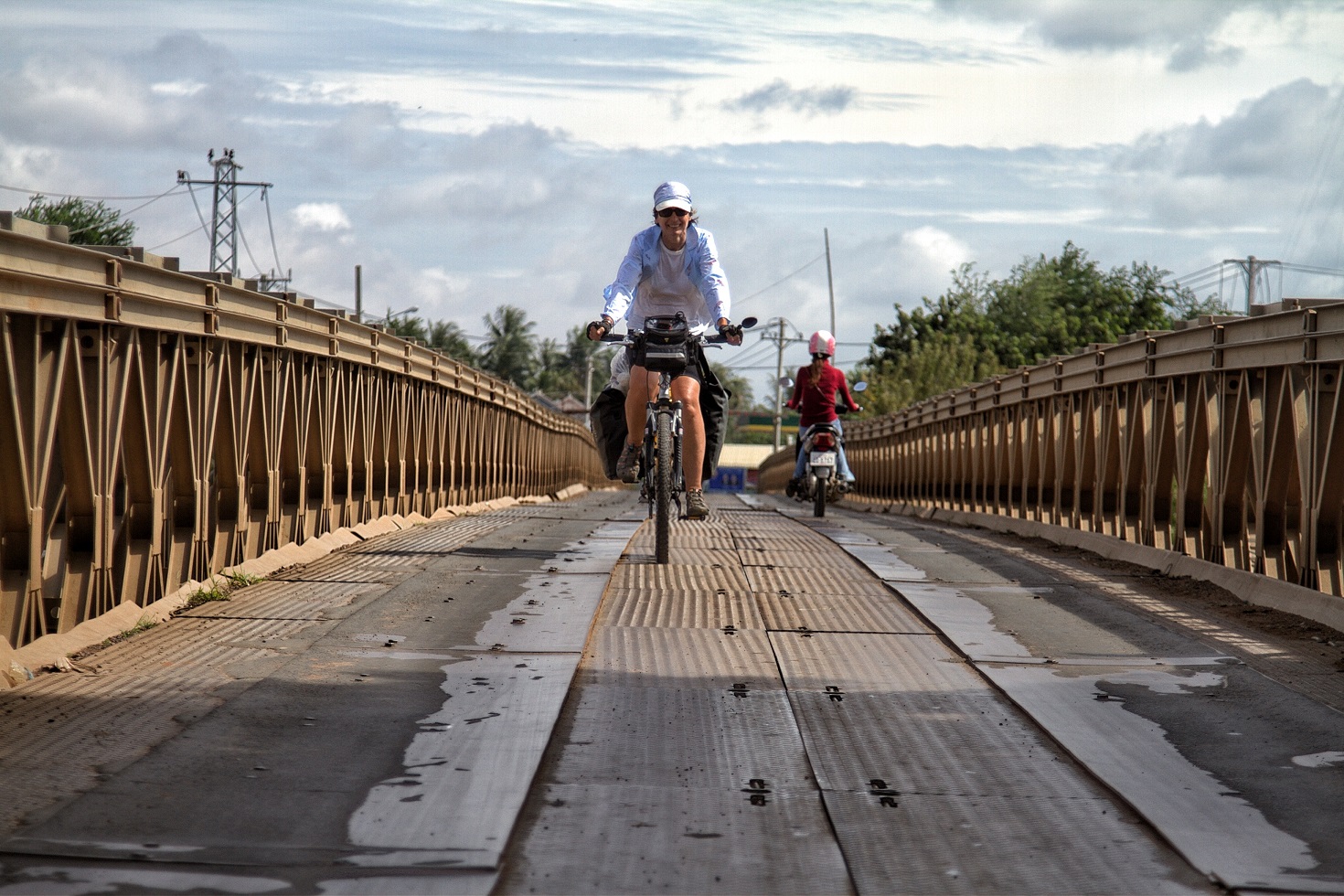
We crossed a multitude of broad rivers and watched the skilful fishermen through their nets with fascination. We passed the Mekong River via the large and modern Strung Treng Bridge. In town, we found a guest house right in the busy market area. After a shower, we walked out to the market looking for food but were rather unsuccessful and eventually settled for a fried noodle dish from the Chinese restaurant.
15 August – Strung Treng – Krati – 142 km
“Hou boude, hou,” Caron said when I told her that it
was 142 kilometres to Krati. As there was not much
in the line of accommodation or
Although it was a challenging day, it was still a
privilege and a pleasure to be out on the road. We
made our way south, past small settlements where
cattle, bare-bum kids and buffalo had the run of the
mill. We stopped for a lunch of fried rice at a
roadside stall,
Basic wooden houses on stilts, friendly Cambodians, and laundry flapping on fences became a familiar scene. We crossed large rivers and cycled past rice fields and forested areas as we made our way south, reaching Krati in a slight drizzle and fading light. Exhausted, and Caron with a somewhat sore behind, we found a room at the Heng Heng Hotel, situated right on the Mekong River, for only $8. No sooner were we in our room when a fierce storm came in, rattling windows and doors, and we could not believe our luck! Needless to say, we were starving, and after a shower, we were off to the nearby restaurant where they had an extensive range to choose from. It was an early night.
16 August – Krati
We
woke to the sounds of the street and a view of the
Mekong River. As we had plans of tracking down the
rare freshwater river dolphins, there was no rush to
go anywhere. A walk through the local market was as
interesting and informative as all markets, and it
gave us a
A somewhat bumpy tuk-tuk ride brought us to a place where we could locate a boatman to take us across a rather strong-flowing Mekong river to where we hoped to catch a glimpse of the river dolphins. The Irrawaddy dolphin is distinctive in that, unlike most species of dolphin which have a long nose and pointed features, the Irrawaddy species has a blunt nose and straight mouth, rounded tail and fins. It was an extraordinary sight to see them. They don’t jump like other dolphins, and we had to look closely to get a good look at them. With the threatening weather, we headed back to the safety of the shore and no sooner were we back at our digs, and the weather came in.
17 August - Krati – Police station – 83 km
Instead of taking the main road, we opted for the
river trail. A narrow, rural road ran
Pyjama-clad women sat in doorways nursing babies or
playing with toddlers while men on haunches fixed
fishing nests and bamboo chicken cages. The usual
roadside eateries also moved onto the road, which
was slightly elevated and that made for convenient
pickings. We meandered through the chaos until we
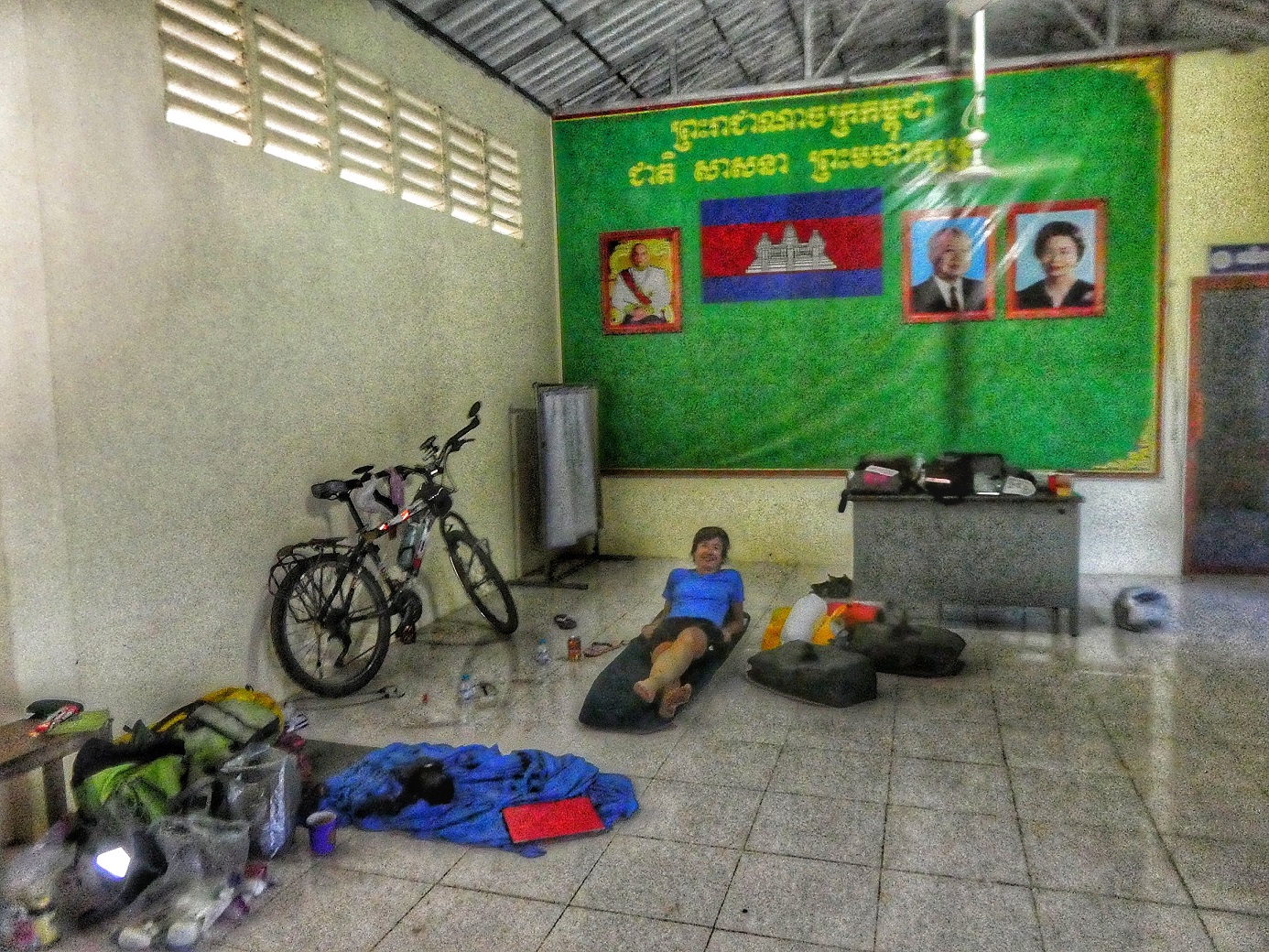
reached what we thought was a guesthouse. There
were, however, no such thing and we opted
18 August Police station – Kampong Cham – 48 km
We
were up early and Caron claimed that she slept with
one eye open. After another photo shoot, we cycled
out of the police station in
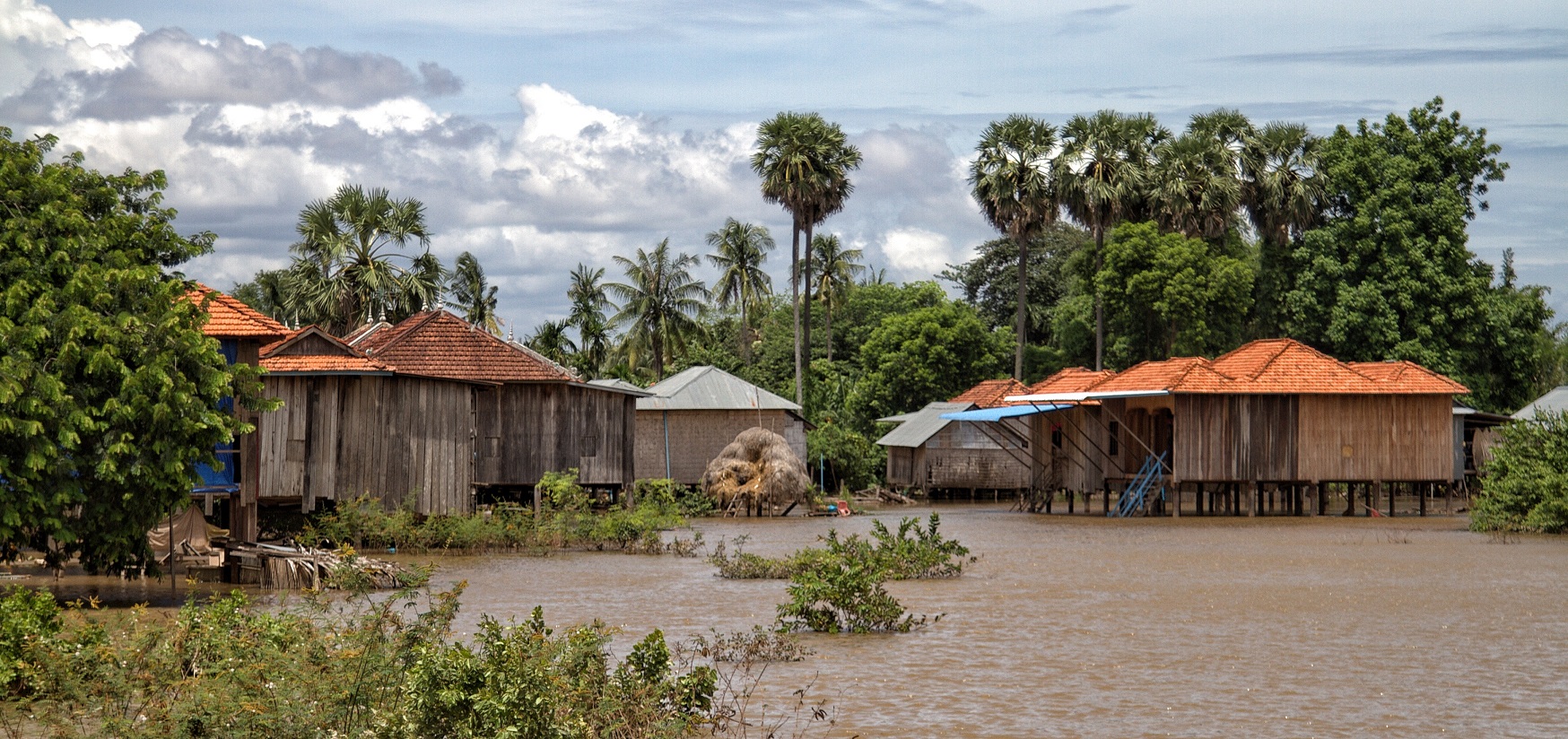
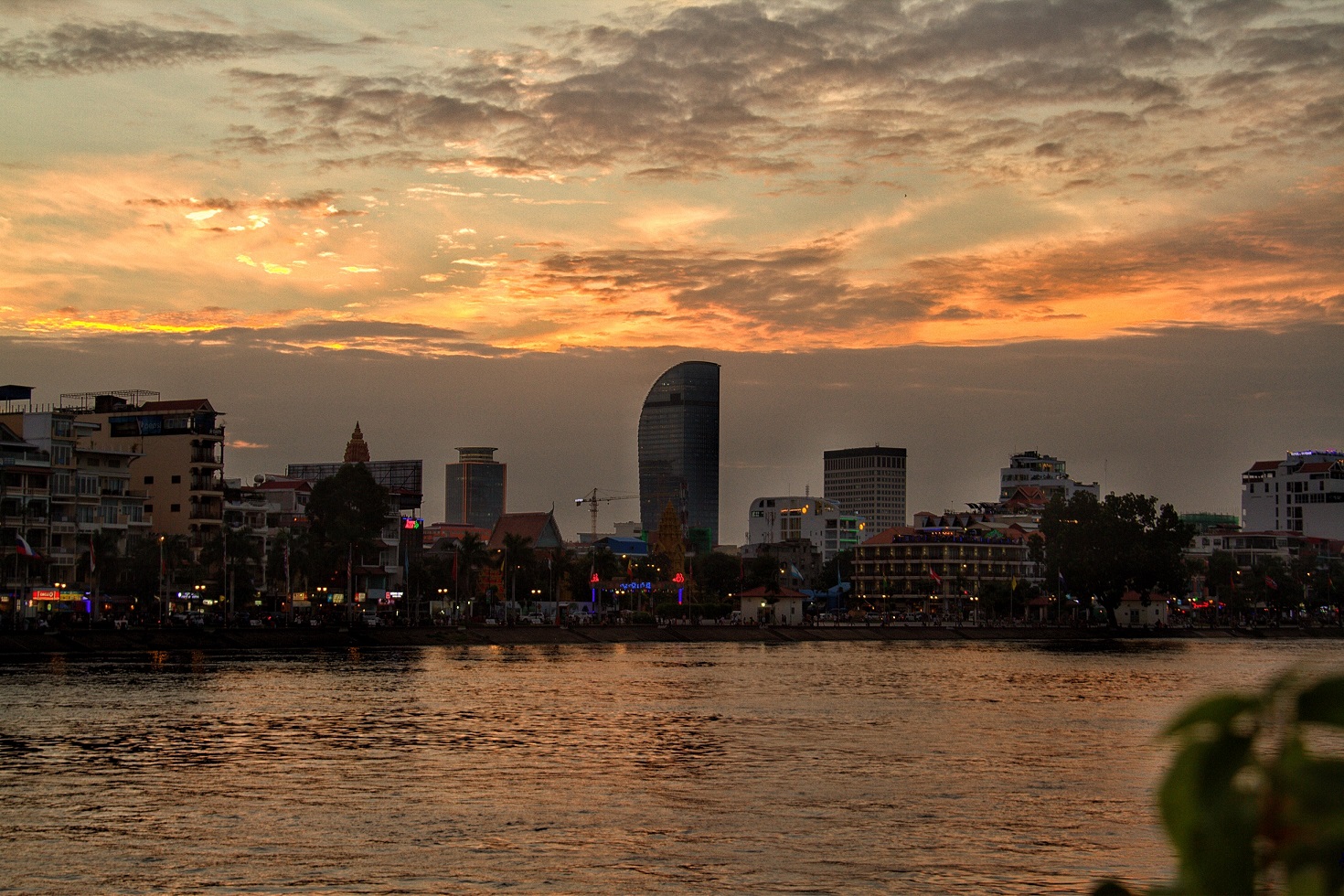
Like the previous day, we found the low-lying areas flooded, sometimes only the rooves of barns or houses were sticking out. Kids loved it and had a ball playing with anything that can float. The slightest of elevated areas were being used for the drying of corn, cooking food and keeping chickens and cattle. As the land used for grazing was flooded, feed had to be collected elsewhere and we passed ladies on bicycles loaded to the hilt with animal feed while men toiled the land with oxen. The river road remains one of my fave rides, and we slowly made our way to sleepy Kampong Cham where we found a lovely spacious room. That evening, we strolled along the riverfront together with the people from Kampong Cham, as this was where they hung out at sunset.
19 August – Kampong Cham –Phnom Penh – 110 km
From Kampong Cham, we were lucky to find a small
road running along the river. We marvelled at the
people living on barges and found it surprising just
how organised
We took a small dirt road which, due to the flooding, abruptly came to an end, forcing us to make a detour. A typical monsoon storm came in, and we pulled into the nearest sheltered area, being someone’s house. We were welcomed in and offered seats to wait out the weather.
20 & 21 August - Phnom Penh
Our
first priority was to obtain a Vietnamese visa.
After a cup of coffee, we hopped on a tuk-tuk to the
Vietnamese embassy only to find that they were
closed for the day. There was zero we could do about
it, and we returned to the guesthouse. Caron
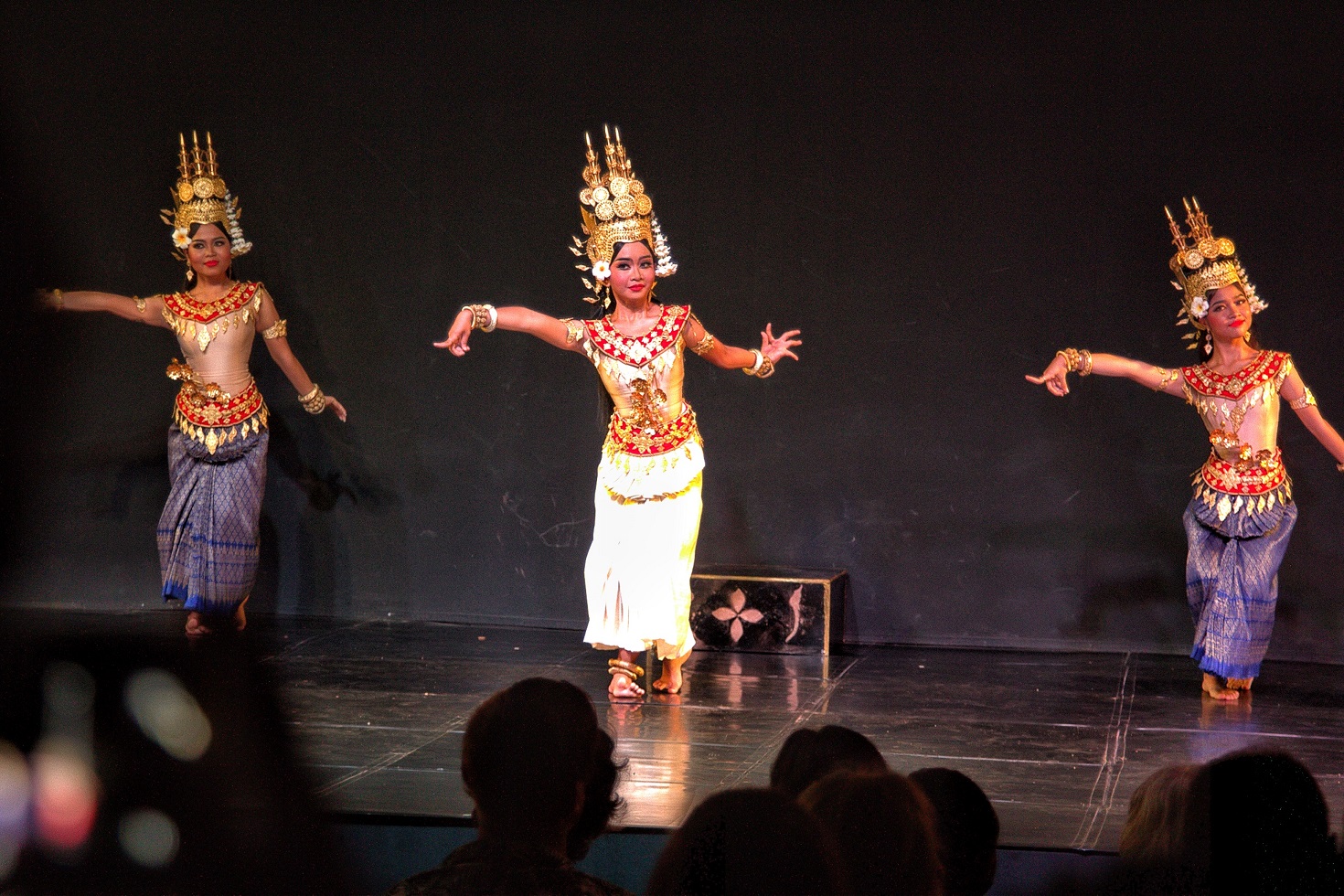
The following morning, we went in search of dumplings, which we found close to the market. Well fed, we felt strong enough to brave the busy market where we weaved through the stalls in search of nuts and other delicacies to concoct a snack for the road. We also bought tickets for that evening's traditional dance show that made for a lovely evening out.
22 August — Phnom Penh — Angkor Borei (Borey) — 91 km
We
managed to get out of busy Phnom Penh easier than
anticipated. We headed for Neak Loeung, but 20
kilometres outside the city, we changed our minds
and headed for Angkor Borei instead. It was a
stunning ride through a seldom visited and very
rural part of Cambodia. The road varied between
Although it was still the rainy season, some of their crops seemed ready for the market while others seemed to have been planted more recently. In the small village of Prey Lovea, we stopped for lunch, and then it was on to our final stretch to Angkor Borei. Although the area has been continuously inhabited for at least 2 500 years (yielding artefacts dating from the Neolithic period, Funan 4th/5th century AD), Chenla (8th century AD), and later, the Angkorian period (9th-15th century AD), there was no sign of past glory. We found a room at a guest house and then went out in search of food. That sounds easier than it turned out to be. Eventually, we managed to order fried noodles, but we would have been happy with just about anything that was dished up.
23 August - Angkor Borei - Kampot
We
planned on taking a boat to Takeo, a trip that would
save us from travelling a long distance on an awful
road around the lake. Since no one spoke any
English, we were not entirely sure that there was a
boat, and we did not know when it would depart. What
we could
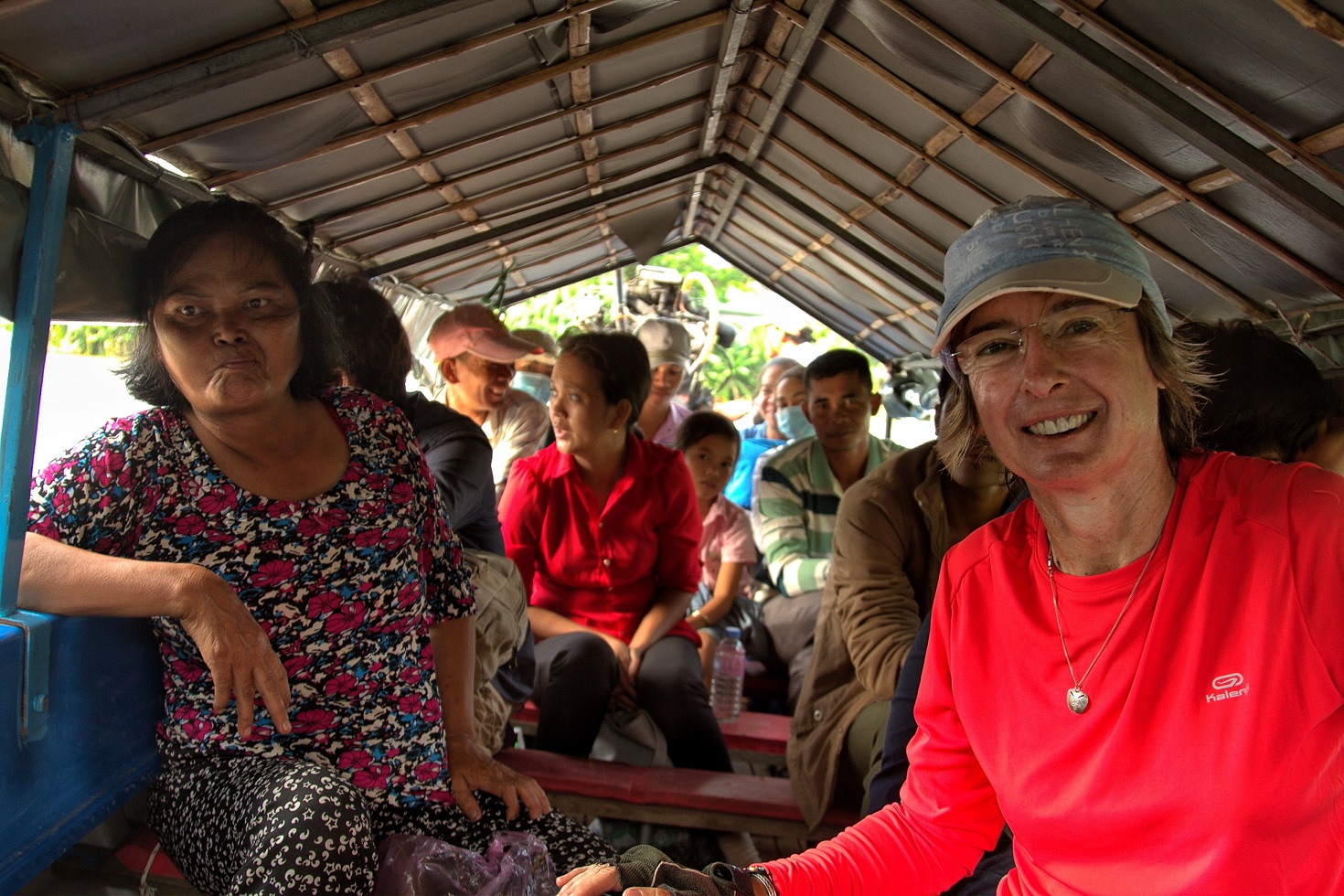
No sooner were we underway when the engine cut out, leaving us adrift for a while. Thankfully, we slowed down only to drop off another passenger, and we were on our way again. The skipper sped across the lake at a high speed, drenching two unsuspecting "farangs". We then understood why the locals filled the boat from the back! About an hour later, we arrived in Takeo, but we were soaking wet!
As my bike tyre had a slow leak, we stopped at a bicycle shop where I could buy a new inner tube. I had no spare tubes as I had neglected to fix the punctured ones. As it appeared that they did not have any in stock, I started fixing my old tube. The job was taken out of my hands by the owner as he must have thought I had no idea what I was doing. I did not resist, and he fixed my two punctured tubes. He wanted no payment for his work and also supplied me with a stack of patches. Before cycling out to Takeo, we stopped for pork pau and iced milk tea. We were served a glass of condensed milk over ice. We thought it strange but drank it anyhow. Afterwards, the owner showed that we were supposed to add the tea that was already on the table! By then, it was already late, and instead of taking the back roads, we headed to the main road that led to Kampot.
The
main road was not as busy as expected and had a good
shoulder for cycling that
Approximately 18 kilometres from Kampot, the road deteriorated to such an extent that we eventually cycled next to the road. The traffic snaked around the potholes as best it could. It was, however, a futile attempt as the road was one giant pothole. It was a dusty affair as we slowly made our way to Kampot.
We were thrilled to arrive in Kampot, and we headed across the river to the bungalows where the people laughed at our dirty, dusty faces, as when we removed our shades, we were left with two large white rings around our eyes. After a shower, it was time for a well-deserved beer and a huge plate of food!
24 August – Kampot
The
Kampot River Bungalows are an ideal place to enjoy a
day of leisure. They are in a jungle-like setting
and its nipa huts on stilts overlook
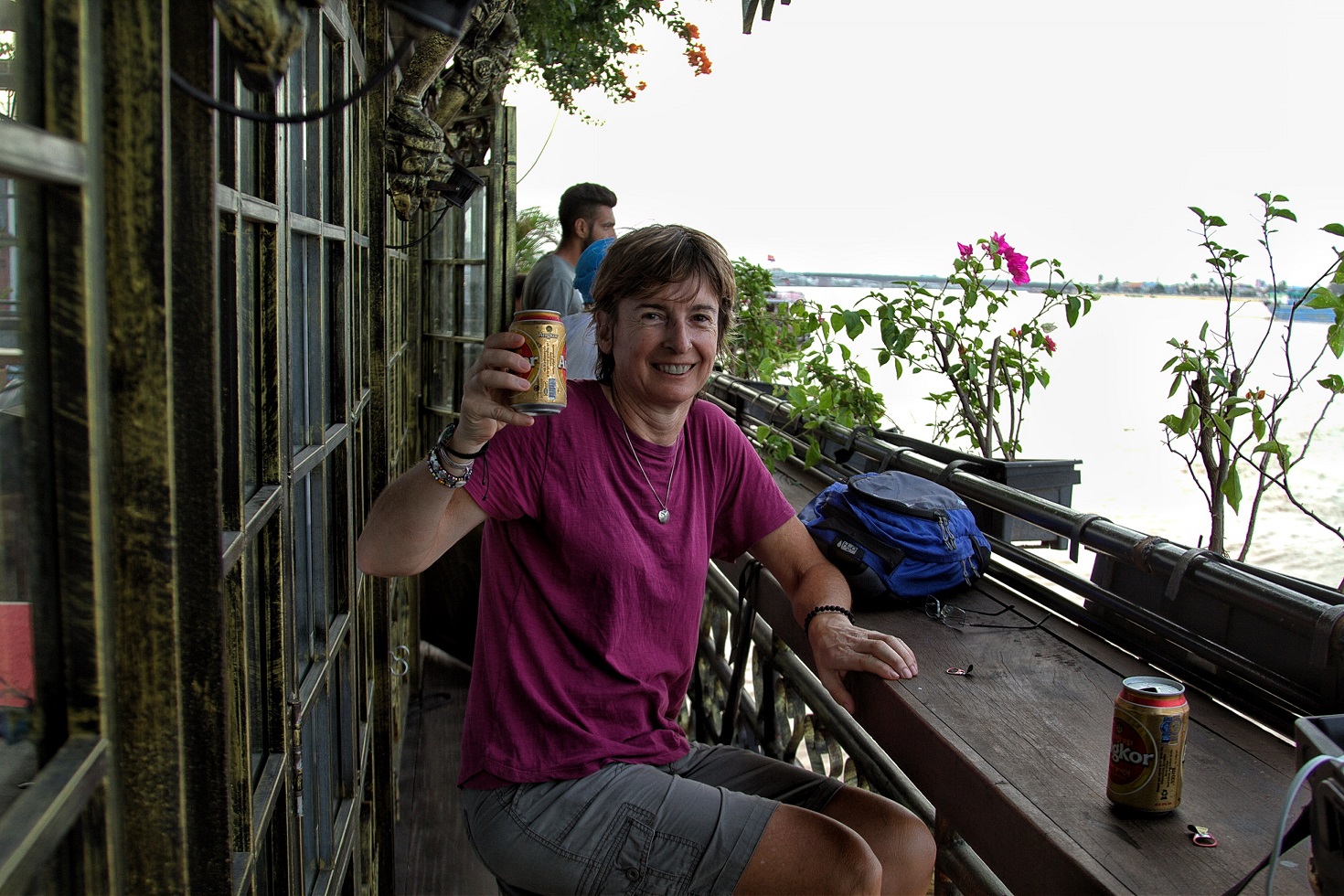
The inner tubes were perfect toys for floating on the river, and the restaurant deck that extended over the water was an excellent place to while away the time. It felt as if we spent the entire day eating. After breakfast, we cycled into the town of Kampot, where we had coffee and cake, shopped for snacks and then returned to our little haven. That evening we had supper on the deck overlooking the river. Life was indeed good behind the potted plants.
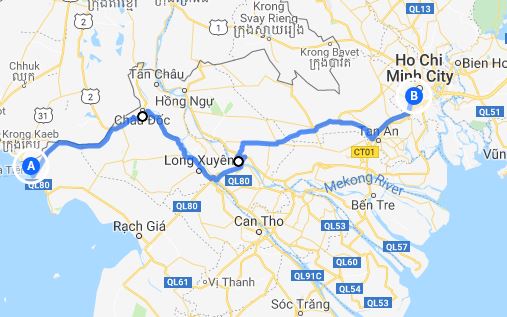
Vietnam (483km - 6days)
25 August Kampot, Cambodia – Ha Tien, Vietnam – 75 km
On
a bumpy, dusty road, we weaved our way through rice
paddies, palm trees and
It
was the Hungry Ghost Festival, and all along the
way, shrines were stacked with tins of beer and
cigarettes. At the full moon of the seventh lunar
month of the Chinese calendar, it is believed that
the gates of hell are opened, and the spirits of
hungry ghosts are allowed to roam Earth. These
ghosts need food and merit. People can help by
offering food, paper money, candles, and flowers,
making merit of their
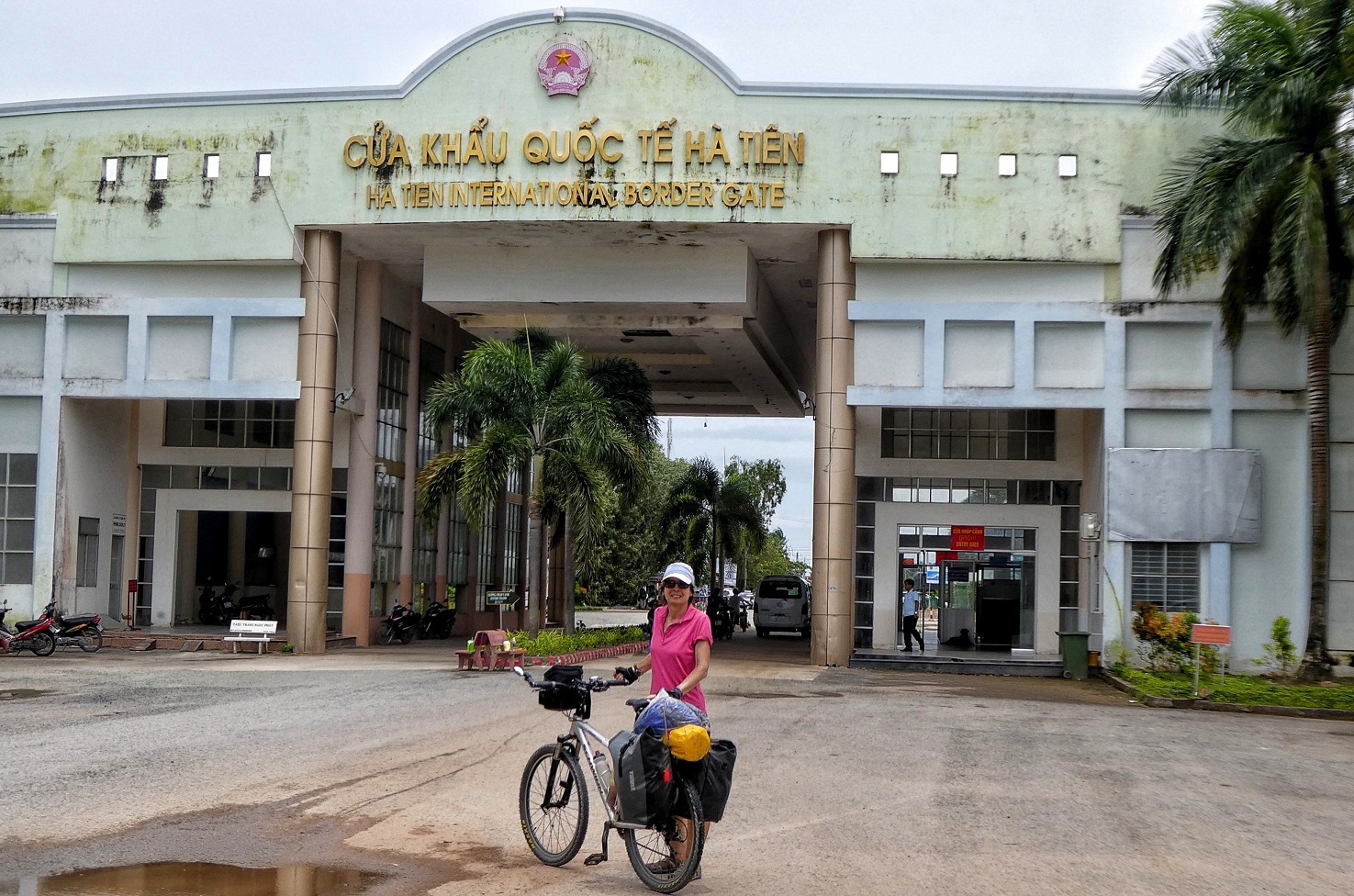
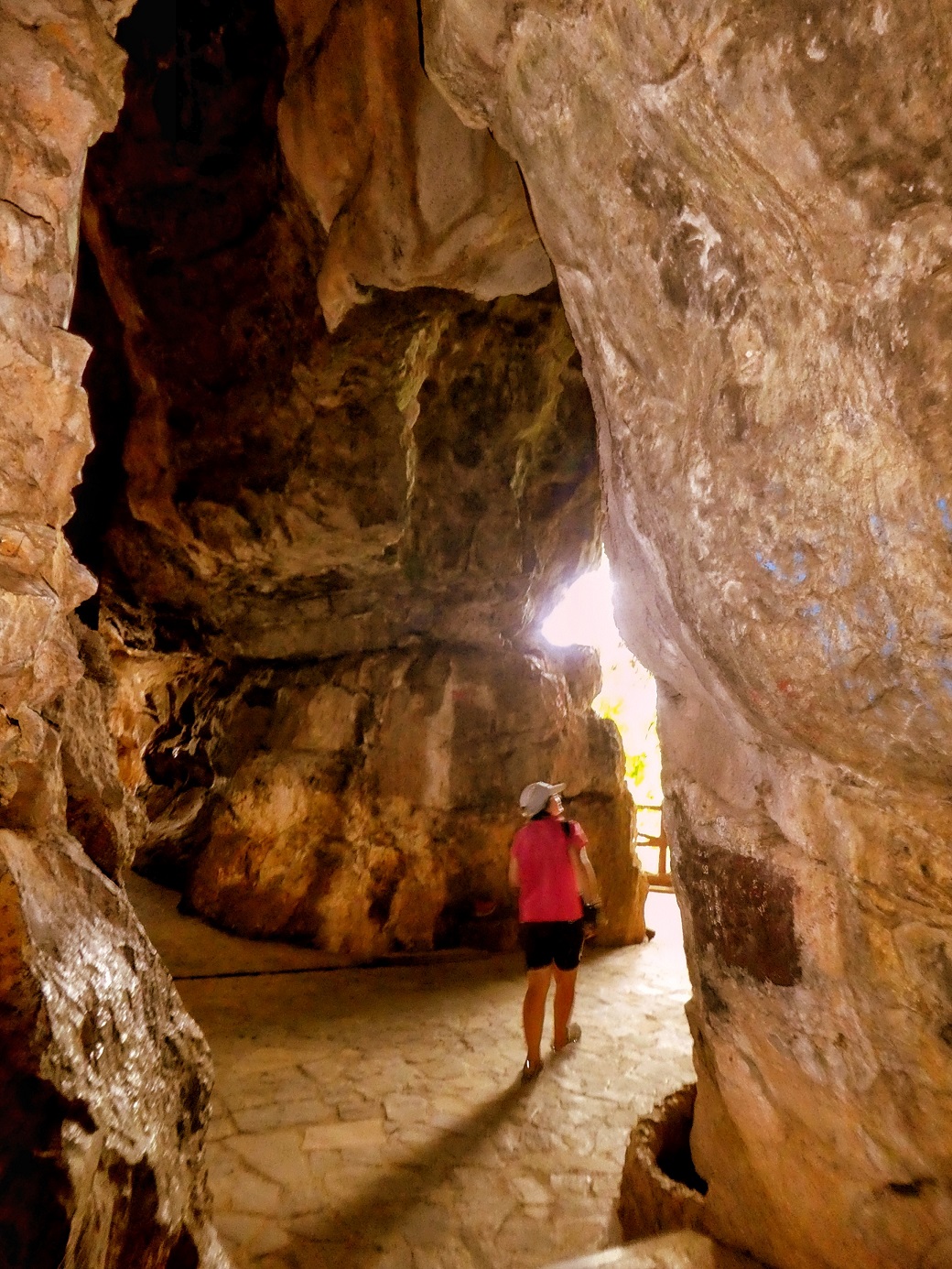
Soon, we arrived at the border, and it was a smooth crossing into Vietnam. Our first stop was at a cave temple, which we reached after climbing some stairs. The cave was surprisingly airy inside and offered great views of the surrounding countryside.
Our first town in Vietnam was one with a fascinating history. Way back, Ha Tien, was a Cambodian province. Being under attack of the Thai back in 1708, the then-governor, Mac Cuu, approached the Vietnamese for assistance, and after this, the area was governed by Mac Cuu as a fiefdom. However, this was not the end of their struggle, as, since then, they have been invaded by the Thais on several occasions. The area also came under attack during the American war as well as during the reign of the Khmer Rouge, who massacred thousands of civilians living in Ha Tien at the time. Today, though, Ha Tien is a busy and laid-back town with a lovely river setting, a busy market, and an exciting night market.
We first had to change money, something that was not as easy as it sounds, as no one spoke any English, the banks were closed, and one typically got a better rate at the gold shops. With a whopping 2,000,000 Vietnamese dong (approx. $85) in our pockets, we felt rich and got ourselves an excellent room that was right on the river.
26 August — Ha Tien — Chau Doc — 103 km
We
woke to the sounds of the street and the general
mayhem of the local market. I sipped my first cup of
coffee while listening to the ferries blow their
horns before leaving for the islands. It was,
indeed, a pleasant way
We followed a canal that ran close to the Cambodian/Vietnam border. The road was congested with motorbikes and minivans that were running to and from Cambodia. It was, however, still a pleasant ride, and the recent rains transformed the delta into what looked like an ocean. At times, the canal we cycled along completely disappeared, and we were amazed that the boats still managed to find their way. River transportation is alive and well in Vietnam, and so is the farming of birds’ nests. These edible birds’ nests are created by swiftlets that use saliva to build their nests. The nests are particularly prized in Chinese culture due to their rarity and supposedly high nutritional value and exquisite flavour. According to what I read, these edible birds’ nests are among the most expensive animal products consumed by humans with nests recently sold at prices up to about US$3 000 per pound, depending on grading! We cycled past many a massive structure built specifically for these birds and their nests.
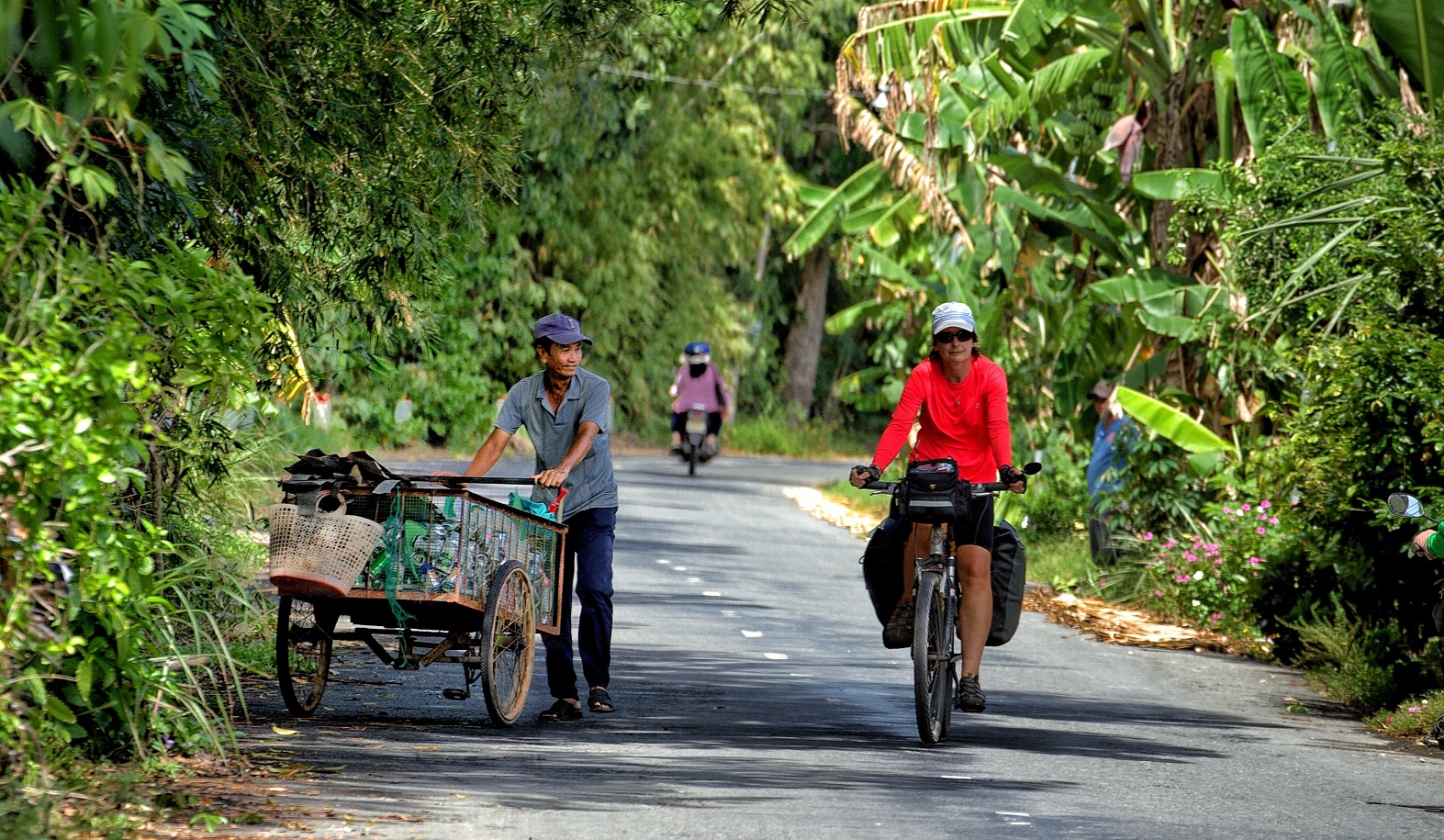
Roadside stalls sold woven baskets and mats, and
peasant villagers collected plastic bottles and tins
for recycling. In Vietnam, roadside stalls not only
come with a table and chairs but also a large number
of hammocks, and it appeared that it was unthinkable
to sit when one could lay in a hammock, something
that made complete sense to me. We followed
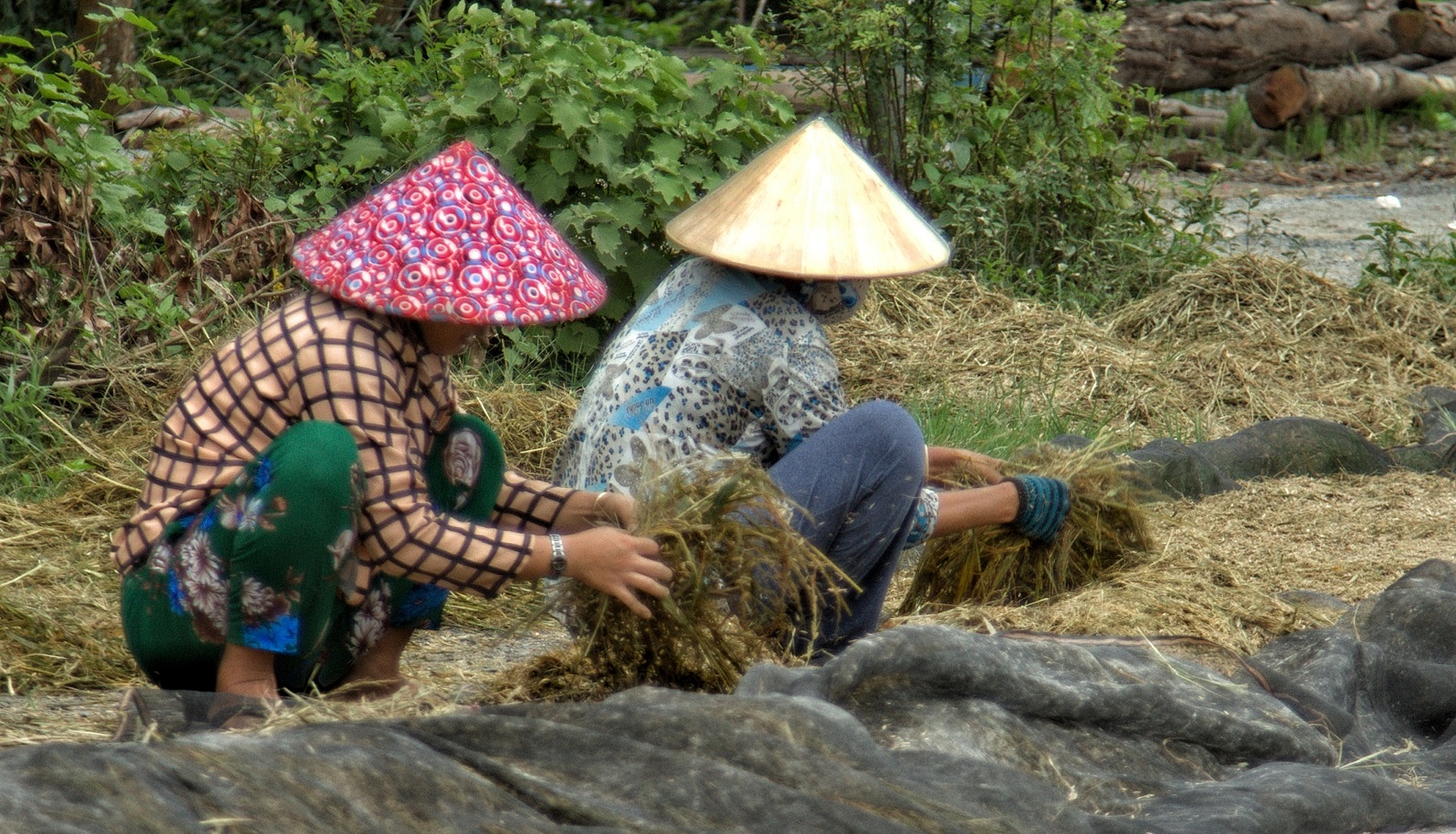
With the recent rain, we found that the farmers had no dry yards for drying their rice crops, so they used the road, forcing the vehicles over it for the thrashing.
We turned off the road to the Ba Chuc memorial, a grim reminder of the horrors perpetrated by the Khmer Rouge. In April 1978, the Khmer Rouge killed 3 157 villagers here; only two survived. It was a rather depressing visit. Outside, a lady sold what I would call Vietnamese pizza (Banh Trang Nuong). It consisted of rice paper grilled on coals and topped with chili paste, quail eggs, spring onions, and minced pork. It was delicious.
Afterwards, we tried to follow a small road to Chau Doc, but unfortunately, it petered out altogether, and we had to return to our original route. Caron was a star and never complained once about the detours or bad roads. Once in Chau Doc, we found a comfortable room at the Thuan Loi Hotel right on the river, after which we went in search of food.
27 August - Chau Doc – Cao Lanh- 75 km
The
delta is a watery world, and no less than four times
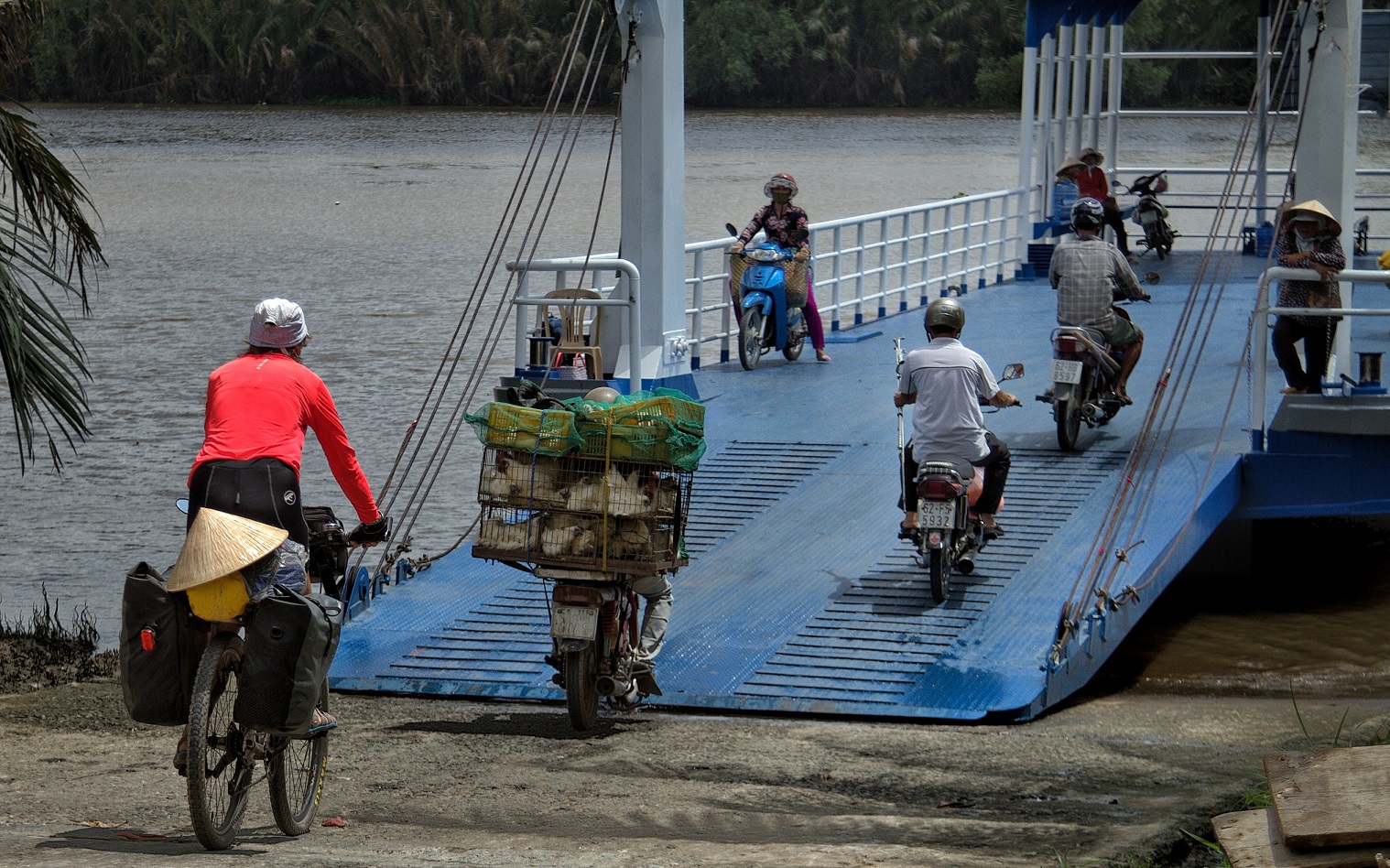
did we have to make use of a ferry to get across
rivers, all making for a fascinating day. The roads
were mostly tiny and the villages small and rural
but, from time to time, we came upon larger towns,
While having a quick bite to eat at a roadside restaurant, we were surprised to see a local man and his chicken also having lunch. I’m not kidding you. There he was, with his chicken sitting next to him on a chair. On leaving, he tucked it under his shirt, got on his motorbike, and off they went!
We managed to find the smallest of roads running flush next to rivers and canals, all making for a good day on the bike.
28 August - Cao Lanh – Vinh Long – 70 km
“I
think we have just doubled the tourist count for Cao
Lanh,” Caron said as we sat down to an excellent
bowl of pho. We ambled along a small road and were
perplexed at the drying of water hyacinth along the
way. As far as I was aware, there was
We came upon Xeo Quyt forest. A magnificent 52-hectare forest and swamp. I understand that it's one of the last natural forests left in the Mekong Delta. During the Vietnam War (1955-1975), the area was used as a base, and today it hides the remains of Viet Cong bunkers. We rented a canoe and were paddled through a thick canopy of trees past the remains of war relics. It was a fascinating visit and gave us a tiny glimpse into the lives of the Vietnamese during that time.
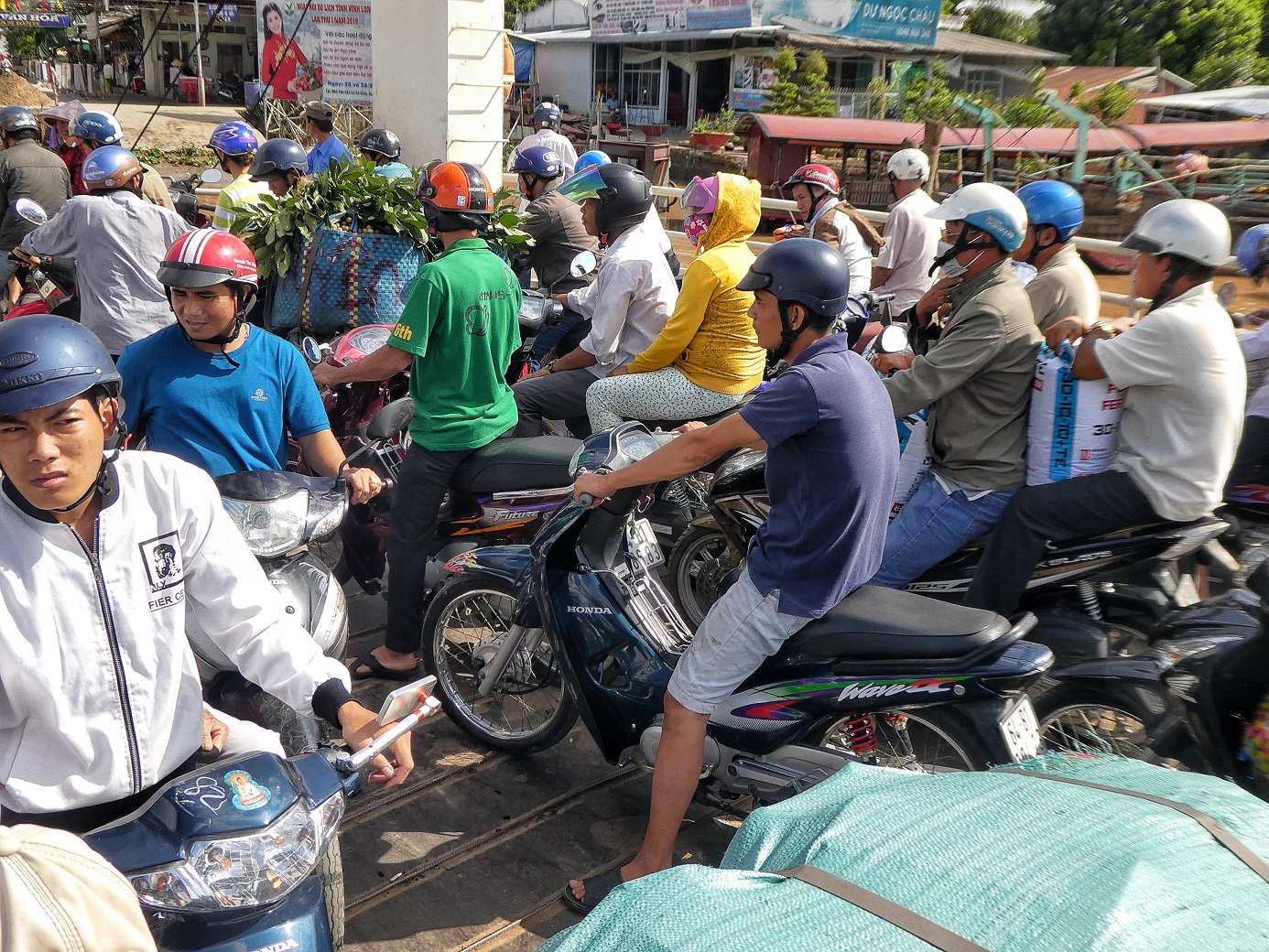
We also discovered the use of the dried hyacinth! The resourceful Vietnamese are using it for weaving baskets and various other products! After ice cream, it was back on the bikes to Vinh Long where we arrived together with trucks, buses, and what felt like thousands of motorbikes. Instead of staying in the city, we took a ferry to an island where we located a homestay for the night. It turned out an interesting evening as we landed up at a brand-new homestay, still in the process of being built.
29 August – Mekong River Homestay – My Tho – 85 km
We
had breakfast, which included a delicious cup of
Vietnamese coffee, the best I have had so far. We
wished the family good luck with their homestay and
crossed the river by ferry back to the mainland. The
boat was packed with farmers and traders
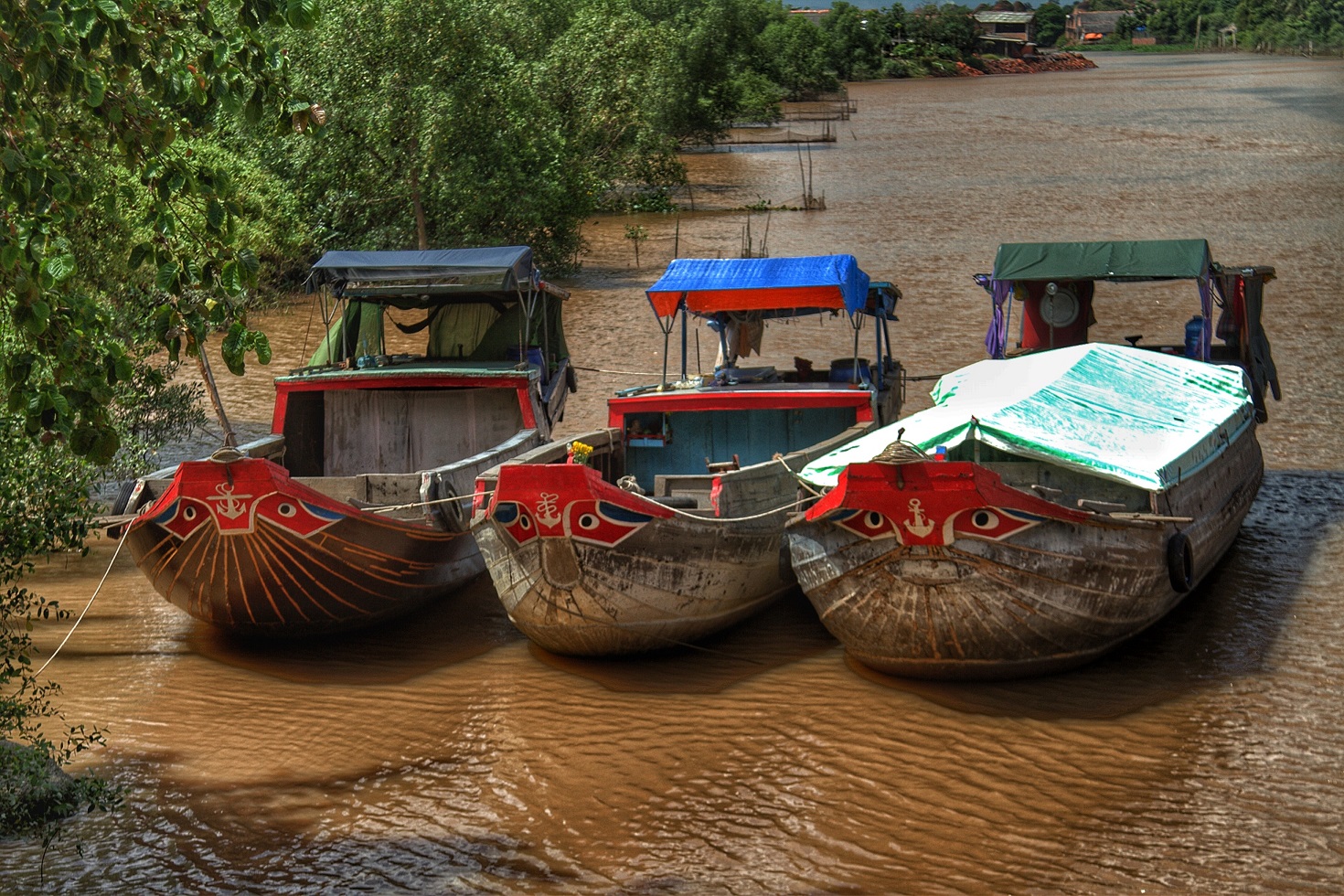
We cycled along a small road that ran next to the river, passing villagers selling their humble home-made nibbles along the route. Others were winnowing their rice the old-fashioned way or drying home-made sausage in the sun. We popped into beautiful temples and interesting-looking brick-making structures. Each area in the delta seems to produce a different crop, and we cycled past many a dragon fruit plantation.
As
can be expected in the delta, we crossed numerous
rivers, some by ferry and some by bridge. The rivers
were busy waterways, and each and every boat had
eyes painted on the bow. Fishermen and seafarers of
all
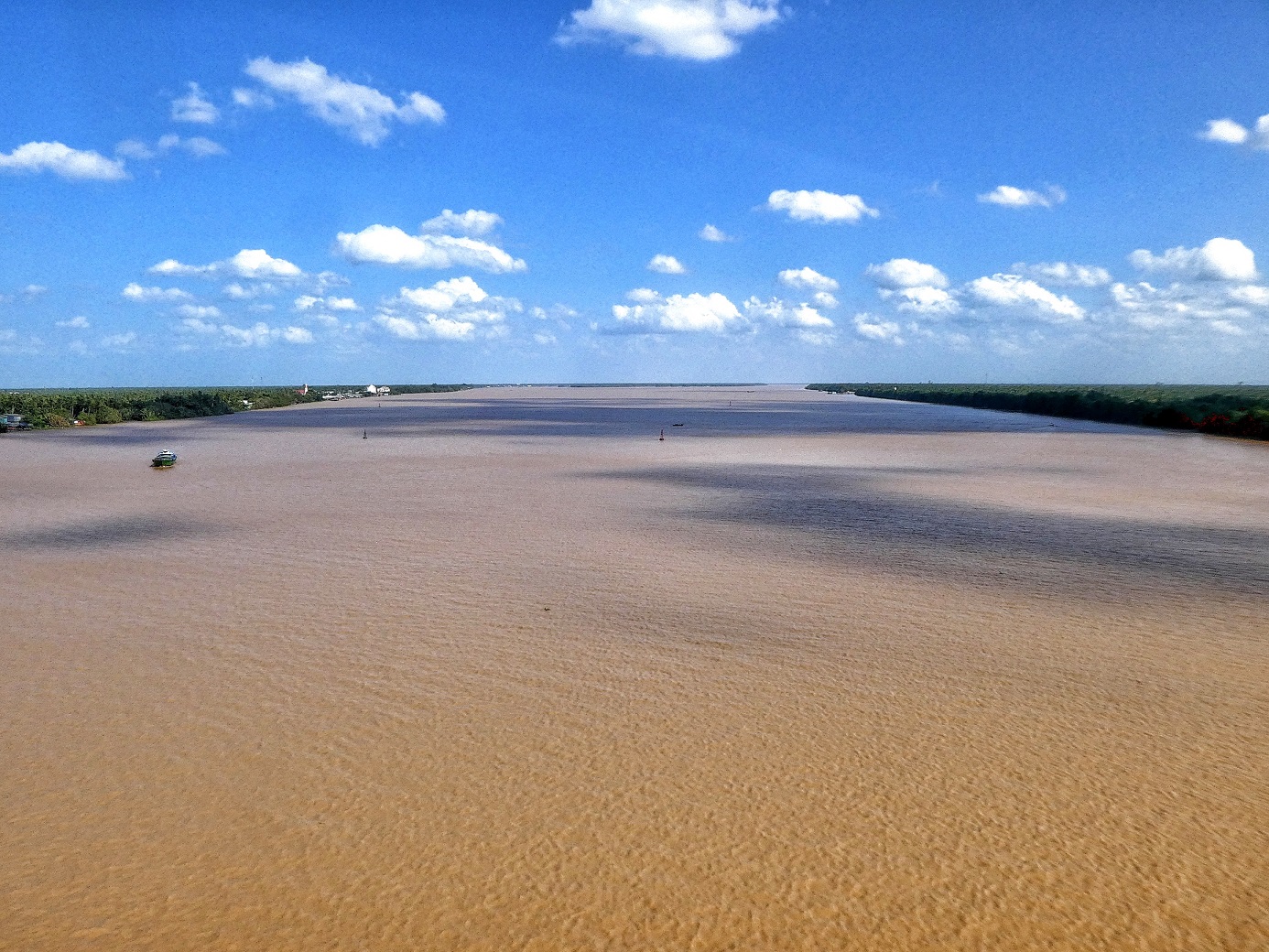
On arrival in My Tho, a helpful man pointed us to a budget hotel right across from the night market. It suited us just perfectly and, after a shower, we headed out to the food court, where we sat overlooking the river. It was a pleasant day of cycling, and watching the Mekong flow past was a suitable end to the day and our ride through the delta.
30 August - My Tho – Saigon – 75 km
We
enjoyed a pavement breakfast of bánh mì (Vietnamese
baguette). There are banh mi stalls on almost every
street in Vietnam. The baguette features a crispy
bread, with a tasty filling of sliced pork, pate,
chicken, egg, spicy chilli sauce and herbs. We ate
our baguette,
Our route led us through farming communities where women with conical hats sat on their haunches cooking food. Chickens pecked in the road and men carted huge piles of hay on small motorbikes. The aroma of home-made food drifted across the road as school children headed home for lunch. We crossed rivers by ferry and meandered through dragon fruit plantations until we reached the city limits. It was time to focus as we joined the eight million motorbikes in Saigon. We followed suit, not looking left or right, only following the traffic, ignoring red lights and road signs, eventually reaching downtown and in one of the allies located Hai Guesthouse with a spacious room and large balcony.
We have sadly reached the end of our journey as from Saigon, Caron leaves for home and I will make a beeline for Thailand where I plan on meeting my friend, Linda, at around 12 September for a cycle tour of Myanmar.
It was a pleasure cycling with Caron and I hope she enjoyed her time here. Go well, my friend! |