|
|||||||
|
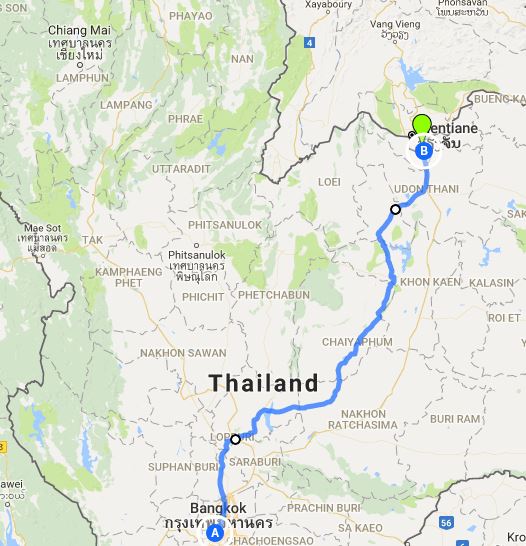
Janice & Chris's tour: Thailand - Laos -Thailand
(2 422km - 51days - 11 February - 2 April 2018) |
|||||||

|
Thailand (825km - 19days)
Day 1 - 11 February - Bangkok
I was excited to
meet Janice and Chris who arrived all stiff and
puffy-eyed after a 24-hour flight from Cape Town. No
time was wasted in exploring Khao San Road where
Day 2 - 12 February - Bangkok The morning was spent reassembling bicycles and, as our guesthouse was closing at the end of that month, Janice and Chris couldn’t leave their bike boxes there and went looking for alternative accommodation. That evening was spent doing a budget “sunset cruise” on the River Phraya, which involved catching the late ferry to its final destination and boarding the last boat back. All for 30 THB. Luckily, it was a beautiful evening and a lovely sunset. After snacking on a few nibbles from the night market, it was time to settle in for our nightly beer.
Day 3 - 13 February - Bangkok
Once back at our abode, a home was found for Janice and Chris’s bike boxes after which it was time for a test ride to see how the bicycles were performing. Weaving through Bangkok traffic was quite challenging, and it was better to return to our guesthouse and explore the rest of Bangkok by river ferry and on foot. On our way to China Town, we popped into the very impressive and newly renovated Temple of Dawn, always an awe-inspiring sight.
Day 4 - 14 February -
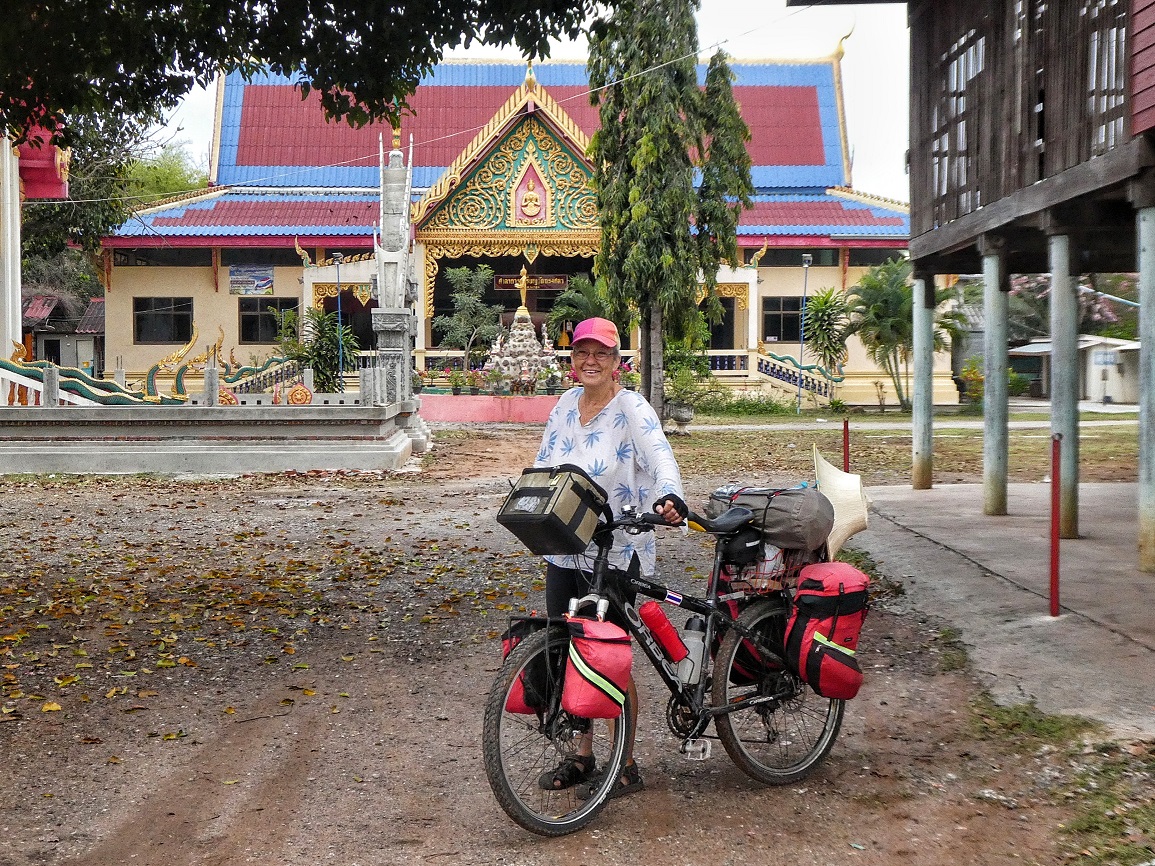
Bangkok – Ayutthaya – 50 km (& 30 km by taxi) Taxi4bikes picked us up and took us 30 kilometres outside the city in the direction of Ayutthaya. I was impressed with the service as, firstly, the driver phoned to let us know he was stuck in traffic and would be 30 minutes late. On his arrival, he had a three-bike roof rack, and although the front wheels had to be removed, he also had three wheel covers for such purpose. The taxi driver dropped us at Rangsit station, making for an easy escape out of the city. After loading the bikes (and with the help of many onlookers and helpers), it was bye-bye Bangkok. Whoo Whoo! The fun had begun!
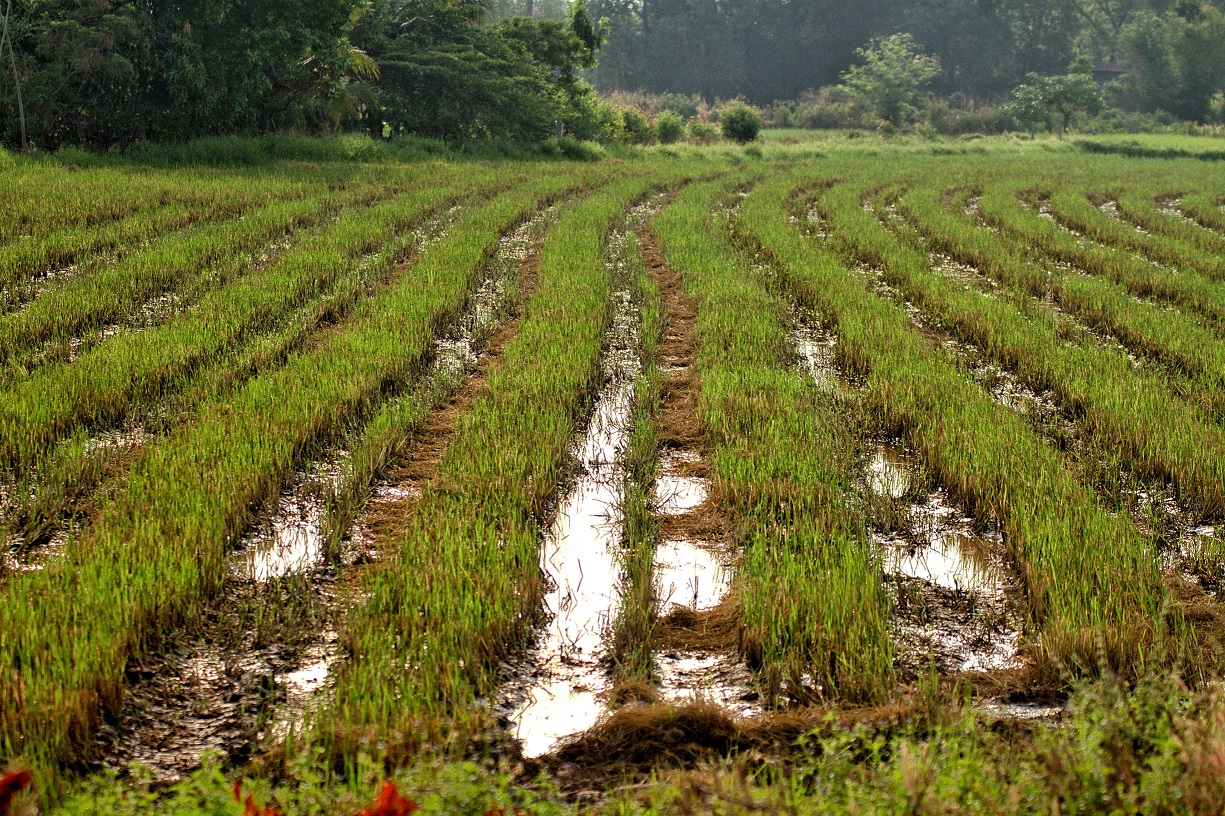
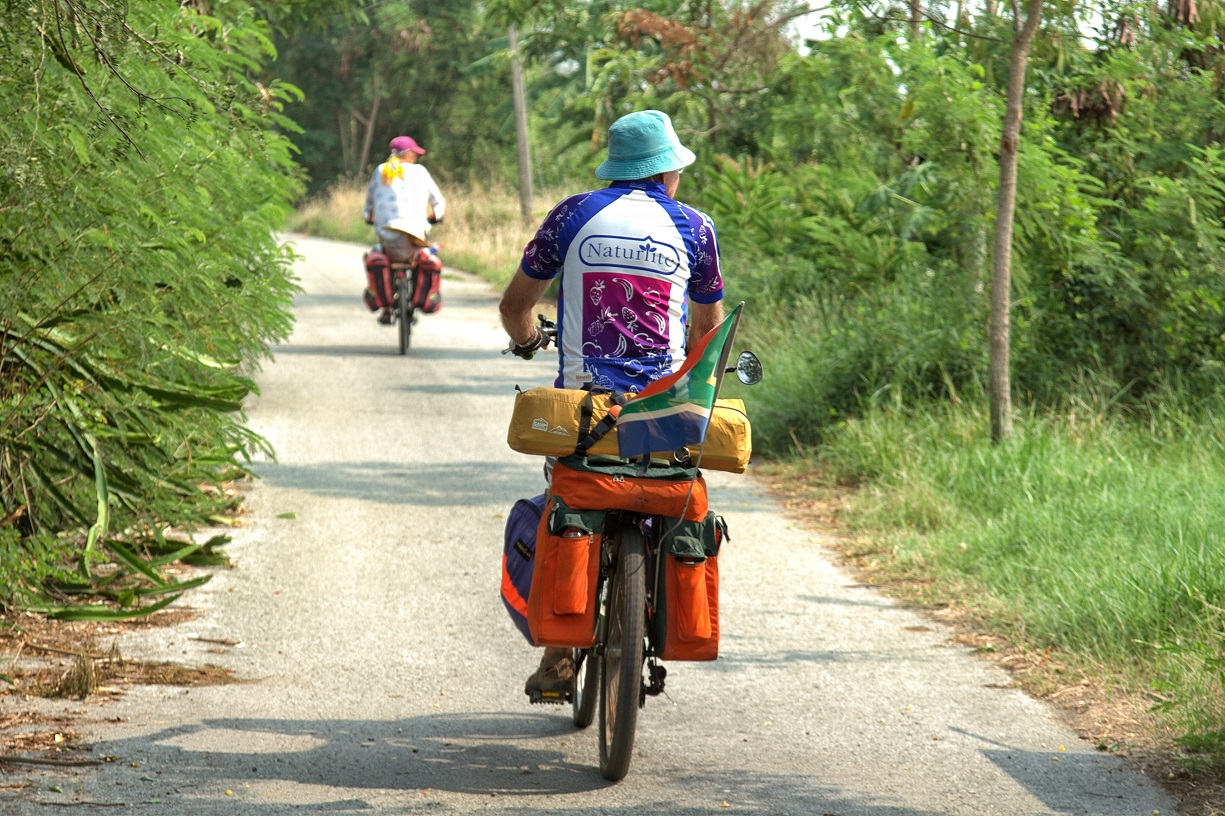
It took us no time at all to find small roads. From Rangsit Station to Ayutthaya was a short and lovely rural ride through typical Thai countryside. At first, our route followed the Prem Prachakon canal past temples, simple eateries, and canal-side villages. People went about their daily lives, fishing, preparing food, worshipping and working in rice paddies. It was a slow amble, enjoying views of bright green rice fields, banana plantations and odd ancient ruins. On reaching Ayutthaya, it was straight to Baan Lotus Guesthouse, a lovely, old, wooden schoolhouse building on extensive grounds. After a quick shower, it was off to a restaurant for supper and beer.
Day 5 – 15 February - Ayutthaya – 26 km The following day was spent exploring Ayutthaya’s ruins. Once the capital of the Kingdom of Siam, Ayutthaya was founded around 1350. With its ideal location between China, India and the Malay Archipelago, it was also the trading capital of Asia. By 1700, Ayutthaya had become the largest city in the world with a total of one million inhabitants. All this came to an abrupt end when Burmese forces invaded Ayutthaya in 1767 and almost completely raised the city to the ground. The ruins are today a UNESCO World Heritage Site.
Day 6 – 16 February - Ayutthaya – Lopburi – 68 km
A decision was made
to leave as early as possible to try and beat the
heat, and we were, therefore, on our way shortly
after 7 a.m. I was pleased with our early start, as
the light was beautiful, and it was good to be out
in the cooler morning air. Soon after leaving, we
found ourselves on a rural road and in the process
cycled past the elephant kraal. I
felt sorry for those lovely animals, all chained and
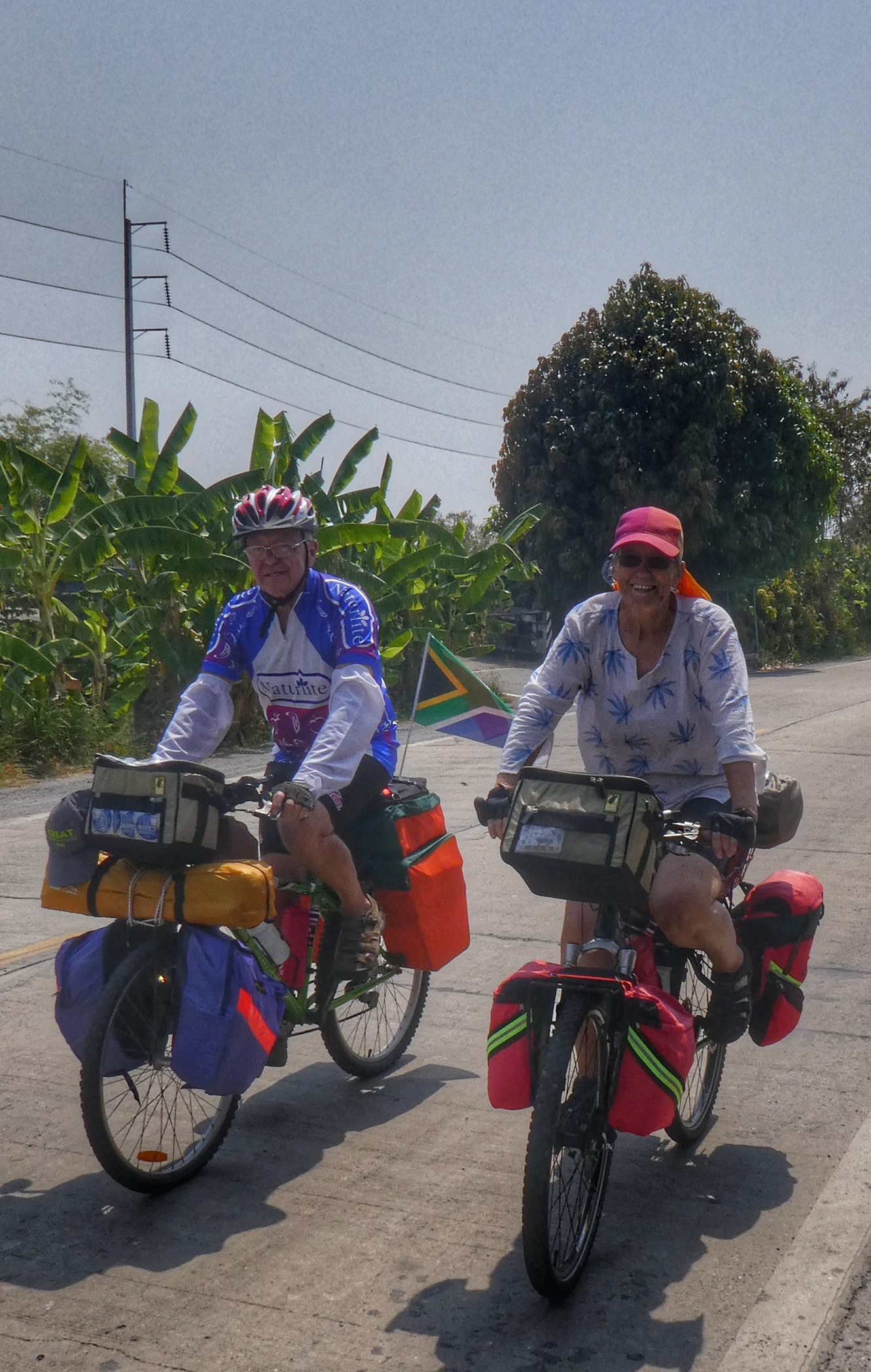
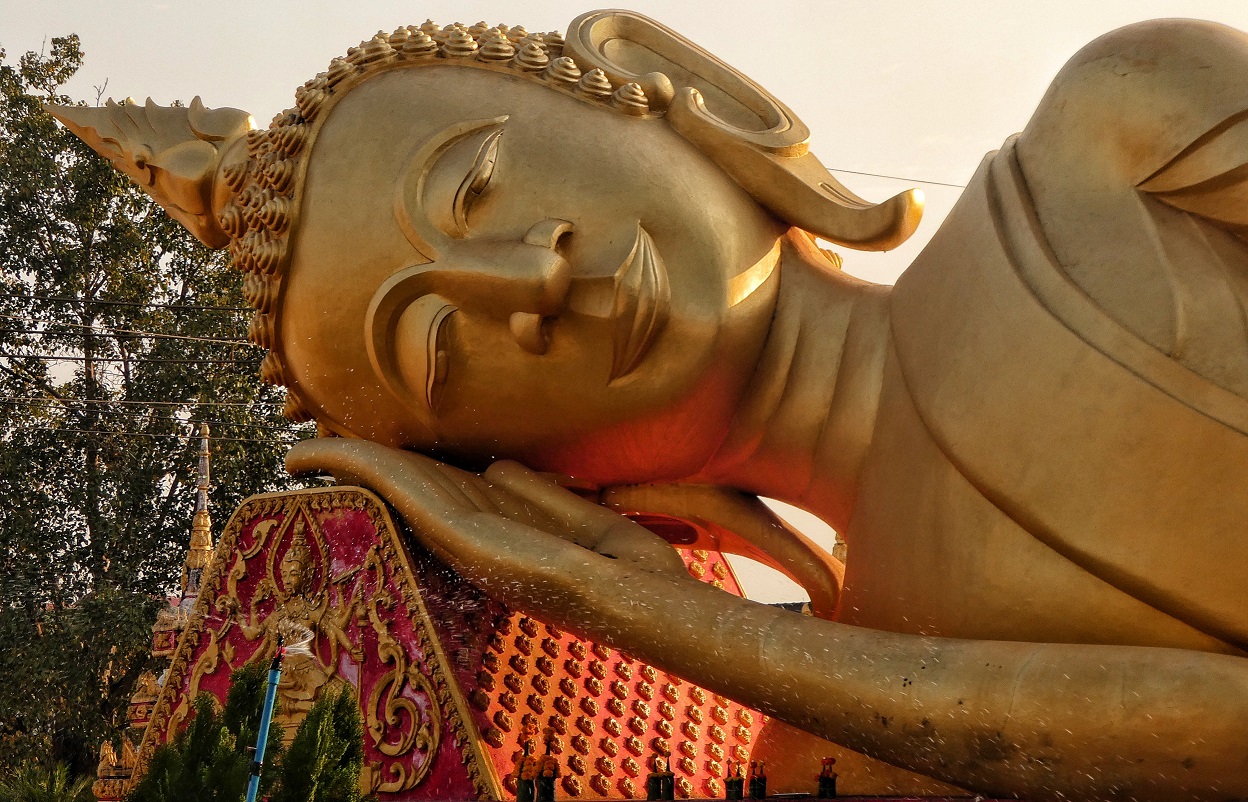
Our route led along back roads through farmlands and, although it was early, it was already sweltering, making for challenging riding, especially for new riders. The route became far too busy and it was better to turn off onto an even smaller road. In fact, it was so small it turned into a narrow dirt road, but it was still a lovely ride past bright green rice paddies, fish drying in the sun and giant Buddha statues.
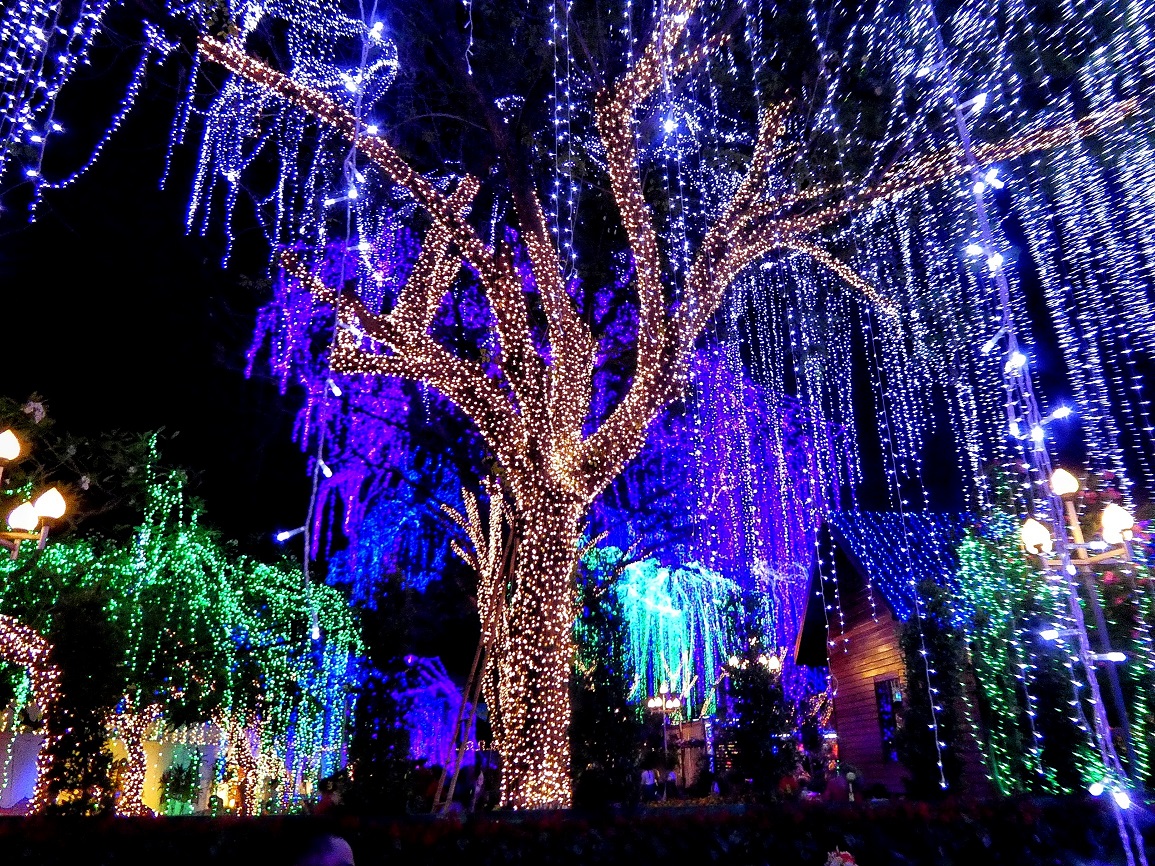
Fortunately, a paved road appeared and then it was on to Lopburi, arriving at around 14h00. It was the time of the Chinese New Year, and we strolled the crowded streets with thousands of others, enjoying all there was to see and do. Most people were beautifully dressed in traditional Thai costumes, and all historic ruins were lit and open to the public. What a sight it was! All the trees were covered in fairy lights, and visitors were entertained by cultural shows, music and fireworks.
Day 7 – 17 February - Lopburi
Day 8 – 18 February - Lopburi – Pasak Jolasit Dam – 65 km In trying to take maximum advantage of the cooler morning air, it was on the road rather early. I say “cooler” as in fact, it wasn’t much cooler in the morning than later in the day. A stop at an organic market revealed exotic food and herbal products. Again, it was a scorcher, and one had to stop as often as possible to fill up with water and, in the process, met some interesting people.
Towards the end of the day, we slinked into Pasak Jolasit dam. The dam was a popular recreational area offering camping as well as food. Camping spots were right on the dam under trees, with a great view of the dam and a short walk from the ablutions. After sunset, a short stroll brought us to a restaurant located outside the gate of the dam's recreation area where a delicious meal was had without being able to speak a word of Thai or read the menu.
Day 9 – 19 February - Pasak Chonlasit Dam – Wat Nong Bong – 67 km Waking up next to a dam is always a pleasure, and there was the tiniest bit of cool air coming off the water. Breakfast was coffee and oats while watching the sun trying to shine through the ever-present haze (most likely from burning sugarcane fields).
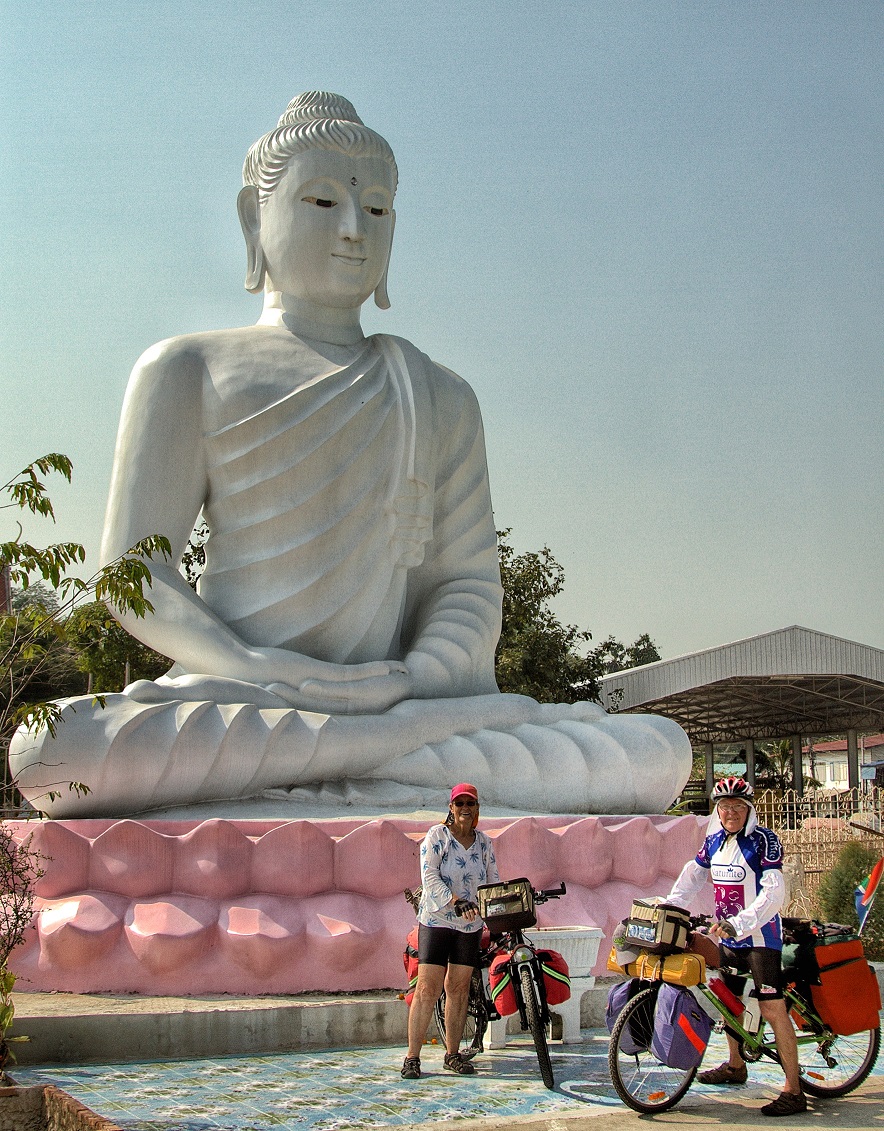
It was a pleasurable ride along the opposite side of the dam past vast areas of sugarcane fields as well as cassava plantations. Our first stop of the day was at the dam’s White Buddha, where we watched the circumambulation of the Buddha. At first, I thought it a strange thing to do but then realised, circumambulation of temples, deity images, or other holy objects isn’t only part of Buddhism but also present in other religions including Christianity, Judaism and Islam.
Our ride took us past workers busy cutting sugarcane
and wondered what all was
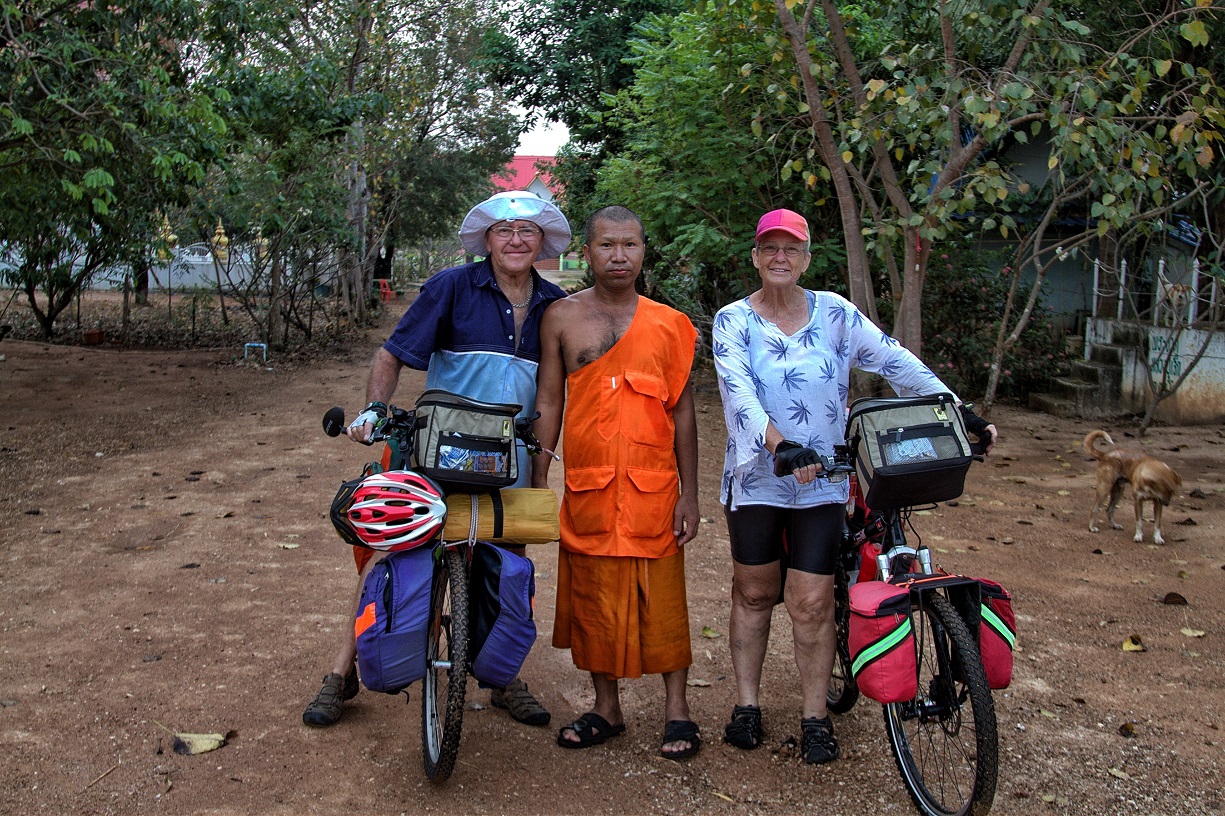
Janice had the first flat tyre of the trip, which took surprisingly long to fix. Soon after, it was time to start looking for a place to pitch our tents. Wat Nong Bong (a Buddhist temple) came at just the right time, and the small store across the road provided enough ingredients for supper. It was a very welcoming temple, and the monks pointed us to the Wat (temple) where they gave us sleeping mats and requested us to speak to the students about our trip in the morning. Janice was appointed to do the talking, and Chris cooked our instant noodles on his small stove, which we ate while listening to the monks chanting their prayers.
Day 10 – 20 February - Wat Nong Bong – Wat Ban Na Samakee – 50 km
Breakfast was courtesy of the monks; a simple but
delicious dish of fried noodles.
Janice (as requested the previous night) spent a few
minutes talking to the school kids about our trip.
Afterwards, we attempted to adjust the disc brakes
on Janice’s bicycle. None of us knew
The way led further north and, as the previous day, it ran past large sugarcane plantations. It was harvesting time, and many large trucks with sugarcane were heading for the market. The plan was to cycle 34 kilometres to the Si Chep Historical Park and then continue for another 30 or 40 kilometres after that. Chris, however, found the heat unbearable and it was better to hang around in the shade at the historical park until 16h00. It was a pleasant way to spend the afternoon. Chris still had enough energy to cycle a further 10 kilometres to where there was another Buddhist temple. The friendly monks allowed us to sleep in the Wat and even gave us mattresses as well as pillows. The temple dogs were, however, not so welcoming.
Our nightly camping spot mostly depended on where Chris could find ice, which he needed to keep his diabetic medication at an optimum temperature.
Day 11 – 21 February - Wat Ban Na Samakee – Wat Sap Ta Khaek - 50 km The alarm went off at 5 o’ clock, and by the time it got light, all were ready to roll. After waving the monks goodbye, we rode along, with the sun peeking through a smoky haze.
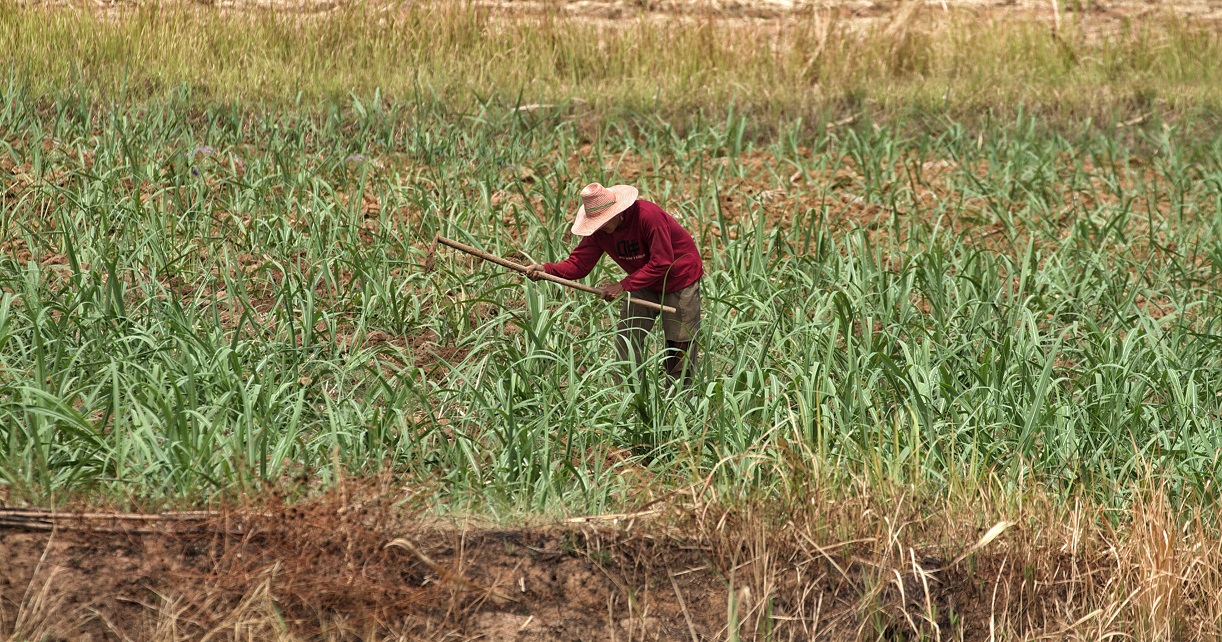
Our path took us along back roads and through farmlands, passing villagers cutting sugarcane by hand and dodging muddy puddles from the previous night's rain. Our little backroad turned into a dirt road, shared with two-wheel tractors, trucks, and monks collecting food. At around 15h00, the heat became too much and a nearby temple gave us permission to camp.
The temple was a very basic one, with only one dusty undercover area and a large dirt yard which was swept continuously. The sweeping caused more dust than the few leaves gathered were worth. Cleaning the undercover area kept us busy for a while. After dusting the Buddha, and lighting a few incense sticks, one could settle in for the night ahead.
Day 12 – 22 February - Wat Sap Ta Khaek – Ban Non-Sa-at – 50 km
For
the first 15 kilometres, the route led straight up
the mountain. It was a slower than usual process
while edging our way higher and higher. After about
10 kilometres,
an
even smaller path turned off which avoided crossing
the high pass, but it was still a pushing-up-the-
It was a typical rural Thai area which consisted of small settlements with basic wooden houses on stilts. Families were swinging in hammocks underneath the homes while kids ran amok, and livestock had the run of the farm. Our muddy path led us back to a paved road with stunning scenery in the distance. Visible to our right were the higher mountains and we were pleased our chosen route avoided it. At around 15h00, the tiny village of Ban Non-Sa-At, which had a temple to spend the night, made for easy camping. Like the previous night, the half-covered hall needed sweeping and the Buddha a bit of dusting. I ate the noodle soup I bought earlier in the day. Janice, not being a big eater, only had a small tin of sardines in tomato sauce and Chris enjoyed cup noodles with a tin of sardines.
Day 13 – 23 February - Ban Non-Sa-at – Wat Song Sila – 50 km
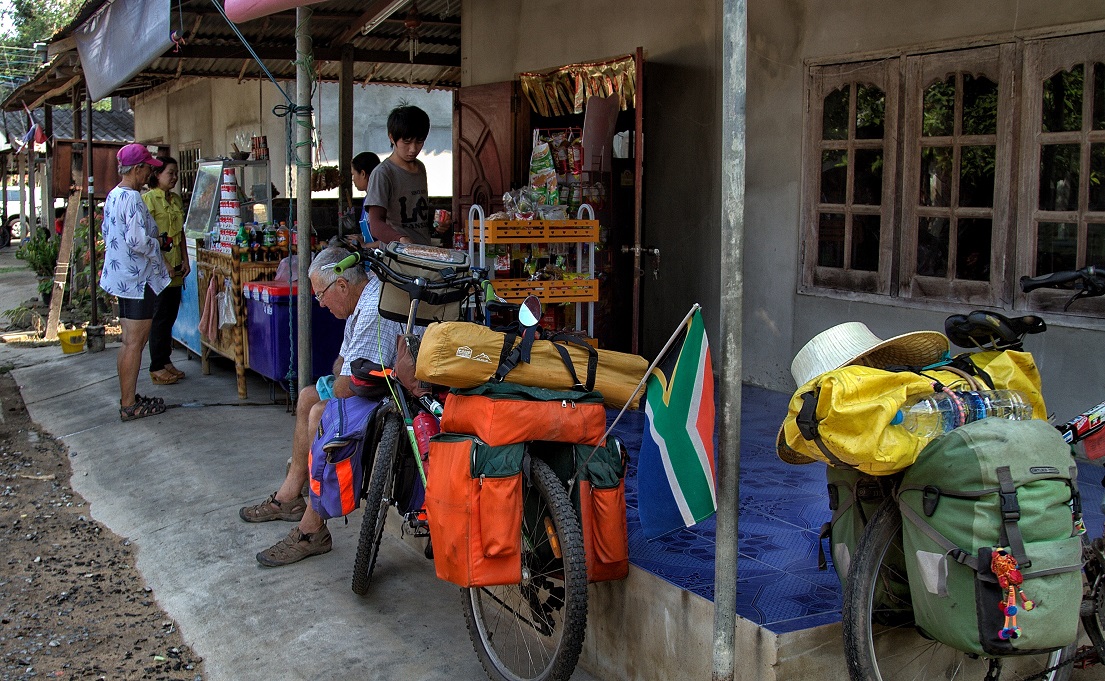
It was a slow process ambling along a paved road. The slight breeze kept us cool, stopping every 10 kilometres or so to stretch necks and shoulder muscles. A roadside stall provided watermelon which went down rather well, and the shop owner gave us a bag of bananas, which made for an impromptu fruit salad. Around midday, it was time for our usual noodle soup, after which it was on to the tiny community of Ban Huabua. I didn’t think any foreigner had ever stayed overnight in Ban Huabua. Even the local temple was abandoned. Eventually, a monk appeared who pointed us to a wooden structure on stilts where one could pitch a tent. By that time, even the roadside restaurants were closed, and we had to make do with our usual cup noodles.
Day 14 – 24 February - Wat Song Sila – Ban Thaen - 66 km
The
colder weather made for a lovely but nippy early
morning ride. Chris was on fire and set off at a
good pace with Janice and me in tow. The early
morning light made
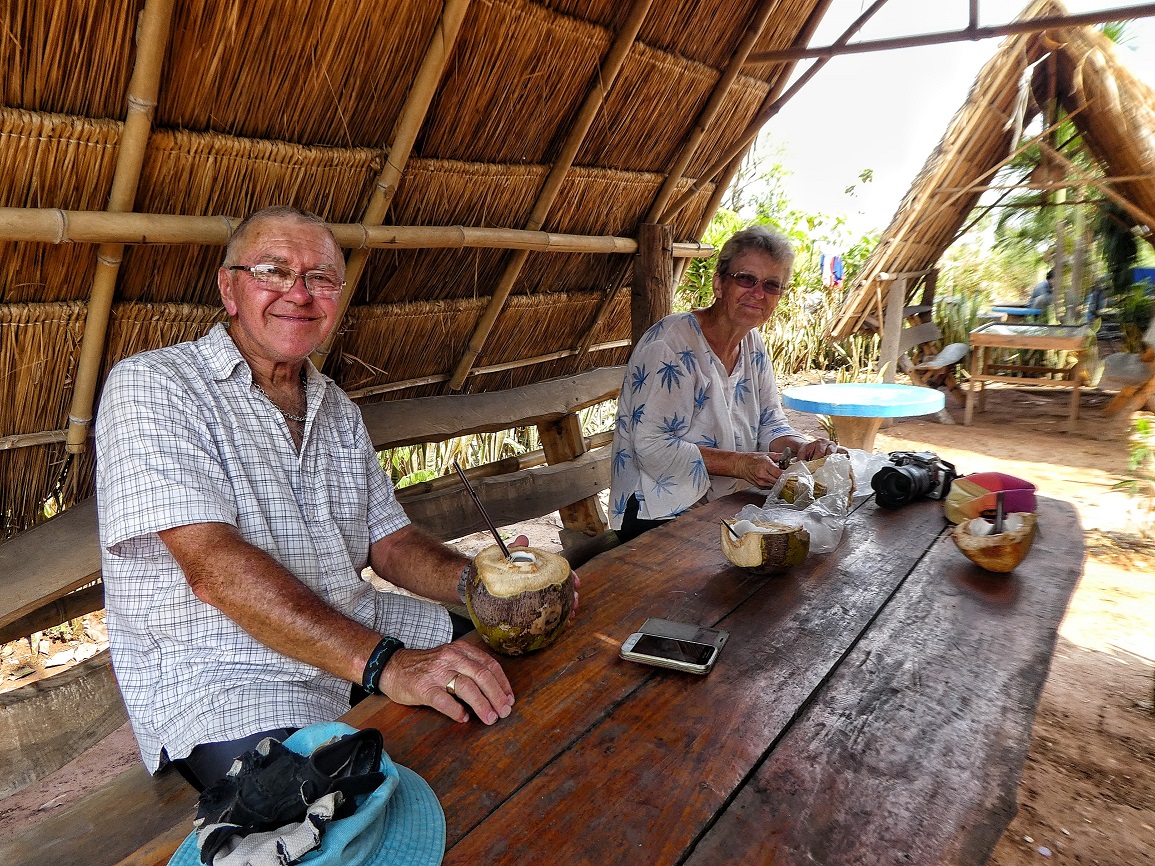
Good time was made, stopping at regular intervals to fill up with water. Around lunchtime, and after a bite to eat, Chris had a quick nap after which it was on to Ban Thaen, en route stopping for coconut juice. At the temple at Ban Thean, permission to camp was sought from the chap sweeping the yard. He indicated he understood and pointed us to an undercover area. It wasn’t entirely clear if it was permission, but after a lengthy wait, the head monk arrived and gestured it was OK.
A short walk revealed a small shop selling food where I bought soup which I later discovered contained a somewhat unusual animal. It was rather bony but delicious, but then Thai food is always delicious. "Aroi mak-mak!" as they say in Thailand.
Day 15 – 25 February - Ban Thaen - Khon Kaen – 60 km
It
was a warm night, and none of us used our tents,
only our sleeping mats. The mozzies didn’t seem to
be a problem as a few mosquito coils were lit, and
even the temple dogs kept their distance. One hardly
ever overslept at a temple as the gong was sounded
at first light,
It was a speedy packing up process as no tents had to be taken down and, in the process, a most stunning sunrise was witnessed. What a fantastic time of day to be out. Chris was thankful for the cooler morning air, and Janice and I were happy to take full advantage of the morning light to practice our photography. A rural road led to Khon Kaen and the path twisted and turned through tiny settlements where both water buffalo and cows were kept in the front yard. It was Sunday and village folk were going about their Sunday chores; some doing necessary household maintenance and others foraging for food or making charcoal.
By lunchtime, it was, however, boiling again, and a very conveniently located 7-11 made for a great rest stop. Then it was onwards to Khon Kaen where a bicycle shop was found to straighten my front wheel which had a slight wobble. Once it was sorted, I paid the small fee of 20 Thai baht and cycled into the centre of town where a hotel was a welcome sight.
Day 16 – 26 February -
Khon Khaen The day was spent doing laundry, shopping for headlamps and going back to the bicycle shop to have headset extensions fitted to both Janice and Chris’s bikes. That evening, Chris made Cape Velvet Liqueur - lovely stuff.
Day 17 – 27 February - Khon Kaen – Ban Pa Kho Temple – 80 km Before 7h00, we were on our way and all felt fresh and energetic with the result we went too far and too fast. The main road never made for very exciting riding but came with large amounts of facilities and fuel stations, all with food and ablutions. The roadside stalls mostly sold bamboo craft and furniture and, once again, I was amazed at the strength of bamboo.
Day 18 – 28 February - Ban Pa Kho Temple – Wat Pho Chum Pattanaram – 63 km It was an uneventful day making our way to Wat Pho Chum Pattanaram where camping was at a temple.
Day 19 – 1 March - Wat Pho Chum Pattanaram – Nong Khai – 50 km
It was easy cycling to Nong Khai along rural roads where the night was spent in a guesthouse. Nong Khai is situated on the banks of the Mekong River at a point where the Mekong forms the border between Thailand and Laos and it was, therefore, our last night in Thailand before crossing the border to Laos. As always, the sunset was a stunning sight.
Laos (486km - 11days)
Day 20 - 2 March - Nong Khai, Thailand – Vientiane, Laos – 33 km
Ten
kilometres from Nong Khai was the immigration office
as well as the Friendship
It was a short ride into laidback Vientiane and onto our hotel. Then it was time to explore, find new SIM cards, an ATM and food. Supper was at one of the many restaurants along the riverfront. Even at 9 p.m., it was still hot and the weather forecast for the following few days didn’t look suitable for cycling, varying between 36˚C and 38˚C, but up to then both Janice and Chris managed the heat like pros, and I didn’t think it a huge problem as long as the days were kept short.
Day 21 - 3 March - Vientiane – Dokphet Guesthouse, Hai – 73 km
It
was another scorcher and, therefore, an early
departure, first stopping at the Patuxay monument,
Vientiane’s Arc de Triomphe, or Victory Monument. I
love the story behind it and that it was built with
cement donated by the USA intended for the
The planned third stop was at the Buddha Park, but the route was in such poor condition, it was no pleasure cycling and best to give it a miss and follow the main road. Chris did exceptionally well and cycled to our destination without having lunch or a nap. Lunch was outside our guesthouse where a rudimentary restaurant served noodle soup. In the process, very generous locals from Vientiane kept buying beer, and we soon had to thank them unless we later wanted to crawl back to our abode.
Day 22 - 4 March - Dokphet Guesthouse – Saunmaiket Hongxaikham Guesthouse - 65 km
With
the weather forecast again indicating temperatures
between 36˚C and 38˚C, it was up and away even
earlier than usual. Our first stop was around 15
kilometres, and
about
four kilometres later, Janice discovered she left
her reading glasses behind. As it was a short
After cycling another 15 kilometres, there was still no sign of Janice and after contacting her, learned she couldn’t locate the rest stop, and in the process, cycled all the way back to the morning’s start! Chris and I continued slowly, hoping she would catch up. As agreed, we only cycled until 13h00 and then found a guesthouse and waited for Janice to arrive. It was a rather long day for her – 100 kilometres all in all! Well done, Janice, on your first 100 kilometres and first solo ride! Your rock, girl!
Day 23 - 5 March - Saunmaiket Hongxaikham Guesthouse – Pakkading Buddhist temple – 60 km It was surprisingly cold in the early morning, and I stopped to buy a long-sleeved sweater. Many of the roadside restaurants had a rail with clothing outside, but I was unsure if it was for sale or if it was their laundry. With only cycling half days, arrival at the temples was usually early and slightly awkward to camp at such an early hour.
The monk at the Pakkading Buddhist temple pointed us to a room we first scrubbed clean. Although the building appeared very new, the bathroom needed a good scrubbing. No sooner had we sat down and the head monk arrived, indicating to us to move to the basement. The basement area was a large, tiled room which also needed cleaning. It appeared a place where the down-and-out overnighted or otherwise one of the monks had a drug problem.
Day 24 - 6 March - Pakkading Buddhist temple - Somejainuek Guesthouse – 62 km
At first, the weather was mild with a good tailwind. The favourable condition did, however, not last and soon it was another scorcher, this time with a headwind thrown in. Around 13h00, a roadside guesthouse appeared with a very convenient restaurant which made a perfect overnight stop.
Day 25 - 7 March - Somejainuek Guesthouse – Roadside Guesthouse – 64 km
Day 26 & 27 - 8-9 March – Roadside Guesthouse – Thakhek – 27 km
Even
though it was a short day, it was still an early
departure to make the best of
the
cooler weather. The Great Wall of Laos, or Kamphaeng
Nyak wall, made for an interesting detour. Although
a geological phenomenon, its physical resemblance to
a man-made structure has given rise to many Laos
myths, some
claiming it was built as a defence system and others
arguing it was made to stem the floodwaters of the
Mekong.
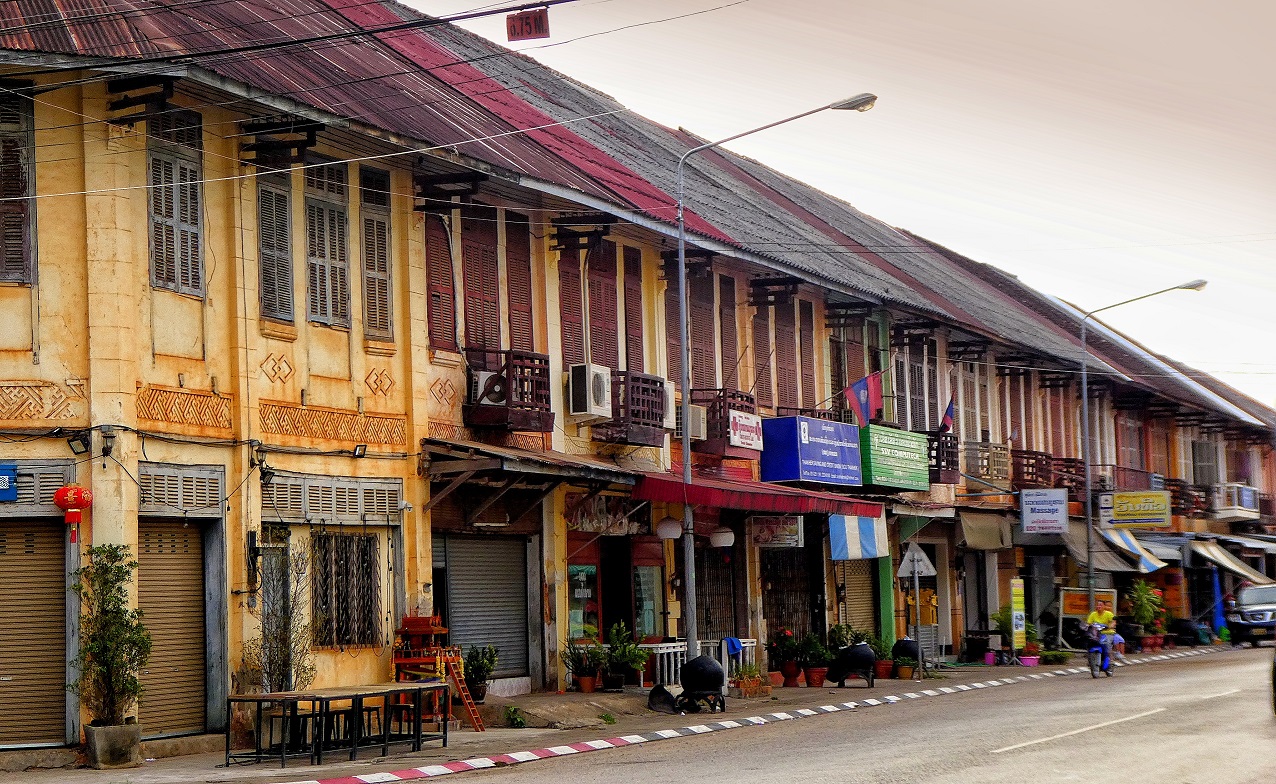
Close to Thakhek, a path turned off onto a smaller road and led past small communities right on the Mekong. The Laos baguette, or Khao Jee, is one of the most famous street foods in Laos, stuffed with salad, paté, chilli paste and cold meats. The baguette is usually warmed on coals, making for a crispy and delightful snack. There was no better place to eat it than right there, on the pavement.
It was an early arrival in Thakhek where the Souksomboun Hotel, situated right on the Mekong River, provided perfect accommodation. With outside motel-style rooms, it was perfect for cyclists, as one could wheel the bikes right into the room.
The following day was a rest day, and a tuk-tuk ride took us to the nearby caves. It was a relaxing morning, and we were home by 14h00.
“From 1964 to 1973, the U.S. dropped more than two million tons of ordnance on Laos during 580,000 bombing missions—equal to a planeload of bombs every 8 minutes, 24-hours a day, for 9 years – making Laos the most heavily bombed country per capita in history. Up to a third of the bombs dropped didn’t explode, leaving Laos contaminated with vast quantities of unexploded ordnance (UXO).”
Day 28 - 10 March – Thakhek – Savannakhet – 102 km
The last part of the day required pushing hard to reach Savannakhét before dark. Everyone did exceptionally well, and I was happy to reach our destination safely. After a shower, it was straight to the Night Market that, sadly, wasn’t there anymore. There was, however, a dim-sum stand, and we had more than our fair share. All in all, a lovely day on the road.
Day 29 & 30 – 11-12 March - Savannakhét
The next morning, I was off to the consulate, handed in my application, and as I could only collect it the following day, I headed back to our guesthouse. It was Chris’s birthday, and we visited the small museum which had interesting artefacts all collected in the vicinity of Savannakhét. Afterwards, we rode out to a nearby lake and enjoyed a sunset meal on a wooden platform on stilts over the water. The meal was enjoyed while sitting on a woven mat, not the most comfortable arrangement for Europeans, but Chris never complained. Then it was back along the potholed road, making back to our digs shortly before dark.
Thailand (1 111km - 21days)
Day 31 - 13 March – Savannakhet – Mukdahan – 15 km
Checkout from our guesthouse was at 12h00, but I
could only pick up my visa after 14h00; an excellent
excuse for coffee and cake. Afterwards, I cycled off
to the consulate while Janice and Chris proceeded to
the border. I collected my visa and met them at the
Once checked in at the Thailand immigration, it was a short and pleasant ride into Mukdahan town, where a Buddhist temple provided a place to sleep, and food was had from the many available options.
Day 32 - 14 March –
Mukdahan – Khemmarat – 91 km Well-rested it was off at a good pace, and our route ran close to the Mekong River, and albeit hilly at times, it was comfortable riding to the small village of Khemmarat.
As always, temples made for convenient camping, and at Wat Pho, the monks didn’t only allow camping but promptly pointed us to a lovely room. The room even had an air-conditioning unit as well as plenty of mats and pillows. Comfortably ensconced in our abode, the heavens opened up, and it didn’t take long to discover why the mats were all piled up in one corner. The roof wasn’t only leaking, but water came pouring in as if through a misplaced gutter. It was a mad scramble to get all electronics out of harm’s way and to move our mats to the driest corner of the room. Fortunately, rain in Southeast Asia came quick and hard and soon it was all over.
Day 33 - 15 March - Khemmarat – Ban Pakhachomson - Ubon Ratchathani – 42km & 105 km by bus
As
was the habit by then, we woke at 5h00 and headed
out at around 6h30 following a pleasant rural road
past the smallest of villages. I was always in awe
of
The map indicated a slightly hilly day, and it was no exaggeration. On reaching Ban Pakhachomson, we called it a halt and instead took a bus to Ubon. Once in Ubon, it was only a six-kilometre cycle into the city centre, where we tried our luck at sleeping at two of the local temples, but without any success. It was always far more challenging to get permission to sleep at temples in big cities, especially if there were plenty of guesthouses and hotels. Eventually, the Ubon Hotel, right across from the night market, made a perfect overnight stop. Albeit pricey, it was very conveniently located. It was also one of the few rooms where the water pressure was (nearly) high enough to blow me out the door. If I didn’t move very quickly, outstretching arms and legs, I could have been blown right out the door into the passage! I’m not kidding you!
Day 34 - 16 March - Ubon Ratchathani – Si Sa Khet – 86 km
It
was a lovely day of cycling along small roads and
rural settlements. On arrival in Si
Day 35 - 17 March - Si Sa Khet – Khun Han - 78 km The weather was good as it was overcast and perfect for cycling. Scrawny cows with long ears were grazing in dry rice fields, and smoke billowed from charcoal pits as our route headed south to Khun Han.
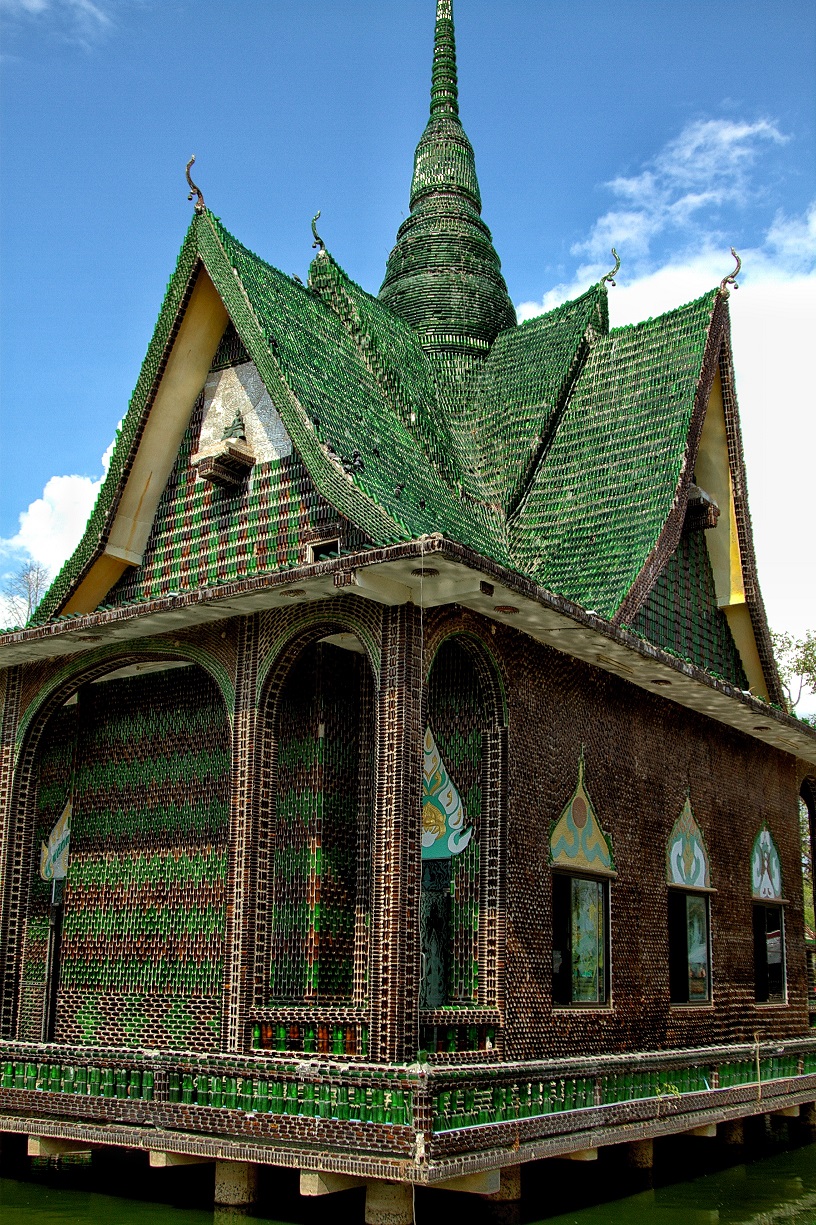
On arrival at Khun Han, we headed straight for the local temple known as Wat Pa Maha Chedi Kaew (The Temple of a Million Bottles). The temple was made of over 1.5 million Heineken and Chang beer bottles. The original temple was built in 1984, but the monks continued to expand the site, and at the time of our visit there were more than 20 structures, including sleeping bungalows and ablutions. Then it was off to the nearby lake in the hope of finding camping, but there was none to be found, and instead we headed to the local town temple where camping was allowed under a covered area.
Day 36 - 18 March - Khun Han – Surin – 120 km We rolled into Surin just before six after cycling the megadistance of 120 kilometres. Needless to say, there were a few sore backsides. Saying that, I think all was chuffed with themselves for cycling such a long distance. After a quick shower, it was time for a Chang beer (or two) and dim-sum from the stall outside the hotel entrance.
Day 37 - 19 March - Surin The following day was a well-deserved rest day in Surin as all had different things they wanted to do and see.
Day 38 - 20 March - Surin – Buri Ram Forest Park – 60 km
What
a lovely day of cycling it turned out to be. As
always, our path followed country
lanes
through rural villages where cattle had the
right
of way and were kept in front yards or under stilted
homes. Old ladies worked in the fields while men
collected animal feed. We
Buri Ram Forest Park consisted of an extinct volcano which rose 265 metres and was home to the Devil Yoni Tree found only in volcanic areas. Chris kept the fort while Janice and I walked to the top and came down the 297 Naga Raj steps, with Buddha statues in various poses.
Day 39 - 21 March -
Buri Ram Forst Park – Ban Khok Mueang – 66 km On a heavily overcast morning, we cycled out of Buri Ram, which made for easy biking. It was a fun day of cycling, and what I consider real cycle touring. We turned off to visit the Phanom Rung Historical Park, and as it was located up a steep hill, I offloaded my panniers at a shop at the start of the climb and cycled past Janice and Chris, who were both labouring up the hill loaded with panniers. They weren’t amused.
A good laugh was had at the silly situation while strolling around ruins dating back a thousand years. The park was located at the top of an extinct volcano situated 400 metres above sea level. It’s assumed the buildings were constructed in the 10th to the 13th century and that it was also a Hindu shrine dedicated to Shiva.
Karma nearly got me as it became slightly cold up on the hill, and I didn’t have a warm top with me. Phew! I almost had to ask to borrow a long-sleeved sweater, LOL.
Once back to our original route, it was a short five-kilometre ride to Ban Khok Mueang where the local temple, Wat Prasat Buraparam, again made for easy camping. The platform where they indicated we could pitch our tents first needed cleaning after which Janice and I visited the Ancient Prasat Muang Tam. We had the ruins all to ourselves as all visitors had left, and we were the only ones there. However, hunger pangs drove us back, and we were lucky to find a still open, excellent noodle soup restaurant.
Day 40 - 22 March - Ban Khok Mueang (Wat Prasat Buraparam) – Wat Mai Thai Thavorn – 65 km Our packing up woke the temple dogs, which started barking continuously. By the time the monks began beating the gong, the dogs were in full swing and went from barking to howling. What a racket!
Our
early start made for a lovely morning ride. Plans
were to camp at Lam Nang Rong Dam, but we got there
too early and decided to continue to Ta Phraya
National Park.
In the process of looking for food, we located not only the food stalls but also a temple to camp at. Wat Mai Thi Thavorn looked slightly forlorn, but the monks pointed us to a structure on the far side of the property. The hall was dirty and dusty, and it took sweeping and dusting for hours, and after cleaning the Buddha and lighting a few incense sticks, the place was transformed into a very usable hall. The monks must have been very impressed with our efforts as they provided us with water, extension leads, and even toilet paper! Before sunset, a quick cycle to the food stalls provided ample to eat and drink.
Day 41 & 42 - 23-24 March - Wat Mai Thai Thavorn – Aranya Prathet – 62 km
As was our habit by then, it was up at five and on the road shortly after six. An overcast day with a tailwind made for comfortable riding into Aranya Prathet where there was a planned rest day. The previous day I broke a spoke and needed to have it replaced. Aran Garden Hotel 1 was well priced and especially convenient for bicycle travellers as one could cycle straight into an undercover area.
It was time to do laundry and catch up on a few outstanding things before hitting the streets for our evening meal. The following day was a rest day, perfect for doing little repair jobs and stocking up on essential stuff.
Day 43 - 25 March -
Aranja Prathet – Khao Chakan Forest Park – 86 km The first stop of the day was the ruins of Prasat Khao Noi. The ruins (a Hindu shrine) were located on top of Khao Noi, a limestone hill. Initially, the sanctuary consisted of three prangs, of which only the one in the middle remained at the time of our visit. One of the lintels discovered here dates back to the seventh century. Excavations revealed exciting artefacts as well as a stone lintel with inscriptions dating back to 637 AD. The lintel was, most likely, reused. On leaving, our path led through the Sunday market, which was somewhat unusual, both for us and the locals.
We took to picking up seeds from the various trees. Upon closer inspection, they turned out to be quite fascinating, and each one unique. Some were light and fluffy, others sticky or thorny, and some seeds were even inside a rather solid shell that popped open with a tremendous bang and shot them a fair distance away.
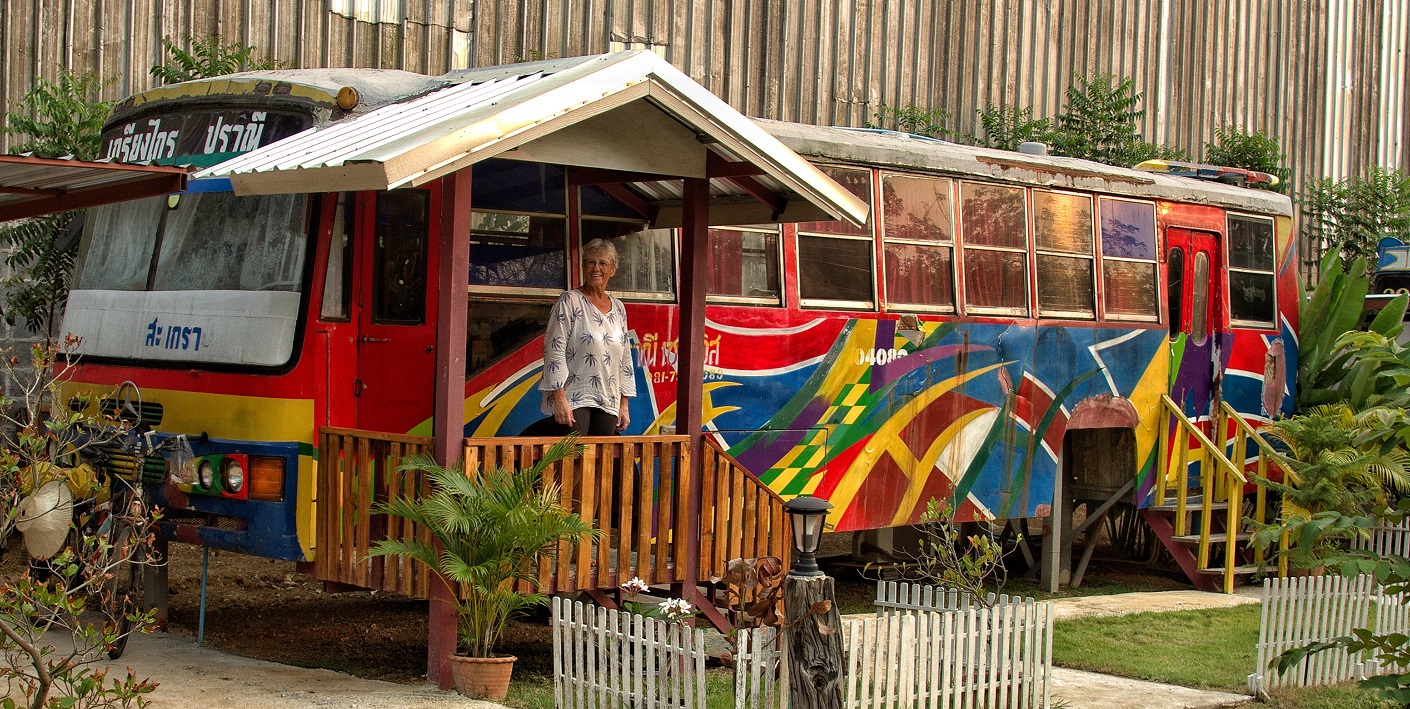
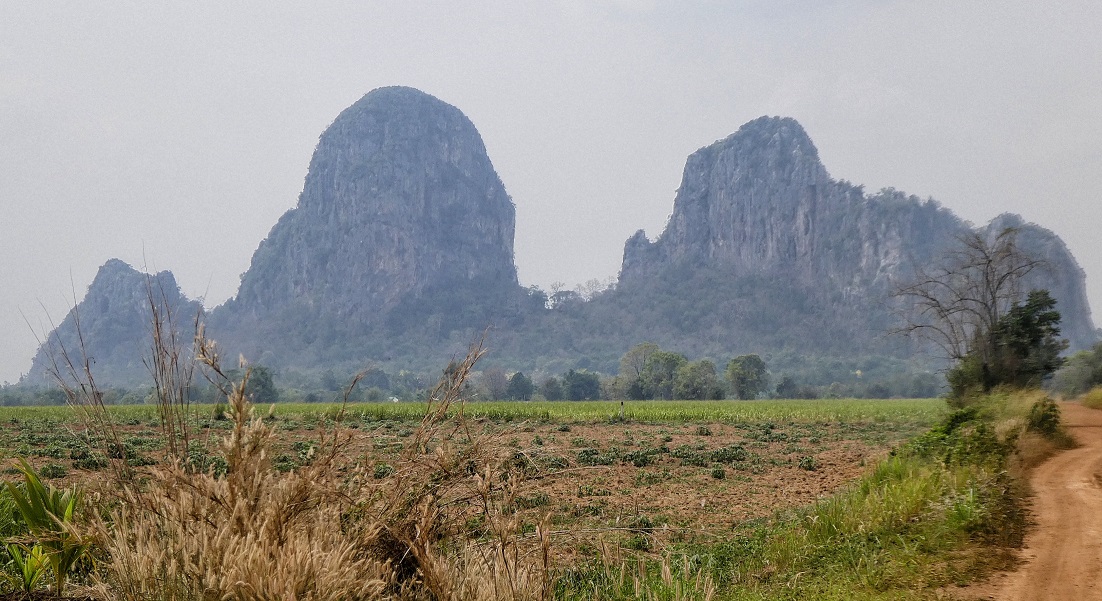
Eventually, we arrived at Khao Chakan Forest Park, with its three big limestone mountains and many caves. A rather steep flight of stairs led to a large hole in the mountain with a magnificent view of the countryside. The park would have been great for camping, but the thousands of monkeys made us look for alternative accommodation. In the process, we found an extraordinary resort, also known as the Bus Resort. It consisted of buses converted into overnight accommodation, all fitted with air-conditioning, fridges and bathrooms.
Day 44 - 26 March - Khao Chakan Forest Park – Sronlai Homestay – 94 km
It
was another fantastic day on the road. The path
winded over the hills and through Khao Ang Rue Nai
Wildlife Sanctuary, where plenty of fresh elephant
dung was spotted on the way but,
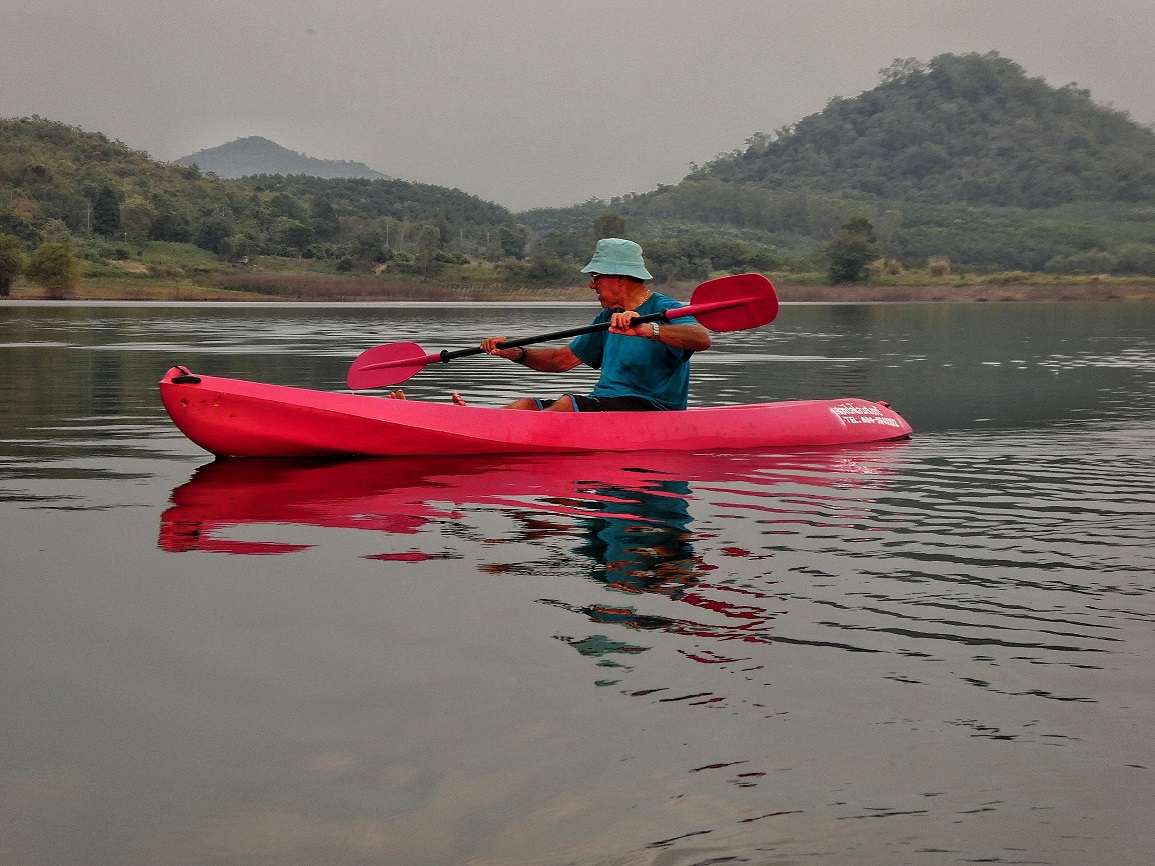
The plan was to camp on the opposite side of the dam, and the map indicated a shortcut via the dam wall. The dam wall was, however, flooded, making for a much longer day than expected. Sronlai Homestay provided idyllic camping, and as soon as the sun started heading for the horizon, we paddled out and had a most relaxing paddle around the dam.
Day 45 - 27 March - Sronlai Homestay – Phanat Nikhom – 76 km
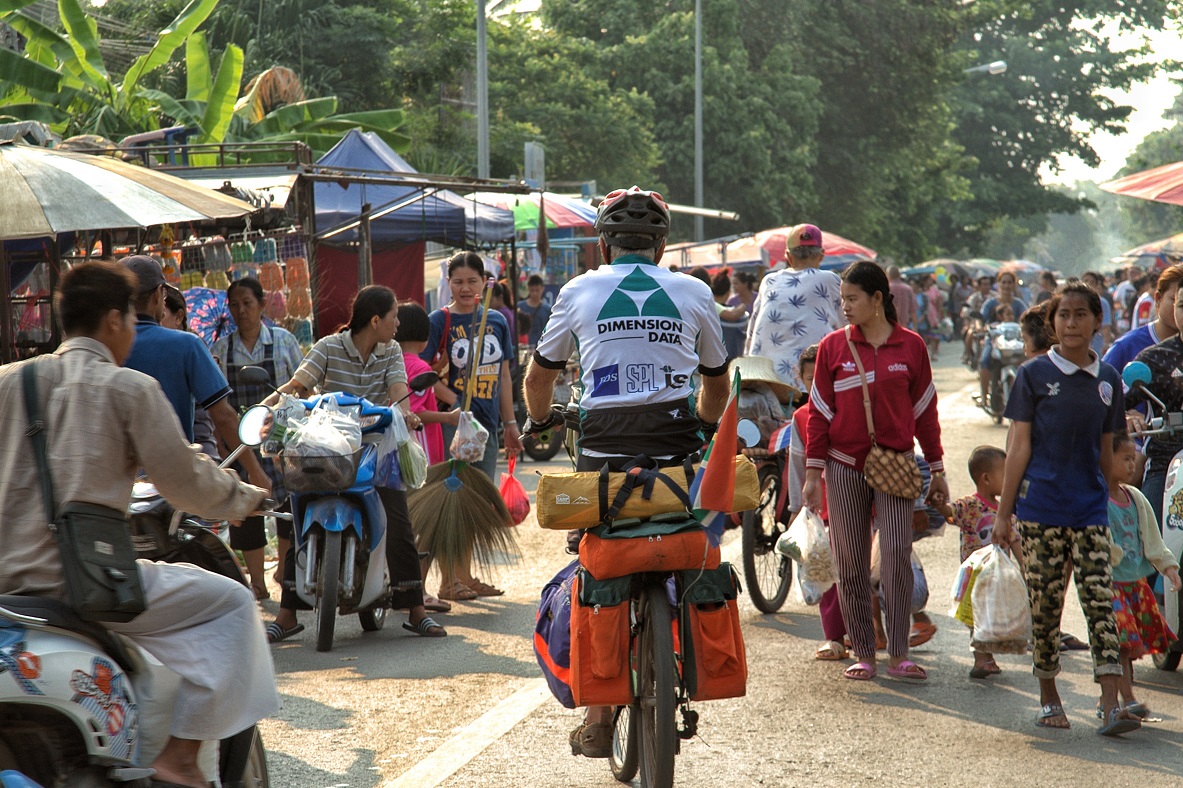
On cycling into Phanat Nikhom, a sign pointed to the weaving market and factory. Some time was spent admiring their remarkable work as well as the largest hand-woven basket in the world. Then, it was off to find accommodation which we did at a temple outside the city. It was a busy temple with far too many temple dogs. A few broom and feather duster salesmen also pulled in to overnight at the temple. They were very well organised with sleeping mats and even fans and cooking equipment.
Day 46 - 28 March - Phatnat Nikhom – Chachoengsao – 65 km It was a somewhat noisy night, partly because the dogs went ballistic every time someone went to the toilet, and partly due to the Wat being on a busy highway. The temple had extensive grounds, and during the night, a few trucks also pulled in. From early morning, there was revving of lorries, beating of gongs, dogs going wild, and the general noise from the highway. We packed up, waved goodbye to the feather duster salesmen and monks, and set off with the temple dogs in tow.
It
took us precisely two kilometres before turning off
and finding the most tranquil rural road. With a
sigh of relief, we slowly made our way to
Chachoengsao via small roads. Our country lane came
to an abrupt end at roadworks, but a super-helpful
farmer escorted us on his
Once in Chachoengsao, we headed through the busy city to the old market situated on the banks of the Bang Pakong River. It’s said the market was over 100 years old. Unfortunately, the market was closed at the time, and all one could do was to wander around admiring the old wooden structures. As is the custom, some people live above their shops, and they were extremely friendly, inviting us to sample their specialities. After coffee at the little coffee shop overlooking the river, it was time to look for accommodation for the night.
Day 47 - 29 March - Chachoengsao – Bangkok - by train The previous night a decision was made to take the train into Bangkok instead of cycling into the city through heavy traffic. As there were a wide variety of trains to pick from, there was no hurry, and we could cycle to the station at leisure. I woke to a flat tyre, and as Janice and Chris were already packed and ready, they cycled off while I fixed my puncture. Upon my arrival at the station, however, Janice and Chris were nowhere to be seen. Somehow, they cycled to the bus station about one kilometre north of the station. Eventually, they arrived, and it was on the train and into Bangkok. From the Bangkok railway station, it was a short six-kilometre ride to Banglamphu and to the Bamboo Guesthouse where Janice and Chris left their bike boxes. It was, as always, an unsatisfying way to end a cycling trip, but the traffic was far too hectic to try and cycle into the city centre.
Day 48 - 30 March - Bangkok
The
following day a canal ferry ride took me to the
centre of town to collect my new passport from the
embassy, only to find it was a South African public
holiday and the
office closed until April 3. I took a walk around
the shops and eventually walked all the way back to
In the meantime, Janice and Chris packed their bicycles back in the boxes for flying home, but there was still a good few days to explore Bangkok and the surrounding area. That evening we met up with Tania as well as Rodd, an amiable chap from New Zealand.
Day 49 - 31 March - Bangkok
The
previous night arrangements were made with Rodd to
join us for a day’s
excursion to the Samut Songkhram Railway Market and
nearby floating market of Amphawa. It was an early
start to catch a taxi for the short ride to Wonwian
Yai Station where the train was right in the middle
of the road. The train to Maha Chai station was only
10 THB and once at Maha Chai station, we found one
had to catch a
ferry
across the river as there was no train bridge;
again, the fee was a mere 3 THB. A
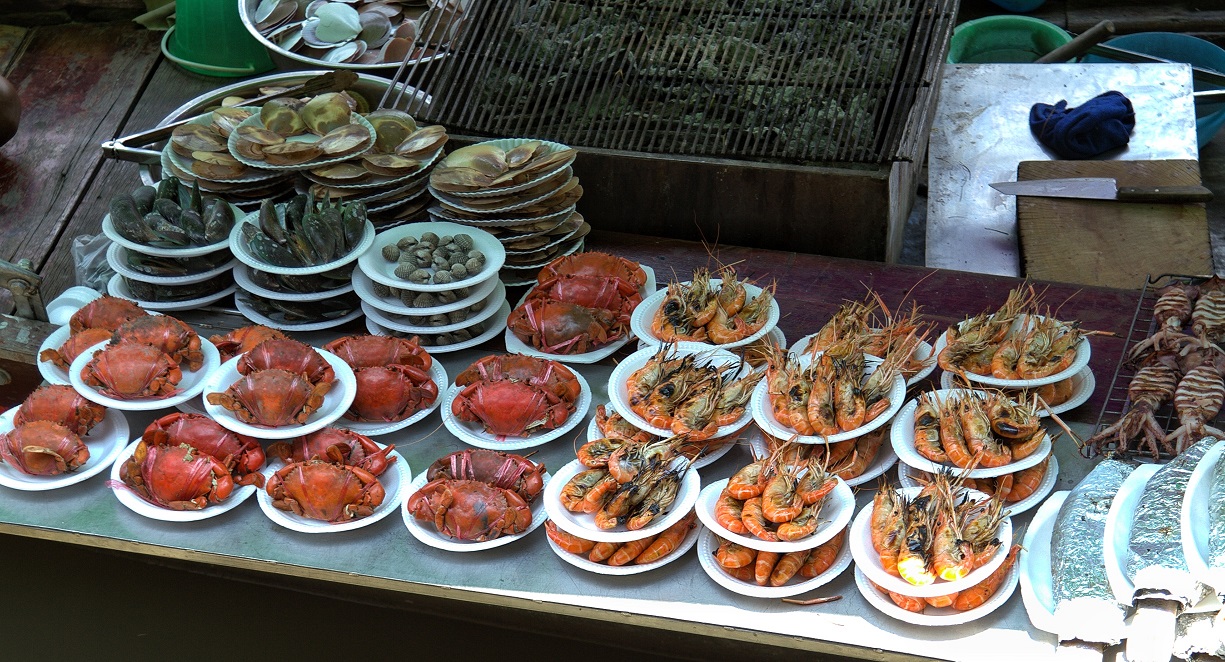
The Railway Market was quite an extraordinary place where the market spilt over onto the rail tracks, leaving no space for a train. Once a train approached, the traders hurriedly picked up their wares, allowing the train to pass, and once the train had passed, everything was put back in place, and trading continued as if nothing happened. After a bowl of noodle soup, it was on to the floating market by Songthaew (or Baht Bus). Our arrival at Amphawa Floating Market was at midday, and in the sweltering heat. A 50 THB canal tour was the perfect option. The trip took more than two hours, and on our return, the weather was much more bearable, and one could walk around and sample the food at leisure. A minivan ride took us back to Bangkok where it was straight to the Gecko Bar for a beer.
Day 50 - 1 April – Bangkok
Together with Rodd, a bus was taken to the Chatuchak Weekend Market. As always, I spent more money than I had intended, but the stalls were all fascinating and inviting. After walking for hours, it was a relief to sit down for coffee before catching the bus back to Banglamphu. As usual, the search of a 70 THB beer was on, which was found right on Khao San Road and where one could sit on small plastic chairs outside the 7-11 and watch the world go by.
Day 51 - 2 April – Bangkok
Meanwhile, Janice bought me a camera backpack as a thank you gift. I was somewhat embarrassed by this very generous token of appreciation, but at the same time, I was over the moon about my present and had it on my back for the rest of the day.
Then it was time for Janice and Chris to hail a taxi to the airport for their flight back to Cape Town. So came to an end their bicycle tour of Southeast Asia. |