|
Around the world by bike
|

|
9-15 November – Cape Town, South Africa - Addis Ababa, Ethiopia (2400 asl) My return to South Africa from Amman, Jordan was due to a dire need for a new passport. To my surprise, Ernest was there as well, but he had an entirely different reason. He left nearly all his belongings in Addis Ababa, Ethiopia whereas I'd all mine. So, following a month of eating and drinking with friends and family, I collected my shiny new passport. This time, it was a maxi passport containing more pages.
Furthermore, Ethiopia was the home of Haile Selassie, seen as a messiah among followers of the Rastafari movement, and Bob Marley thus considered Ethiopia his spiritual home. Most of all, Ethiopia is home to coffee from the Ethiopian highlands and injera, a traditional, sourdough-type flatbread or pancake. Traditionally, injera is made from teff flour, but any grain can be used. The flour and water mix is fermented for several days before being baked into a giant, flat pancake with a slightly spongy texture. Usually, a variety of small amounts of stews are scooped onto the injera. When eating, small pieces of injera are torn off and used as utensils to scoop up the food using one's fingers.
Much time was spent organising visas to Egypt and Sudan, a long and frustrating process. Performing these mediocre tasks can make anyone feel transported into another dimension as, in Ethiopia, time starts at sunrise. Hence an hour beyond sunrise is 1 a.m. Moreover, the Ethiopian calendar is a solar calendar beginning on 29 or 30 August in the Julian Calendar, adding to the confusion. At the time of our visit, the Ethiopians were celebrating the millennium. Albeit 2007, Addis was a blaze of colour and light as they celebrated the year 2000.
In Addis, I bumped into Wondey, one of the 2005 Tour D'Afrique guides. What a small world.
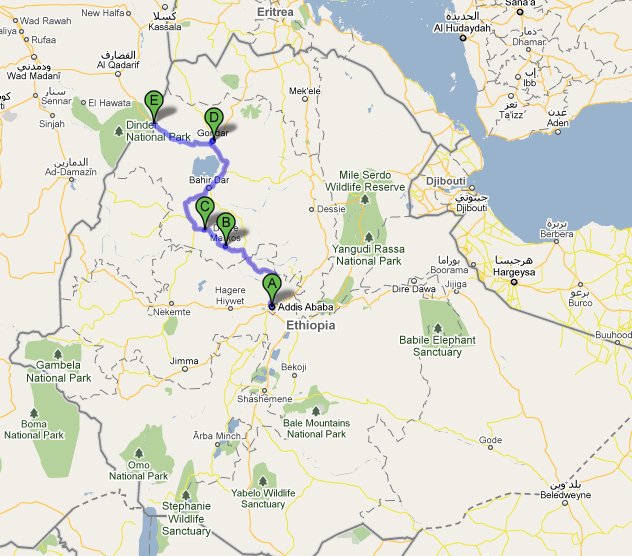
16 November - Addis – Muka – 80 km Seven days passed before biking out of Addis to pedal the relatively short distance to the Sudanese border. I'd become surprisingly unfit, or maybe I'd forgotten how hilly Addis was. The countryside was colourful and the farmlands were in different shades of green and yellow - November is an excellent time to visit Ethiopia.
Eighty percent of Ethiopians are farmers, and the road north leads past fields, where farmers still use oxen and wooden ploughs. The hills encountered virtually killed me and, exhausted, I reached Muka a mere 80 kilometres away.
17 November - Muka – Fiche – 38 km Even though Fiche (situated at an altitude of 2,780 metres above sea level) was only 38 kilometres further, my backside wasn't used to cycling, and it was best to make the ride a short one.
As expected, Ethiopians were fascinated by us. The children called, "You, you, give money!" and, if ignored, stones came flying. Yes, kids did throw stones at cyclists, but I don’t think the act was ever intended to hurt but more a way of getting a person's attention. These kids are pretty good at aiming; they wouldn't have missed if they wanted to hit you. It’s, however, a habit that remains highly annoying.
18 November - Fiche – Gohatsion (Goha Tsion) – 76 km
The Nile is considered the longest river in the world and consists mainly of two tributaries, the Blue Nile and the White Nile. The White Nile begins somewhere in Rwanda or Burundi (no one seems quite sure of the exact location). The Blue Nile originates at Lake Tana in Ethiopia. From Ethiopia, the Nile flows through Sudan where it meets up with the White Nile and then flows into Egypt, eventually draining into the Mediterranean.
19 November - Goha Tisy – Debra Markos – 70 km In the morning, the route descended into the legendary Blue Nile Gorge and, to our surprise, we discovered the 1500-metre descent half-paved, making the ride a piece of cake. However, the sharp 1500-metre climb out was still under construction. Workers had put down a thick layer of gravel, making riding somewhat tricky. Having already biked this section previously, I saw no need to cycle it again and opted for a ride on a truck to the top. Ernest was, however, determined to cycle.
Debra Marcos was our overnight stop and allowed for plenty of time to shop. At the market, we uncovered dried beans, potatoes, onions and chillies, which Ernest concocted into a stew - something different to injera eaten almost daily.
History has it that when the Italians arrived in Debra Markos in 1936, they told astonished villagers they'd come to free them from their oppressors. This news left them baffled as they were unaware of said oppressors. I giggled at this information, imagining the surprised look on the Ethiopians' faces.
20-21 November - Debra Markos – Finote Selam – 85 km
I found Ethiopia more interesting than ever; not only is it Africa's oldest independent country but a country that had never been colonised, apart from a five-year stint by Mussolini. Amharic, Ethiopia's official language, is equally fascinating and is written using an abugida, or syllable alphabet, based on the Ge'ez script. Unfortunately, there’s no formal method of translating Amharic writing into Roman or Latin characters and thus the reason for the variety in the spelling of town names.
22 November - Finote Salam – Dangla (Dangila) – 99 km From Finote Salam to Dangla was a pleasant and comfortable 100 kilometres accompanied by the usual, "Where you go?" from kids, before demanding money, clothing and even the bicycle at times.
We finished the day's ride in Dangla. Though a tiny village with a mere 25,000 inhabitants, the town had a long history. The city was said to be the centre of the African slave trade route back in 1930 when the British maintained a consulate in town.
Supper was firfir, my favourite food, being injera fried in butter smothered in a hot sauce. By the time I went to bed, I knew the meal was a mistake.
23-24 November – Dangla – Bahir Dar – 80 km
The Dar Gioa Hotel offered camping along the edge of beautiful Lake Tana. Still, I weakened at the thought of a comfortable bed as I had no energy to pitch a tent. Still feeling unwell, an additional day was spent in Bahir Dar. Little did I know whatever I'd contracted would linger a long time. Again, feeling sick, nothing came of my plans to explore the island monasteries or the Blue Nile Falls. I felt disappointed at this lost opportunity.
25 November - Bahir Dar – Addis Zena – 88 km The route to Addis Zena stretched along Lake Tana and was thus flat and scenic. Addis Zena marked the end of the day's ride and had a superb location at the foothills of the Simien Mountains and the start of the immensely impressive Ethiopian highlands. By evening, Ernest offered to cook spaghetti as I still wasn't up to Ethiopian cuisine. We ate our food while admiring Mount Asaba, Addis Zena's famous landmark.
26-27 November – Addis Zena – Gondar – 100 km Spectacular views greeted us as we pedalled the 100 kilometres to Gondar. The following day was spent roaming the streets of Gondar, an old town offering plenty to explore. The town was further our last chance to buy essentials prior to heading into Sudan.
Gondar is a historic city and was once the capital of Ethiopia (1632-1667). As a result, there were plenty of remnants of ancient castles and fortresses.
The walled Fasil Ghebbi fortress is a vast complex of forts and palaces measuring 70,000 square metres. It contains numerous restored castles and other buildings and has been declared a UNESCO World Heritage Site. However, the main attraction remained the immense 17th-century castle of Emperor Fasilides, as it included a surprising mixture of architectural styles.
28 November - Gondor Ernest headed to the border, but I decided to stay an extra day and take a bus as I'd already cycled this stretch not too long before, but never had time to investigate the area.
I popped into the Debre Berhan Selassie
Church, famed for its elaborate murals and ceiling. At leisure, I
wandered the streets and markets of Gondar, giggling at school
29 November – Gondor – Metema (by bus) The next morning, a bus took me to the town of Metama, home to the Ethiopian/Sudanese border. The trip was quite an experience. In true African style, the driver charged for loading the bike as well as offloading it. We overtook Ernest, and I expected him to catch up when the bus broke down. I got to Metema dusty and maybe more saddle-sore than on a bike, as the seats were rock-hard.
Metema, being a real border town, was dirty, dusty, and lined with pubs and brothels. I located accommodation consisting of a mud hut containing only a sagging bed. The electricity came on when the generator started and went off when the generator switched off or ran out of fuel. With the lack of individual switches, I kept a torch handy as the toilets were a distance away behind a rickety, corrugated iron sheet.
30 November - Metema Ernest arrived the next day, covered in dust and sweat, and we located a different room (not much better but at least a tad more spacious). We enjoyed our last beer as our path crossed the border into Sudan the following day.
Being a conservative Muslim country, alcohol was forbidden and women were seldom seen outside. This explained the considerable number of pubs and brothels as Sudanese men frequently popped across the border for a bit of R & R.
1 December – Metema, Ethiopia - Galabat – Doka, Sudan – 88 km
Not being early starters, it turned out
late in the day before crossing the border from Ethiopia into Sudan. The
immigration office was no
The day was hot and windy and, not feeling 100%, riding became a struggle, only reaching tiny Doka towards the end of the day. The tents were pitched in the vicinity of a police checkpoint at the turn-off to the village. Camping close to the police wasn't the safest place, as the trouble in South Sudan was ongoing and police were continuously under attack. The only reason for camping near the checkpoint was the availability of water. Checkpoints had plenty of water; we could thus wipe ourselves down and have water to cook and fill the bottles.
Water is a significant concern in the desert, and the police, mercifully, didn't mind sharing. Before setting up camp, Ernest and I first rode to the market. But, as Doka was no more than a few simple homes, a mosque, and a small market, only a few potatoes and tomatoes were available.
Laying in my tent, I grinned as never in my wildest dreams did I think I would cycle Sudan twice! |